Oral vs Injection vs Topical: Side Effects, Speed, and Which Route Works Best
 Jul, 5 2026
Drug Administration Route Comparator
Oral
Pills, Tablets, Capsules
Injectable
IV, IM, Subcutaneous
Topical
Creams, Ointments, Patches
Overview: Oral Administration
Performance Metrics
Detailed Analysis
- Average Cost Low ($)
- Pain Level None
- Main Drawback First-Pass Metabolism
- Ideal For Chronic Conditions
Gastrointestinal issues affect 25-30% of patients on oral medications due to stomach acid interaction.
Why does your doctor prescribe a pill for one condition but insist on an injection or a cream for another? It isn't just about convenience. The path a drug takes into your body-known as the route of administration-fundamentally changes how fast it works, how much of it actually reaches your target, and what kind of side effects you might experience.
Understanding these differences can help you manage your health better, ask smarter questions during appointments, and potentially avoid unpleasant adverse reactions. Whether you are dealing with chronic pain, acute infection, or skin conditions, knowing the trade-offs between oral, injectable, and topical routes is crucial.
The Oral Route: Convenience Comes with a Metabolic Tax
Oral administration is the method of taking medication by mouth, where it travels through the gastrointestinal tract before entering the bloodstream. This is the most common route, used in approximately 75% of all medication administrations according to the Merck Manual (2023). It’s easy, non-invasive, and cheap. You pop a pill, drink some water, and go about your day. But this simplicity hides significant biological hurdles.
When you swallow a tablet, it doesn’t go straight to work. It first has to survive the harsh acid environment of your stomach. Then, it must be absorbed through the intestinal wall. Finally, it travels via the portal vein directly to the liver. Here lies the biggest drawback: first-pass metabolism. Your liver acts as a filter, breaking down a significant portion of the drug before it ever reaches the rest of your body.
This means oral drugs often have variable bioavailability-the percentage of the drug that actually enters circulation. For example, propranolol, a common beta-blocker, has only about 25% oral bioavailability because the liver destroys most of it. Penicillin V drops even lower, with just 15-30% surviving the journey. To compensate, manufacturers often prescribe higher doses, which can increase the risk of dose-dependent side effects like nausea, dizziness, or stomach upset.
In fact, gastrointestinal issues affect 25-30% of patients on oral medications. Long-term use of NSAIDs (like ibuprofen) can lead to gastric ulcers in 1-2% of users. Plus, food interactions are a major headache; roughly 40% of commonly prescribed oral meds interact with certain foods, altering their effectiveness. If you take them on an empty stomach when they require fat for absorption, you’re essentially wasting the dose.
Injectable Routes: Speed and Precision at a Cost
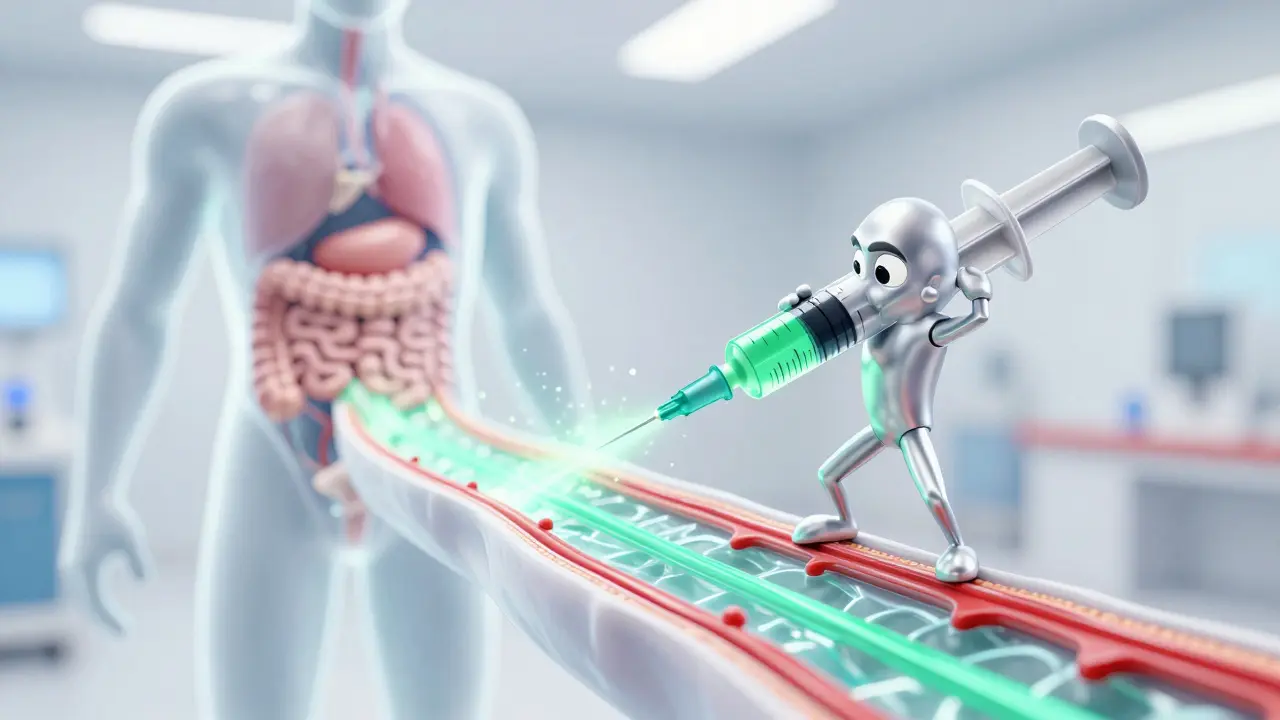
Injectable administration is a method delivering drugs directly into tissue compartments or the bloodstream using needles, bypassing the digestive system entirely. Invented by Alexander Wood in 1853, injections remain critical for situations requiring rapid action or when the gut cannot absorb medication properly. They come in three main flavors: intravenous (IV), intramuscular (IM), and subcutaneous (SubQ).
The primary advantage of injections is speed and certainty. IV administration achieves 100% bioavailability immediately. If you need emergency care, seconds matter, and IV drugs reach peak concentration in 2-5 minutes compared to 30-60 minutes for oral pills. IM injections hit peak plasma levels in 45-60 minutes with 70-90% bioavailability, while SubQ injections take 60-90 minutes with 75-85% bioavailability. By bypassing the liver’s first-pass effect, you get more drug per milligram, allowing for lower total doses and potentially fewer systemic side effects for certain cardiac medications, reducing severe adverse events by up to 35%, according to Dr. Susan Thompson of the FDA.
However, injections are not without risks. They are invasive, painful, and carry a 1-5% risk of infection at the injection site. Anaphylaxis, though rare (0.01-0.05%), is a serious concern. There’s also the psychological barrier: needle phobia affects 20-25% of the population. Furthermore, long-term injectable use can cause local tissue damage. For instance, 45% of diabetes patients report lipohypertrophy (fatty lumps under the skin) after years of insulin injections. Cost is another factor; injectable biologics average $2,500-$5,000 per dose, vastly more expensive than oral alternatives.
Topical Treatments: Localized Power with Minimal Systemic Impact
Topical administration is the application of medication directly to body surfaces such as skin, eyes, or mucous membranes for localized or systemic effects. With roots tracing back to ancient Egyptian ointments, topical treatments are ideal for dermatological issues. They offer the most favorable side effect profile because the drug stays mostly where you put it.
For localized conditions like eczema or psoriasis, topical corticosteroids achieve 80-90% efficacy with less than 5% systemic absorption. Compare that to oral steroids, which have a 25-30% incidence of systemic side effects including weight gain, bone thinning, and immune suppression. Dr. Alan Chen of the American Academy of Dermatology notes that topical corticosteroids demonstrate a 92% reduction in HPA axis suppression compared to oral doses, making them the clear winner for chronic skin inflammation.
But topical isn’t always simple. Skin permeability is a strict gatekeeper; molecules generally need to be under 500 Daltons to penetrate effectively. This limits which drugs can be delivered this way. Also, absorption varies wildly based on skin condition. Psoriasis-affected skin absorbs 3-5 times more medication than healthy skin, which can accidentally turn a safe topical dose into a systemic overdose if not monitored. Application technique matters too: applying less than the recommended 'fingertip unit' (0.5g of ointment) reduces efficacy by 35-40%. Despite these challenges, patient preference leans heavily here. A 2022 study showed an 87% reduction in systemic side effects with topical vs. oral equivalents, and 68% of pharmacy community respondents preferred topicals for skin issues due to 'no stomach upset.'

Comparing the Routes: Speed, Safety, and Satisfaction
| Feature | Oral | Injectable (IV/IM) | Topical |
|---|---|---|---|
| Bioavailability | Variable (5-100%) | High (70-100%) | Low (<10% for local) |
| Onset of Action | Slow (30-90 mins) | Rapid (2-60 mins) | Variable (mins-hours) |
| First-Pass Metabolism | Yes (Significant loss) | No | No (Minimal systemic) |
| Common Side Effects | GI upset, ulcers | Infection, pain, anxiety | Skin irritation, redness |
| Patient Preference | High (92% prefer over inj.) | Low (Needle phobia) | High (Non-invasive) |
| Cost | Low ($25-$100/dose) | High ($2,500+ for biologics) | Moderate |
The choice often boils down to the clinical goal. Need immediate stabilization? Go injectable. Managing a chronic condition with high adherence needs? Oral is usually best. Treating a localized skin issue without messing with your whole body? Topical wins. However, innovations are blurring these lines. New technologies like Capsugel's 'liquid-in-capsule' tech improve oral bioavailability by 30-50%, while Sontra Medical's ultrasound-enhanced patches are pushing topical delivery into new territories, potentially replacing some injectables by 2030.
Practical Tips for Patients
Regardless of the route, proper usage is key to minimizing side effects and maximizing benefits.
- For Oral Meds: Always check if food affects absorption. Take with water, not alcohol or grapefruit juice unless instructed. If you experience persistent stomach pain, talk to your doctor about switching formulations or adding a protective agent.
- For Injections: Rotate injection sites to prevent tissue damage like lipohypertrophy. Ensure proper disposal of needles to avoid injury or infection. If you have needle phobia, discuss alternative routes or behavioral techniques with your provider.
- For Topicals: Use the 'fingertip unit' rule to ensure adequate coverage. Don’t apply to broken skin unless directed, as this increases systemic absorption and risk of side effects. Wash hands thoroughly after application to prevent accidental transfer to eyes or other sensitive areas.
Adherence is also a major factor. Complex oral regimens lead to 50% non-adherence within six months. Simplifying dosing schedules or switching to once-daily extended-release formulas can help. For injectables, training is essential; 30-40% of patients need multiple supervised sessions to master self-injection techniques.
Why do oral medications sometimes cause stomach problems?
Oral medications pass directly through the stomach lining, which can irritate the mucosa. Additionally, some drugs alter stomach acid production or motility. NSAIDs are particularly notorious for causing ulcers because they inhibit protective prostaglandins in the stomach lining.
Is an injection always stronger than a pill?
Not necessarily 'stronger,' but more efficient. Injections bypass the digestive system and liver's first-pass metabolism, meaning a higher percentage of the drug reaches your bloodstream. This allows for faster action and often lower total doses, but it doesn't change the drug's inherent potency.
Can topical creams cause systemic side effects?
Yes, especially if applied over large areas, on damaged skin, or under occlusive dressings. While designed for local action, enough drug can absorb into the bloodstream to cause systemic effects. This is why potent steroid creams should be used cautiously and under medical supervision.
What is first-pass metabolism?
First-pass metabolism is the process where the liver metabolizes a drug absorbed from the gastrointestinal tract before it reaches systemic circulation. This reduces the amount of active drug available, often requiring higher oral doses compared to injectable forms.
Which route is best for chronic pain management?
It depends on the type of pain. For widespread chronic pain, oral medications or transdermal patches (like fentanyl) are common because they provide steady blood levels. For localized joint pain, topical NSAIDs or lidocaine patches minimize systemic side effects and are often preferred for long-term use.
Peter Sverla
July 6, 2026 AT 07:47I never really thought about the liver acting as a filter until now. It makes so much sense why some pills feel like they take forever to kick in while others hit you instantly. The first-pass metabolism thing is wild.
Brett Aungst
July 8, 2026 AT 01:00Yeah, bioavailability is the key term here. Most people just assume that if they swallow a pill, 100% of it goes to work. But with stuff like propranolol, your body is literally destroying most of it before it even starts doing its job. That's why doses are often higher for oral meds compared to injectables.
Isis Fleming
July 9, 2026 AT 23:12It is quite fascinating how the route of administration dictates the therapeutic outcome. One must consider that the gastrointestinal tract is not merely a passive conduit but an active metabolic organ. The variability in absorption due to food interactions or individual enzymatic differences can lead to significant discrepancies in plasma drug levels. This is precisely why therapeutic drug monitoring is essential for medications with narrow therapeutic indices, such as warfarin or lithium. Furthermore, the psychological aspect of needle phobia cannot be overlooked when considering patient compliance. Many individuals would prefer the inconvenience of oral medication over the anxiety associated with injections, despite the pharmacokinetic advantages of parenteral routes.
Amrithaa Thayaparan
July 10, 2026 AT 10:02you ppl are so naive thinking doctors have ur best interest at heart. they just want to keep u dependent on their expensive treatments. the whole system is designed to exploit the weak and ignorant. i refuse to trust any medical advice that comes from these corrupt institutions. stay woke and dont let them push their poison down ur throat.
Lorena Suarez
July 10, 2026 AT 16:04i totally get where you're coming from but maybe try to look at it from another angle? lots of people really do benefit from these treatments. its not always about money sometimes its just about getting better. no need to be so harsh tho
Fred Stone
July 12, 2026 AT 07:05honestly the topical section was eye opening. i had no idea skin permeability was such a strict gatekeeper. explains why my eczema cream works better when i apply it right after showering when the skin is still damp. moisture helps lock it in i guess. also the fingertip unit thing is super useful info most people just scoop random amounts
Ellen Zeman
July 13, 2026 AT 23:56OMG yes! The fingertip unit is a game changer! I used to just guess how much cream to put on my face and wonder why nothing was working. Now I measure it out properly and wow what a difference it makes. Also who knew psoriasis skin absorbs meds so much faster? That’s scary tbh. We gotta pay attention to our bodies signals and listen to experts. Let’s spread this knowledge far and wide!
Ben Murphy
July 14, 2026 AT 04:40The epistemological framework underlying pharmaceutical delivery systems is fundamentally flawed when one ignores the holistic integration of psychosomatic variables. The reductionist approach to categorizing administration routes fails to account for the nuanced interplay between patient expectancy effects and pharmacodynamic responses. It is imperative to recognize that the placebo effect, often dismissed by reductionist clinicians, constitutes a significant portion of therapeutic efficacy, particularly in subjective outcomes such as pain management. Therefore, the purported superiority of injectable routes based solely on bioavailability metrics is a superficial assessment that neglects the broader clinical context.
Blythe Ward
July 15, 2026 AT 18:26lol imagine being so basic you don't know about lipohypertrophy. rich people get custom compounding injections tailored to their specific metabolic needs while you guys are stuck guessing with generic pills. true luxury is personalized medicine 🧬💉✨
Casey Eickhoff
July 16, 2026 AT 20:46While the economic disparities in healthcare access are indeed a pressing concern, it is important to distinguish between systemic inequities and the pharmacological principles discussed in the article. The mention of lipohypertrophy serves as a valid clinical warning regarding long-term injection practices, regardless of socioeconomic status. Proper rotation of injection sites is a standard recommendation for all patients requiring subcutaneous insulin, not merely a privilege of the wealthy. We should strive for evidence-based understanding rather than cynical generalizations.
Vinay Bairagi
July 18, 2026 AT 03:10Western medicine is full of useless complications. In our tradition we use natural herbs applied topically which heal without side effects. Your needles and pills only create more problems. Stop trusting these foreign methods and return to roots.
Mark Smalley
July 19, 2026 AT 19:51I appreciate the detailed breakdown of the comparison table! It really highlights the trade-offs involved in choosing a treatment path. For instance, knowing that oral NSAIDs can cause gastric ulcers in 1-2% of users makes me much more cautious about taking ibuprofen regularly. I’ve switched to topical anti-inflammatories for my joint pain recently, and while they aren’t as fast-acting as an injection might be, the lack of stomach upset is worth the slight delay in relief. It’s all about finding the balance between efficacy and quality of life.