Mouth Sores and Ulcers from Medications: Prevention and Care
 Feb, 15 2026
Oral Mucositis Prevention Risk Assessment
This tool helps you assess your risk of developing mouth sores (oral mucositis) during cancer treatment and provides personalized prevention recommendations based on your specific treatment regimen and risk factors.
When you’re undergoing cancer treatment, the last thing you want is to be in constant pain from mouth sores. Yet, for many people on chemotherapy or radiation, these painful ulcers aren’t just common-they’re expected. This isn’t a random reaction. It’s a direct result of how these treatments work: they attack fast-growing cells, and the lining of your mouth is one of the fastest-growing tissues in your body. The result? Inflammation, breakdown of tissue, and open sores that make eating, talking, and even swallowing unbearable. This condition is called oral mucositis is a predictable, inflammatory condition caused by direct damage to oral epithelial cells from cytotoxic agents. Also known as chemotherapy-induced stomatitis, it affects 20% to 100% of patients depending on the type of treatment, according to a 2022 NIH review.
Why Some Medications Cause Mouth Sores
Not all drugs cause mouth sores, but the ones that do are usually powerful. Chemotherapy agents like 5-fluorouracil and melphalan are especially hard on oral tissue. Radiation therapy to the head or neck area is even more damaging-it’s like a targeted burn to the inside of your mouth. Even some antibiotics, antivirals, and immune-targeting drugs can trigger these sores. The damage happens fast. Within days of starting treatment, the cells lining your mouth begin to die off faster than they can regenerate. Without enough healthy tissue to protect nerves and blood vessels, you get ulcers.
It’s not just about the drug itself. Your body’s response matters too. If you already have gum disease, dry mouth, or poor dental health before treatment, your risk jumps significantly. A 2023 NCCN guideline found that 78% of severe cases could have been avoided with proper dental care before treatment even started. That’s not a coincidence-it’s a warning.
The Real Problem: Treating After It Happens
Most people wait until the pain starts before doing anything. That’s the mistake. By the time you see a white patch or a red, raw spot in your mouth, the damage is already done. Think of it like a sunburn-you don’t wait until your skin peels to start using sunscreen. Prevention isn’t optional here. It’s the only thing that works consistently.
The Multinational Association of Supportive Care in Cancer (MASCC)/ISOO is a global group that sets evidence-based guidelines for managing cancer treatment side effects. Also known as MASCC, it was formed in the 1990s and updated its oral care guidelines in 2020 made this clear: don’t treat the sore. Stop it before it starts.
What Actually Works: Evidence-Based Prevention
There are several methods backed by real clinical trials. Not all are created equal. Some are cheap and simple. Others are expensive and complex. Here’s what science says works best.
1. Cryotherapy (Ice Chips)
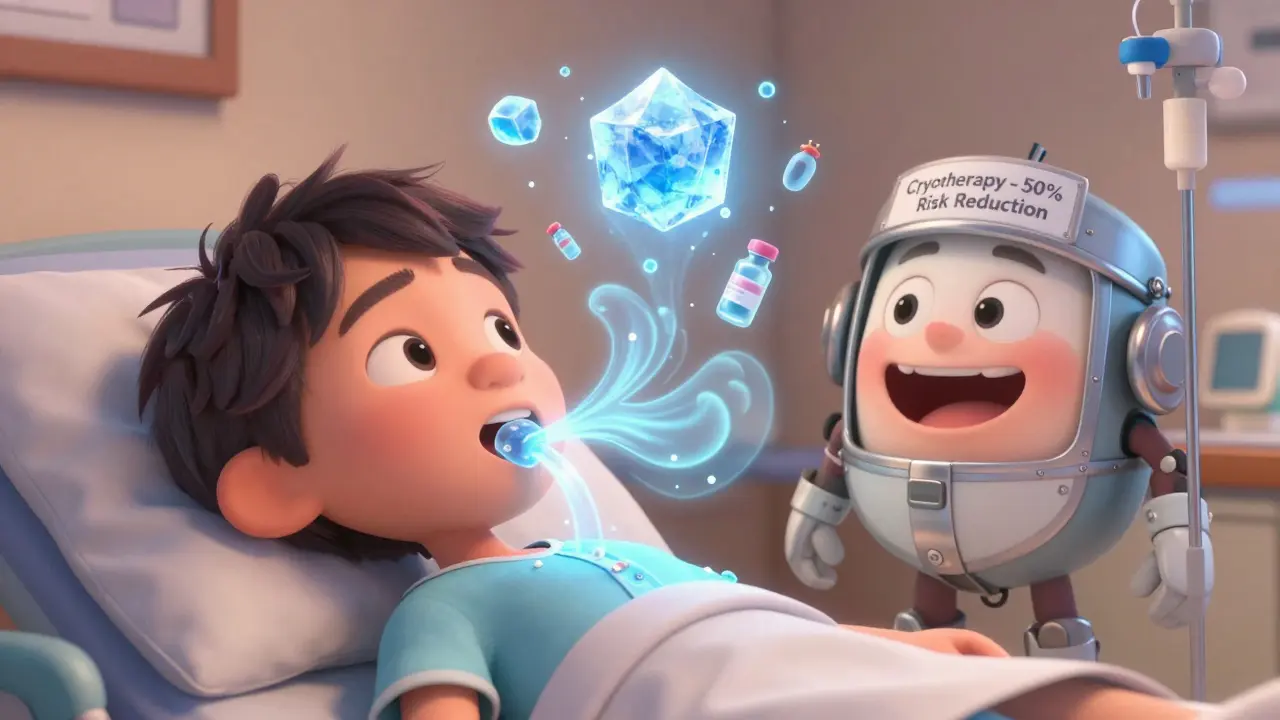
If you’re getting melphalan or 5-fluorouracil, sucking on ice chips is one of the most effective tools you have. The cold narrows blood vessels in your mouth, reducing how much of the drug reaches the tissue. A 2015 Cochrane review showed it cuts the risk of severe mucositis by 50%. The catch? Timing matters. You must start sucking on ice chips 5 minutes before your infusion and keep going for 30 minutes after it starts. No breaks. No sipping. Just constant, slow melting.
One study found 87% adherence was needed to get results. That means if you take a sip of water, stop for a minute, or let the ice melt too fast, you’re losing protection. It’s hard. Many patients say it feels like torture. But 78% of users on CancerCare’s forum reported it helped reduce pain. If you can handle it, it’s free and doesn’t interact with any other drugs.
2. Benzydamine Mouthwash
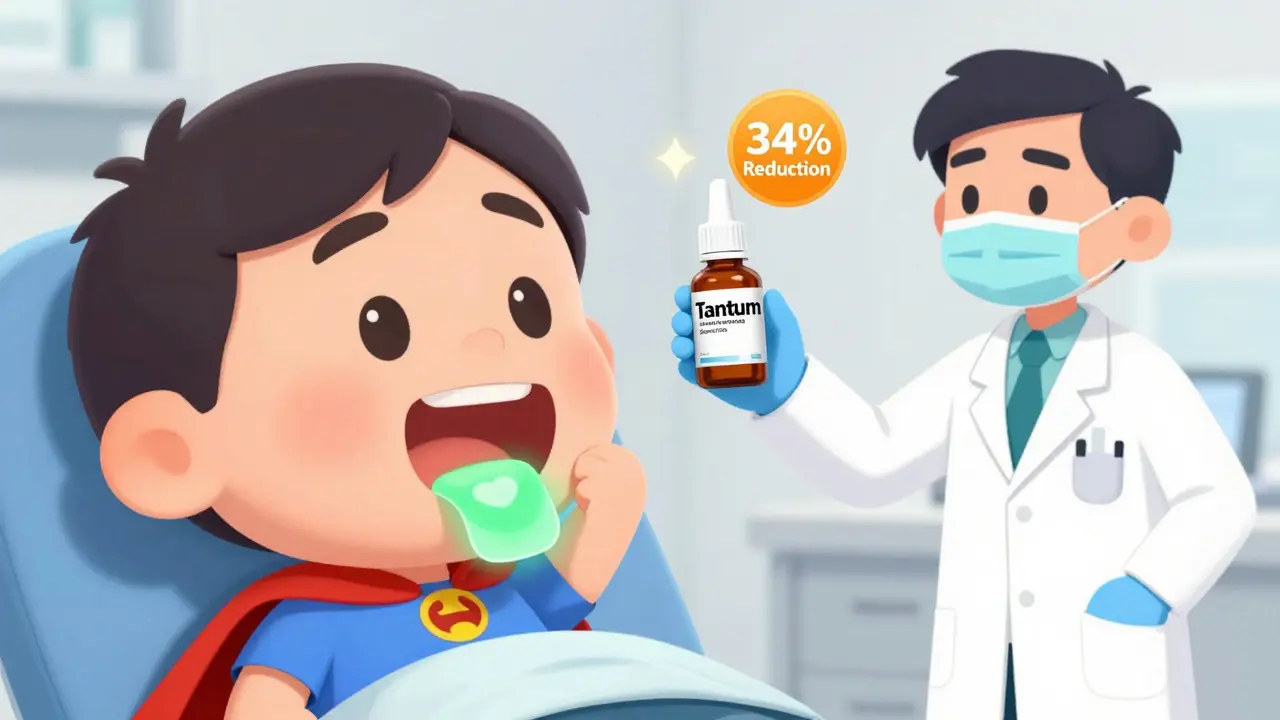
For patients getting radiation therapy to the head or neck, benzydamine hydrochloride 0.15% is an anti-inflammatory mouthwash that reduces incidence of oral mucositis by 34% when used 3-4 times daily before treatment begins. Also known as Tantum, it’s widely available in Europe and Canada is the gold standard. It doesn’t numb you-it reduces inflammation at the source. Used 15 minutes before meals, it cuts severe sores by a third. It costs $15-$25 per course. Side effects? A mild stinging feeling for some, but 82% of users kept using it because the pain relief was worth it.
It’s not for everyone. If you’re allergic to aspirin or other NSAIDs, skip it. It’s not a miracle, but it’s the most cost-effective option for radiation patients.
3. Palifermin (Kepivance)
This is the heavy hitter. Palifermin is a recombinant human keratinocyte growth factor that stimulates healing of oral tissue. Also known as Kepivance, it’s administered intravenously at 60 mcg/kg/day for three days before and after high-dose chemotherapy is given to patients getting stem cell transplants. In a landmark 2004 NEJM study, it cut severe mucositis from 63% down to 20%. That’s huge. But it costs $10,500 per course. Medicare and most insurers cover it for transplant patients, but if you’re not in that group, it’s rarely approved. It’s not for routine chemo-it’s for the most intense treatments.
4. Gelclair
Once the sores are there, you need pain relief. Gelclair is a mucoadhesive oral gel containing polyvinylpyrrolidone, sodium hyaluronate, and glycerin that forms a protective film over ulcers. Also known as oral protective gel, it’s available over the counter in pharmacies is one of the best. It sticks to the sore, forming a cushion that shields nerves from food, saliva, and air. In a 2018 BMC Cancer study, it provided relief for up to 4 hours per application. Reddit users gave it a 4.2/5 rating. The downside? The texture is slimy. Some people say it feels like snot in their mouth. But if you can get past that, it’s one of the few things that gives real, fast relief.
5. Glutamine
This amino acid supplement has been promoted for years. A 2017 JAMA Oncology trial showed a 43% reduction in duration of mucositis. But later studies? Mixed. A 2022 meta-analysis found it only helped patients with head and neck cancer getting radiation-not those on chemo alone. Still, some people swear by it. If you try it, dissolve 15g in water, swish for 2 minutes, then swallow. Do it four times a day. It’s cheap, safe, and worth a shot if nothing else is working.
What Doesn’t Work (And Why)
Chlorhexidine mouthwash is everywhere. Dentists hand it out like candy. But here’s the truth: a 2022 NIH review found it only reduces risk by 15%. That’s barely better than placebo. Worse, long-term use can stain your teeth and change your taste. A 2020 survey in Oral Diseases found 28% of users had a metallic or bitter taste that never went away. It’s not harmful, but it’s not helping much either.
Allopurinol mouthwash? Promising for radiation, but not chemo. Dexamethasone mouthwash? Good for pain, but only short-term. Antibiotics? Don’t use them preventively. A 2021 JAMA Internal Medicine study showed they increase the risk of C. difficile infection by 27%-and that infection can kill.
What You Can Do Today
Start now, even if treatment hasn’t begun.
- Get a dental checkup 2-4 weeks before treatment. Fix cavities, clean teeth, remove problematic teeth. This alone prevents 78% of severe cases.
- Switch to a soft-bristle toothbrush (bristles under 0.008 inches). Brush twice a day with fluoride toothpaste. Avoid toothpaste with sodium lauryl sulfate-it’s a known irritant.
- Use a baking soda rinse after meals: 1 teaspoon in 8 ounces of warm water. It neutralizes acid and soothes tissue.
- Keep your mouth moist. If you have dry mouth (xerostomia), try Biotene or pilocarpine 5mg tablets three times a day. Saliva is your natural protector.
- Ask your oncologist: "Which drugs am I getting? Is cryotherapy or benzydamine right for me?"
The Future: Personalized Prevention
Research is moving fast. Memorial Sloan Kettering has developed a risk tool that uses 12 factors-like age, diabetes status, smoking history, and drug type-to predict who’s most likely to get severe sores. It’s 84% accurate. In the next few years, you’ll get a personalized prevention plan before treatment even starts.
Low-level laser therapy (LLLT) is also showing promise. A 2023 JAMA Network Open study found it cut severe mucositis from 41% to 18% in head and neck cancer patients. It’s not widely available yet, but clinics in the U.S. and Europe are starting to offer it.
And new drugs are coming. GC4419, a superoxide dismutase mimetic, reduced mucositis duration by 38% in a 2024 trial. It’s not on the market yet, but it’s the next big thing.
Final Thought: Prevention Is Power
You can’t control cancer. But you can control how much damage your mouth takes. The difference between mild discomfort and unbearable pain often comes down to one thing: what you did before the sores appeared. Don’t wait. Don’t assume it’s normal. Ask your care team what’s proven, what’s affordable, and what works for your specific treatment. Your mouth matters. It’s how you eat, talk, and connect with the people you love. Protect it.
Can mouth sores from medication be prevented entirely?
Not always, but in many cases, yes. Studies show that with proper prevention-like using benzydamine before radiation or ice chips before certain chemo drugs-up to 80% of severe cases can be avoided. The key is starting before symptoms appear. Once an ulcer forms, it’s much harder to heal quickly.
Is it safe to use mouthwash if I have open sores?
Yes, but only certain ones. Avoid alcohol-based mouthwashes-they sting and dry out tissue. Benzydamine, saline rinses, and Gelclair are safe. Chlorhexidine is okay for short-term use but can worsen taste changes. Always rinse gently and don’t scrub. If it burns, stop and ask your doctor for alternatives.
Why do some people get mouth sores and others don’t?
It depends on the drug, your genetics, your oral health before treatment, and how well you follow prevention steps. Some people naturally have thinner oral tissue or less saliva. Smokers and those with gum disease are at higher risk. A 2023 study from Memorial Sloan Kettering showed that combining 12 risk factors could predict who would develop severe sores with 84% accuracy-so it’s not random.
Can I still eat normally with mouth sores?
You can, but you need to adjust. Avoid spicy, acidic, crunchy, or very hot foods. Stick to soft, cool, bland options: yogurt, mashed potatoes, scrambled eggs, smoothies. Use Gelclair before meals to protect the sores. Stay hydrated. If swallowing becomes too painful, talk to your care team about liquid nutrition options. Eating is critical-starving yourself weakens your body’s ability to heal.
Are there any natural remedies that help?
Some show promise, but evidence is limited. Aloe vera gel applied gently may soothe irritation. Honey has antibacterial properties and some patients report relief. But don’t rely on them alone. Stick to proven methods like cryotherapy, benzydamine, or Gelclair. Natural doesn’t mean safe or effective-some herbs interact with chemo drugs. Always check with your oncologist before trying anything new.
How long do medication-induced mouth sores last?
It depends on the treatment. For chemo, sores usually peak around day 7-10 and start healing within 2-4 weeks after the last dose. Radiation sores can last longer-sometimes 6-8 weeks after treatment ends. If sores persist beyond 6 weeks, get checked. It could be infection, fungal overgrowth (like thrush), or a sign of other complications.
Sam Pearlman
February 16, 2026 AT 09:22I get it, ice chips sound like a joke until you're sitting there for 30 minutes with a mouth full of frozen slush, trying not to cry while your chemo drip hums like a microwave. I did it for six rounds. My dentist said I had the cleanest mouth in the clinic. But here's the kicker-my oncologist didn't even mention it until week three. Why? Because no one pushes prevention. They just hand you painkillers and call it a day. We're treating symptoms like they're the problem, not the symptom of a system that doesn't care enough to prep you.
Steph Carr
February 18, 2026 AT 04:18Let’s be real-this whole post reads like a pharmaceutical ad disguised as a public service. Benzydamine? Palifermin? Gelclair? All expensive, all patented, all pushed by people who profit from your suffering. Meanwhile, the real solution-better hydration, less sugar, avoiding fluoride toothpaste with SLS-is buried under jargon. And don’t get me started on cryotherapy. You mean telling someone with stage IV cancer to ‘suck on ice’ like it’s a 1990s ice cream challenge? Cute. But also condescending. The system doesn’t want you to heal. It wants you to keep paying.
Tony Shuman
February 19, 2026 AT 05:40Y’all are overcomplicating this. Back in my day, we didn’t have all this fancy gel and cryo nonsense. You got chemo, you got sores, you toughed it out. Salt water rinse. That’s it. No $10k drugs. No 30-minute ice marathons. Just grit. America’s gotten soft. We turn every minor discomfort into a medical crisis. My uncle did radiation in '89. Didn’t have Gelclair. Didn’t have Kepivance. Ate hot dogs and watched football. Lived to 82. Maybe the real problem isn’t the chemo-it’s the expectation that you need a spa day to survive it.
Logan Hawker
February 20, 2026 AT 13:04Let’s not romanticize the 'salt water rinse' era-this isn't a nostalgia piece, it's a clinical imperative. The Cochrane review on cryotherapy (2015) had an NNT of 2.3 for preventing grade 3+ mucositis. That’s not anecdotal, that’s statistically robust. And palifermin? A 63% to 20% reduction? That’s not a ‘maybe,’ that’s a paradigm shift. The fact that you’re dismissing evidence-based protocols in favor of folk remedies suggests either profound ignorance or a willful rejection of science. Either way, you’re endangering lives. And yes, Gelclair *does* feel like snot. So? It works. You wouldn’t refuse insulin because the syringe is ‘creepy.’
James Lloyd
February 22, 2026 AT 11:34As a nurse who’s managed over 200 chemo patients, I can tell you: the most effective tool isn’t the drug-it’s the conversation. Too many providers skip the pre-treatment dental consult because ‘it’s not in the protocol.’ But 78% of severe cases are preventable? That’s not a statistic-that’s a moral failure. I’ve seen patients show up with abscesses and cavities because their dentist said, ‘You’re going to chemo? Just wait.’ No. You don’t wait. You fix it. You ask. You demand. And yes, ice chips are brutal-but so is swallowing through a mouth full of raw meat. I’ve had patients cry because they couldn’t kiss their kids. Ice chips are the least you can do. Do them. Even if you hate it.
Digital Raju Yadav
February 22, 2026 AT 21:15This whole thing is a Western scam. You think we in India don’t get mouth sores? We do. But we don’t pay $10,000 for a gel. We use turmeric paste. Neem leaves. Coconut oil. Traditional medicine works. Why? Because it’s been tested by time, not by FDA-approved trials. Your system is broken. You sell solutions instead of healing. Your ‘science’ is just a marketing department with a lab coat. We don’t need your Gelclair. We need your humility.
Carrie Schluckbier
February 24, 2026 AT 21:13Ice chips? Benzydamine? You think this is about health? No. This is about control. The system wants you dependent. They don’t want you to heal-they want you to keep coming back. That’s why they don’t tell you about the real cause: glyphosate in your water, fluoride in your toothpaste, and corporate greed hiding behind ‘evidence.’ They’ll sell you a $10,000 drug to fix what they caused. Wake up. This isn’t medicine. It’s a pyramid scheme with IV drips.
guy greenfeld
February 25, 2026 AT 19:08What if… the mouth sores aren’t the problem? What if they’re the signal? The body screaming, ‘This isn’t natural.’ Chemotherapy is poison. Ice chips are a band-aid. Gelclair is a distraction. The real question: why are we poisoning people at all? Why not target the cancer with precision? Why not use immunotherapy, gene editing, or light-based therapies? We’re still using 1950s toxins because the system is too slow to change. The sores aren’t a side effect-they’re a verdict. We’re fighting cancer with stone tools. And we call it progress.
Adam Short
February 26, 2026 AT 07:47Ice chips? Please. In the UK, we’ve got NHS guidelines that say ‘oral care’ means brushing and rinsing. No cryotherapy. No expensive gels. Just common sense. You think Americans need 30 minutes of frozen torture to survive chemo? We’ve got people in rural Wales surviving radiation with nothing but a toothbrush and a prayer. This isn’t science-it’s American over-medicalization. You turn every minor discomfort into a $200 product. We don’t need a gel. We need better access. And less hype.
Prateek Nalwaya
February 27, 2026 AT 07:34As someone who watched my sister go through this, I’ll say this: none of the fancy stuff matters if you’re not heard. The ice chips? She did them. The gel? She used it. But what broke her was the silence. No one asked if she could swallow. No one checked if she was eating. No one said, ‘I’m sorry this is happening.’ The science is good. But the care? That’s what heals. Don’t just give me a protocol. Give me a hug. Ask me if I’m okay. That’s the treatment no drug can replicate.