Exercise and Statins: What You Need to Know About Muscle Pain and Recovery
 Dec, 1 2025
Many people start taking statins to lower their cholesterol and protect their heart. But then something unexpected happens: their muscles start hurting. It’s not just fatigue-it’s a deep, persistent ache that makes walking, climbing stairs, or even getting out of bed feel like a chore. And when they try to exercise, the pain gets worse. So they stop. They think exercise is the problem. But what if it’s not?
Statins and Muscle Pain: The Real Story
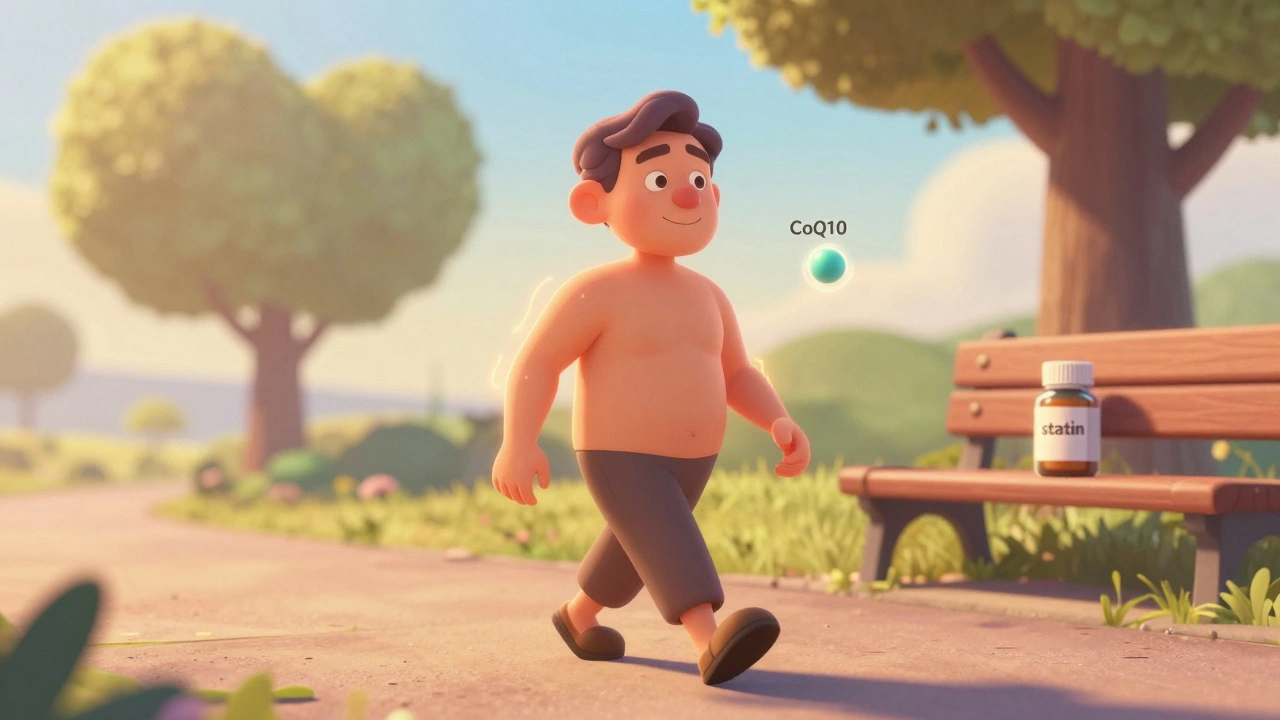
Statins are one of the most prescribed drugs in the world. In the U.S. alone, nearly 39 million people take them. They work by blocking an enzyme your liver uses to make cholesterol. But that same enzyme is also involved in making coenzyme Q10 (CoQ10), a compound your muscles need to produce energy. When statins lower CoQ10 by up to 40% within weeks, your muscles can struggle to recover, especially under stress. The medical term for this is statin-associated muscle symptoms, or SAMS. About 5-10% of people in clinical trials report muscle pain, but real-world numbers are higher-up to 29% in some studies. The pain isn’t always sharp. It’s often a dull, constant soreness that doesn’t go away after rest. It usually shows up within the first 30 days of starting a statin. If you’ve been exercising regularly and suddenly feel stiff and tired all the time, it might not be aging. It might be the statin.Not All Statins Are the Same
Some statins are more likely to cause muscle issues than others. That’s because of how they move through your body. Lipophilic statins-like atorvastatin, simvastatin, and lovastatin-can easily slip into muscle tissue. Hydrophilic ones-like pravastatin and rosuvastatin-can’t. They stay mostly in the liver, where they’re supposed to work. A 2023 FDA analysis found that high-dose atorvastatin (80 mg daily) carries a 10.5-fold higher risk of severe muscle damage than pravastatin at 40 mg. In one case, a cyclist on simvastatin developed rhabdomyolysis-muscle tissue breaking down so badly her CK levels hit 12,450 U/L (normal is under 200). She ended up in the hospital. That’s rare, but it happens. Switching statins can make a huge difference. One study showed that 65% of people who switched from a lipophilic to a hydrophilic statin saw their muscle pain disappear within weeks. If you’re on atorvastatin or simvastatin and having trouble, ask your doctor about switching to rosuvastatin or pravastatin. It’s not a gamble-it’s a proven fix.Exercise Isn’t the Enemy-But Intensity Matters
You’ve heard it before: exercise is medicine. For people on statins, that’s still true. But not all exercise is created equal. A major 2023 study from Radboud University Medical Center followed 105 people-some on statins, some not-and had them cycle at moderate intensity for 30 minutes. They measured muscle damage markers like creatine kinase (CK), myoglobin, and troponin. The results? No difference between statin users and non-users. Moderate exercise didn’t make muscle damage worse. Now try a marathon. Or 40 minutes of high-intensity interval training (HIIT). That’s a different story. A 2007 study of Boston Marathon runners found statin users had nearly 50% higher CK levels after the race than non-users. Another study showed eccentric exercise-like downhill running or lowering weights slowly-raised CK levels 300% in statin users versus 200% in others. That’s a big gap. The takeaway? Exercise is safe. Vigorous exercise isn’t. Stick to walking, swimming, cycling at a steady pace, or light resistance training. Avoid sprints, heavy lifting with eccentric movements, or anything that leaves you sore for days.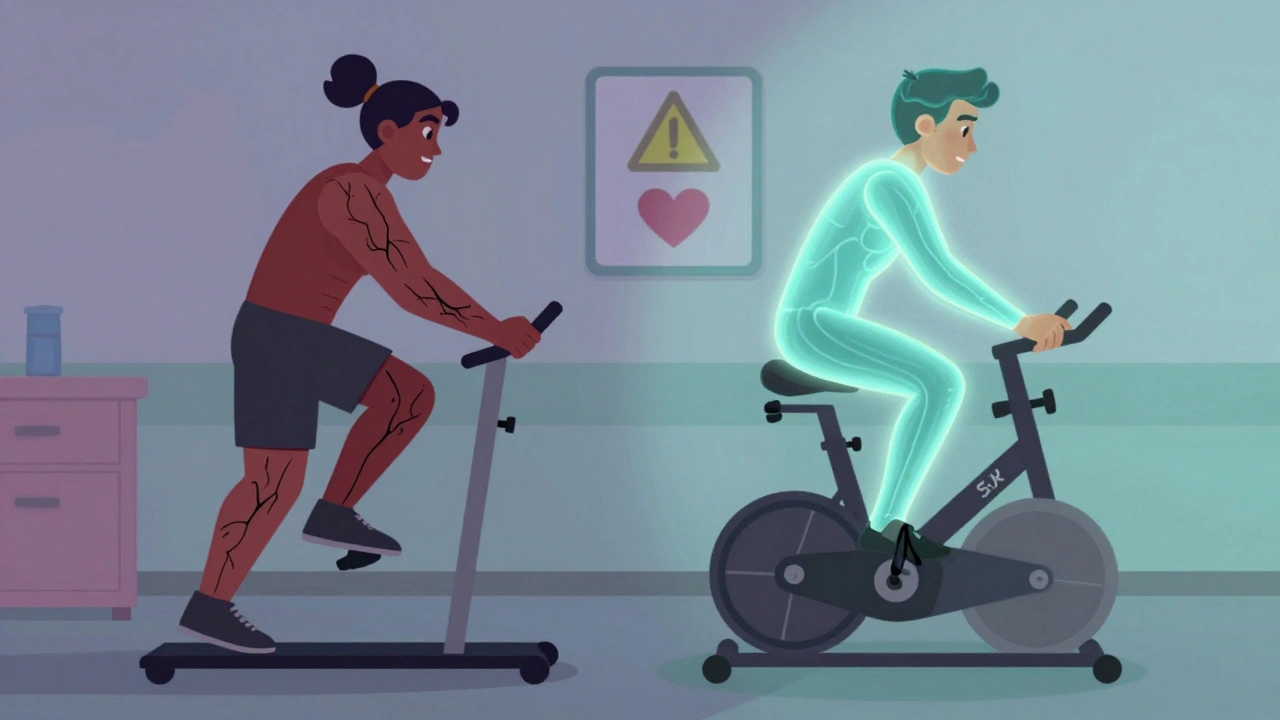
What Your Body Is Telling You
How do you know if the pain is from your statin or your workout? Statin pain is different. It’s constant. It doesn’t show up after a single workout. It’s there whether you’ve exercised or not. It often feels like your whole body is heavy. Exercise pain? It shows up after activity, peaks within 24-48 hours, and fades with rest. If you’re sore after a hike but feel fine the next day? That’s normal. If you’re sore all week, even on days you didn’t move? That’s a red flag. Harvard Medical School recommends tracking your symptoms for 30 days after starting a statin. If the pain started around the same time you began the drug, it’s likely related. If you’ve been exercising for years and only noticed pain after starting statins, that’s another clue.How to Keep Moving Without Worsening Pain
You don’t have to quit exercise. You just need to adjust it. Start slow. The American College of Cardiology recommends beginning with 10-15 minutes of brisk walking daily. Walk at a pace where you can talk but not sing. After a week, add five more minutes. Keep going until you hit 30 minutes, five days a week. That’s the gold standard for heart health-and it’s safe for statin users. Avoid these triggers:- High-intensity interval training (HIIT)
- Heavy weightlifting with slow lowering phases
- Long-distance running or cycling without training
- Exercising in extreme heat
- Walking, swimming, or cycling at a steady pace
- Bodyweight exercises like squats, lunges, and push-ups (controlled movements)
- Yoga or tai chi for flexibility and recovery
Supplements and Other Fixes
CoQ10 supplements are often recommended. Statins lower your body’s natural CoQ10, and some studies show that taking 200 mg daily can reduce muscle pain in about half of users. It’s not magic, but it’s low-risk and worth trying. Another option: take your statin every other day. For some people, this reduces muscle symptoms without losing cholesterol control. One study found a 58% success rate with this approach. If nothing helps, talk to your doctor about switching statins. Many people don’t realize they have options. Rosuvastatin or pravastatin may work just as well for your cholesterol-with far fewer muscle issues.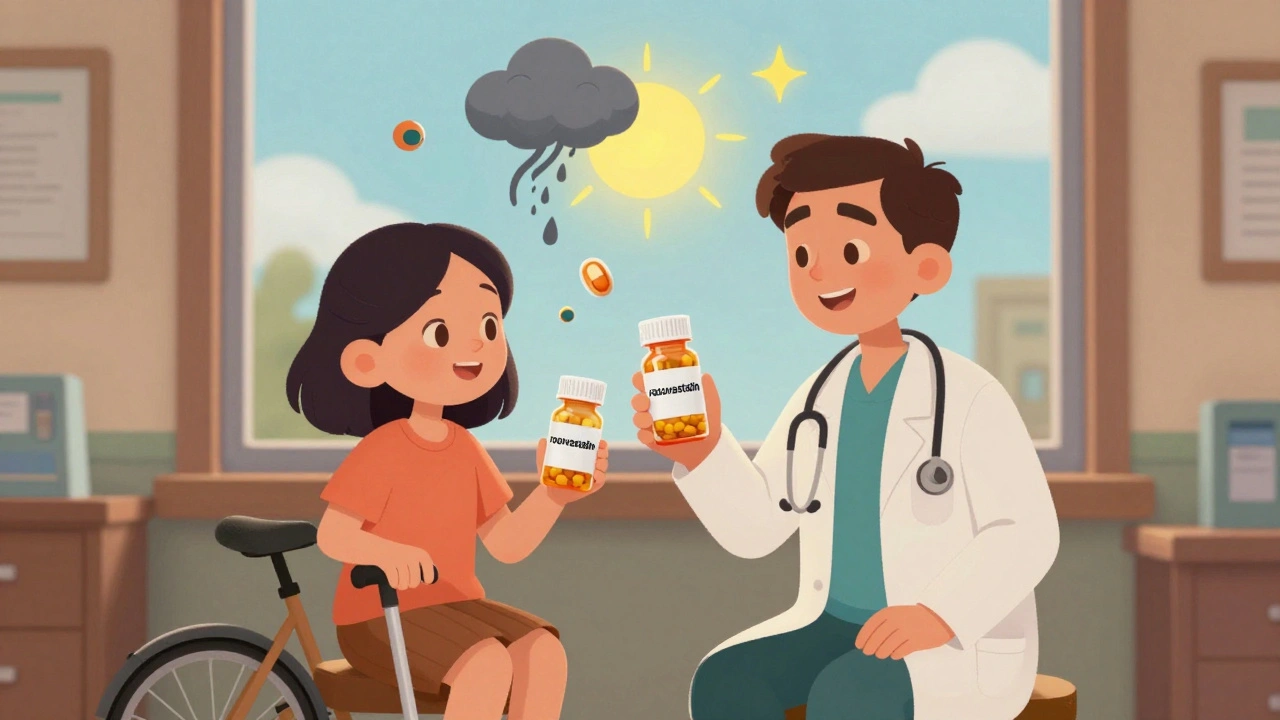
What Happens If You Stop Exercising?
A 2023 survey found that 61% of statin users stopped exercising after developing muscle pain. The biggest reason? Fear of making it worse. But here’s the catch: stopping exercise makes everything worse. Without movement, your muscles weaken. Your heart loses fitness. Your insulin sensitivity drops. Your cholesterol might even rise again. The American Heart Association says 68% of statin users now get exercise advice from their doctors-up from 42% in 2018. That’s progress. But you still need to be your own advocate. Don’t let fear silence your body. Move smartly. Move consistently.What’s Next?
Scientists are now looking at genetics. A gene called SLCO1B1 makes some people far more likely to develop muscle pain on statins. If you carry a certain variant, your risk doubles. Genetic testing isn’t routine yet-but it’s coming. Within five years, doctors may use your DNA to pick the right statin and the right exercise plan for you. In the meantime, the message is clear: Exercise and statins can coexist. You don’t have to choose between a healthy heart and pain-free movement. You just need to move the right way.Can I still exercise if I’m on statins?
Yes, you can-and you should. Moderate exercise like walking, swimming, or cycling at a steady pace is safe and beneficial. Avoid high-intensity workouts like HIIT, heavy weightlifting, or long-distance running until you know how your body responds. Studies show moderate activity doesn’t increase muscle damage in statin users.
Why do statins cause muscle pain?
Statins reduce your body’s production of coenzyme Q10 (CoQ10), which helps muscles generate energy. Lower CoQ10 can lead to fatigue and soreness, especially during physical activity. Some statins, like atorvastatin and simvastatin, also penetrate muscle tissue more easily, increasing the chance of side effects.
Which statin has the least muscle side effects?
Hydrophilic statins like pravastatin and rosuvastatin are less likely to cause muscle pain because they don’t enter muscle tissue as easily. Studies show switching from a lipophilic statin (like atorvastatin) to one of these reduces symptoms in about 65% of cases.
Should I take CoQ10 with my statin?
It’s worth trying. Taking 200 mg of CoQ10 daily has helped reduce muscle pain in some people on statins. While it’s not a guaranteed fix, it’s safe and may improve energy levels and recovery. Talk to your doctor before starting any supplement.
When should I stop exercising because of muscle pain?
Stop if your muscle pain is severe, sudden, or accompanied by dark urine, extreme weakness, or swelling. These could be signs of rhabdomyolysis. Also, if your creatine kinase (CK) level exceeds 1,000 U/L after exercise, pause activity and consult your doctor. Otherwise, mild soreness after a workout is normal-just reduce intensity next time.
Can statins ruin the benefits of exercise?
Some studies suggest yes-especially high-dose lipophilic statins. One trial found that after 12 weeks of training, people on simvastatin improved their VO2 max (a measure of fitness) 6.9% less than those on placebo. The statin may blunt your gains, but it doesn’t eliminate them. Moving regularly still protects your heart, even if your fitness doesn’t improve as much.
Lauryn Smith
December 2, 2025 AT 15:42Just started pravastatin last month and switched from atorvastatin. My muscle ache vanished in two weeks. I walk 4 miles every morning now and feel better than I have in years. Don’t let fear stop you-talk to your doc about switching.
Bonnie Youn
December 4, 2025 AT 05:31CoQ10 saved my life literally. Took 200mg daily and suddenly I could climb stairs again. No more feeling like an 80-year-old at 45. Stop overthinking it-just try it. Your muscles will thank you.
Edward Hyde
December 4, 2025 AT 22:46Statins are just Big Pharma’s way of turning healthy people into patients. I stopped mine cold turkey and my cholesterol’s fine. Exercise is the real medicine-not some lab-made chemical that turns your legs to cement.
Rachel Stanton
December 5, 2025 AT 17:24Important to note: SLCO1B1 genetic testing is available through companies like 23andMe. If you carry the *5 allele, your risk of SAMS increases 3- to 5-fold. Many clinicians don’t mention this-but it’s a game-changer for personalized statin selection. Ask for it.
Charlotte Collins
December 7, 2025 AT 06:28Let’s be real-the 65% success rate with switching statins? That’s cherry-picked data. What about the 35% who still feel awful? And what about the people who can’t tolerate even pravastatin? The article ignores the real suffering. This isn’t a one-size-fits-all fix. It’s a band-aid on a bullet wound.
Margaret Stearns
December 7, 2025 AT 14:42I’ve been walking 30 minutes every day for 6 months since starting rosuvastatin. No pain. No issues. Just steady progress. Don’t overcomplicate it. Walk. Breathe. Repeat.
Amber-Lynn Quinata
December 8, 2025 AT 11:49Someone needs to tell these people that if they’re too weak to handle a little muscle soreness, maybe they shouldn’t be exercising at all. I’ve been on statins for 12 years and I run marathons. You’re not special. You’re just lazy. Stop making excuses.
Scotia Corley
December 9, 2025 AT 16:53It is imperative to underscore that the pharmacokinetic profile of hydrophilic statins confers a significantly reduced propensity for myotoxicity due to diminished tissue penetration. The clinical evidence supporting the substitution of lipophilic agents is robust and warrants universal consideration in patients presenting with myalgia.
Kenny Leow
December 10, 2025 AT 18:04As someone from Singapore who’s been on statins for 8 years, I can confirm: walking daily is the secret. No fancy gear, no supplements. Just shoes and pavement. My doctor said I’m the healthiest 58-year-old he’s ever seen. Simple works.
Kelly Essenpreis
December 11, 2025 AT 23:05Statins are a scam invented by the FDA to sell more drugs. In my country we just eat garlic and turmeric and our hearts are fine. America turns everything into a pill problem. We don’t need your science. We need common sense.
Erin Nemo
December 13, 2025 AT 00:29I switched to rosuvastatin and started swimming. No more pain. I’m 52 and I feel like I’m 35 again. Just try it.
ariel nicholas
December 13, 2025 AT 19:27But… what if the real issue isn’t the statin… but the *narrative*? We’ve been conditioned to believe that pain equals damage, that aging equals decline, that medicine must fix everything. What if the body isn’t broken… but silenced? What if the solution isn’t a different pill… but a different relationship with discomfort?
amit kuamr
December 14, 2025 AT 17:18I am from India and here doctors rarely talk about CoQ10 or statin types. Most just say take pill and walk. I did walk daily for 3 months and pain went away. Simple. No science needed.
elizabeth muzichuk
December 15, 2025 AT 16:11My husband died from rhabdomyolysis after taking simvastatin. He was a runner. He followed all the advice. No one warned him. Now I scream this from the rooftops: DON’T TRUST YOUR DOCTOR. ASK FOR GENETIC TESTING. SAVE YOURSELF.