Ciprofloxacin and Theophylline Interaction: Why This Drug Pair Can Be Dangerous
 Feb, 22 2026
Theophylline Toxicity Risk Calculator
Enter Your Current Theophylline Level
Risk Assessment
Symptoms at Different Levels
- 10-20 mg/L: Safe range. Therapeutic effect.
- 20-25 mg/L: Nausea, vomiting, jitteriness, fast heartbeat
- 25-30 mg/L: Heart arrhythmias, muscle tremors, confusion
- Over 30 mg/L: Seizures - even in people who've never had them before
• If level is above 20 mg/L: Contact your doctor immediately
• If taking ciprofloxacin: Check levels every 24-48 hours
• Watch for nausea, vomiting, racing heart, shaking hands
• Older adults need extra caution - clearance drops 45% with ciprofloxacin
When you're managing a chronic lung condition like COPD or asthma, theophylline might be part of your daily routine. It’s been around for decades, works well, and keeps breathing easier. But if you get a bad infection - say, a stubborn sinus infection or pneumonia - your doctor might reach for ciprofloxacin. It’s a strong antibiotic. Quick. Effective. Ciprofloxacin and theophylline? Sounds fine, right? Not even close. This combo can push your body into a dangerous zone - one that lands people in the hospital, sometimes with seizures, heart rhythm problems, or worse.
What Happens When These Two Drugs Meet?
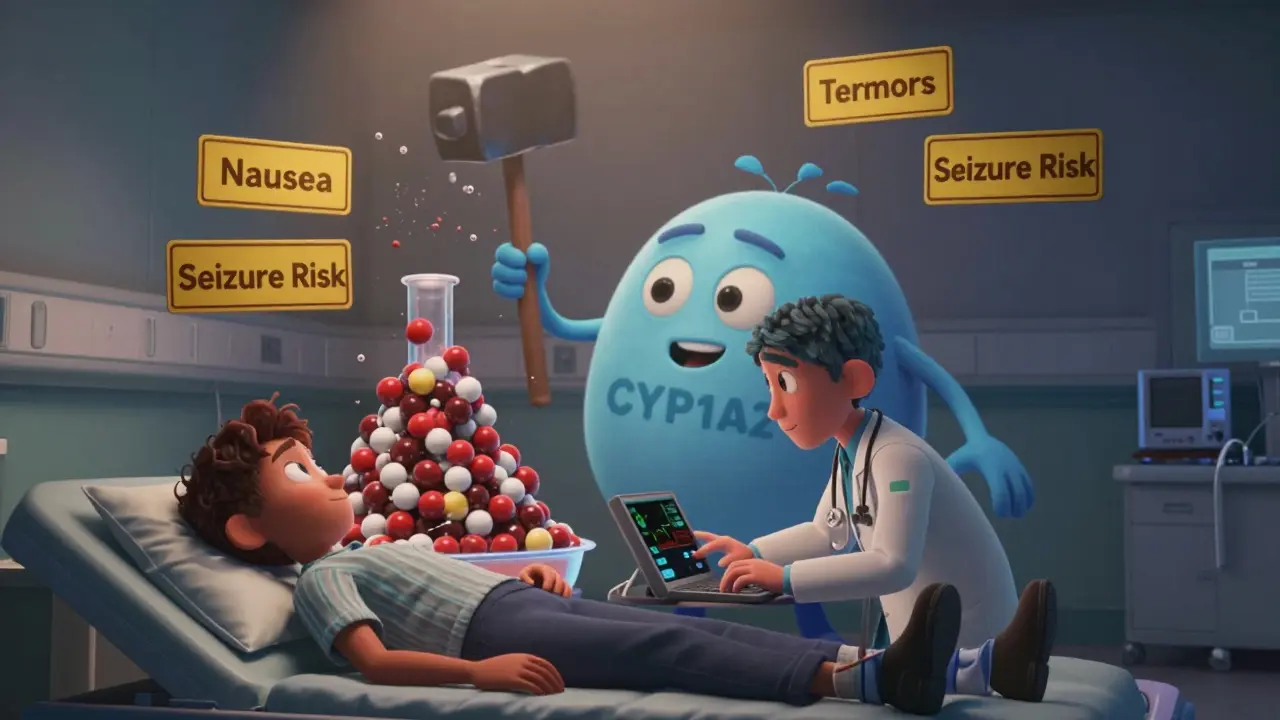
Theophylline doesn’t just float through your body. It’s broken down by one specific enzyme: CYP1A2. Think of this enzyme like a factory worker who shreds theophylline so your body can get rid of it. Now, ciprofloxacin walks in - not as a coworker, but as a wrecking ball. It slams the brakes on CYP1A2. Hard. When that happens, theophylline stops getting cleared. It piles up. And because theophylline has a razor-thin safety margin - between 10 and 20 mg/L in your blood - even a small buildup can turn deadly.
Studies show ciprofloxacin can boost theophylline levels by 40% to 80%. That’s not a little bump. That’s like doubling your dose without taking an extra pill. The half-life? Normally, theophylline clears out in about 8 hours. With ciprofloxacin? It can stretch to 15 hours. That means the drug lingers, builds, and keeps climbing.
What Does Toxicity Look Like?
The symptoms don’t sneak up. They hit fast - and they’re hard to ignore.
- At 20-25 mg/L: Nausea, vomiting, jitteriness, fast heartbeat
- At 25-30 mg/L: Heart arrhythmias, muscle tremors, confusion
- Over 30 mg/L: Seizures - even in people who’ve never had one before
There’s a documented case from 1990: a 93-year-old woman on theophylline for COPD got ciprofloxacin for a urinary infection. Two days later, she had a grand mal seizure. No history of epilepsy. No other drugs. Just this combo. That’s not rare. In fact, a 2011 study of over 77,000 older adults found ciprofloxacin nearly doubled the risk of hospitalization for theophylline toxicity. And it wasn’t just one or two cases - it was 180 hospitalizations directly tied to this interaction.
Why Is This Still Happening?
Here’s the kicker: doctors know about this. The FDA put a black box warning on ciprofloxacin in 1994. That’s the strongest warning they give. Guidelines from the American College of Chest Physicians and the American Society of Health-System Pharmacists say: avoid this combo. But guess what? A 2018 study found that over 12% of older adults on theophylline were still getting ciprofloxacin. Why? Because in the moment - fever, cough, feeling awful - the urgency of treating the infection overshadows the slow-burning risk of the drug interaction.
Electronic alerts pop up in hospital systems warning about this. But a 2017 study showed that nearly 7 out of 10 times, clinicians just clicked past them. Why? They thought the patient had taken this combo before and was fine. Or they believed the infection was too serious to delay. That’s the trap. Past tolerance doesn’t mean safety. One infection, one dose, one change in kidney function - and suddenly, the numbers spiral.
What Should You Do Instead?
Not all antibiotics are created equal. If you’re on theophylline and need an antibiotic, there are safer choices.
- Levofloxacin and moxifloxacin: These are also fluoroquinolones, but they barely touch CYP1A2. Levofloxacin raises theophylline levels by only 10-15%. That’s manageable. Often, it’s the go-to if you really need a fluoroquinolone.
- Amoxicillin-clavulanate: A common antibiotic for respiratory infections. No interaction. No risk.
- Azithromycin: Another good option. Minimal effect on theophylline.
If your doctor insists on ciprofloxacin - maybe you’re allergic to everything else - then you need a plan. Don’t just take it. Here’s what your care team should do:
- Check your theophylline blood level before starting ciprofloxacin.
- Reduce your theophylline dose by 30-50% right away.
- Test your blood level again within 24-48 hours.
- Watch for early signs: nausea, vomiting, racing heart, shaking hands.
And if you’re elderly? That’s even more critical. A 2015 meta-analysis found people over 65 clear theophylline 45% slower than younger adults when ciprofloxacin is added. Your body doesn’t handle drugs the same way it used to. Lower doses aren’t just safer - they’re necessary.
Genetics Might Play a Role Too
Not everyone reacts the same. Some people have a genetic quirk called CYP1A2*1F. If you have it, ciprofloxacin cuts your theophylline clearance by 65% more than someone without it. Researchers at the University of Toronto are already testing machine learning tools that can predict this risk based on your DNA. In the future, a simple genetic test might tell you: Don’t touch ciprofloxacin if you’re on theophylline. But for now, we can’t wait for that tech. We have to act with what we know.

How Many People Are Affected?
Around 9,300 Medicare patients each year have a theophylline-related adverse event because of ciprofloxacin. That’s 4,200 hospitalizations. That’s lives disrupted. That’s money spent - billions in preventable costs. And it’s all because we forget one thing: drugs don’t just work alone.
Every time you add a new pill, you’re changing the chemistry of your body. That’s not magic. It’s biology. And when you’re on theophylline, ciprofloxacin isn’t just another prescription. It’s a red flag.
Bottom Line: Don’t Guess. Test. Adjust. Switch.
If you’re on theophylline and your doctor suggests ciprofloxacin, ask: Is there another option? If not, demand a plan: blood tests, dose reduction, close monitoring. Don’t assume you’re safe because you’ve taken it before. Your body changes. Your kidneys slow down. Your liver works differently. What worked last time might kill you this time.
This isn’t a rare edge case. It’s a textbook example of why drug interactions matter. And it’s still happening - right now - in homes, clinics, and ERs across the country. Knowledge isn’t enough. Action is.
Can I take ciprofloxacin if I’m on theophylline?
It’s not recommended. Ciprofloxacin can cause dangerous buildup of theophylline, leading to seizures, heart problems, or death. If no other antibiotic works, your doctor must reduce your theophylline dose by 30-50%, check your blood levels before and during treatment, and monitor you closely for signs of toxicity.
What are the early signs of theophylline toxicity?
The first signs include nausea, vomiting, a fast or irregular heartbeat, shaking or tremors, and feeling jittery or anxious. If you notice these while taking ciprofloxacin, call your doctor immediately - don’t wait for seizures or confusion to appear.
Why is this interaction worse in older adults?
As we age, liver and kidney function decline, slowing how fast drugs are cleared. Studies show theophylline clearance drops 45% more in people over 65 when ciprofloxacin is added. That means even standard doses can become toxic. Older patients need lower starting doses and tighter monitoring.
Are all fluoroquinolones equally dangerous with theophylline?
No. Ciprofloxacin is the worst offender. Levofloxacin and moxifloxacin have minimal effect on theophylline levels - increasing them by only 10-15%. If you need a fluoroquinolone, those are safer choices. Always check with your pharmacist or doctor before switching.
How often should theophylline levels be checked during ciprofloxacin use?
Levels should be checked before starting ciprofloxacin, then again within 24-48 hours after the first dose. After that, monitor every 2-3 days until the antibiotic is stopped. Theophylline levels can rise rapidly and unpredictably - waiting too long can be life-threatening.
What antibiotics are safe to take with theophylline?
Amoxicillin-clavulanate, azithromycin, cefuroxime, and trimethoprim-sulfamethoxazole have little to no interaction with theophylline. These are often preferred alternatives for respiratory infections in patients on theophylline. Always confirm with your pharmacist - not all antibiotics are safe.
Bhaskar Anand
February 23, 2026 AT 13:14Let me be clear: this isn’t some theoretical risk-it’s a death sentence waiting to happen. I’ve seen it in my ER in Delhi. Elderly patients on theophylline for COPD, given cipro for a UTI, and two days later, seizing in the hallway. No warning. No prior history. Just a prescription that should’ve been banned. The FDA warning? It’s not a suggestion. It’s a command. Yet doctors still write it. Why? Because they’re lazy. Or worse-they think they’re invincible. This isn’t about pharmacology. It’s about arrogance. And people are dying because of it.
Southern Indiana Paleontology Institute
February 24, 2026 AT 13:57yo so i had this buddy in indiana who was on theophylline and his doc gave him cipro for a sinus thing. he got real jittery, started puking, thought he was gonna die. went to the er and they were like ‘oh god you’re lucky you’re alive’. turns out his levels were 38. he didn’t even know what theophylline did. just took his pill every day. doctors don’t talk. patients don’t ask. this is why america’s healthcare is a joke.
Anil bhardwaj
February 26, 2026 AT 04:51Interesting read. I’m a respiratory tech in Mumbai and we see this more often than you’d think. Older patients on theophylline-usually because it’s cheap and available-get cipro because it’s the go-to antibiotic in clinics. No lab checks. No dose adjustments. Just ‘take this’. I’ve seen three cases this year alone. One man was on 300mg of theophylline daily. Got cipro. Ended up in ICU with ventricular tachycardia. He survived. But his wife cried for two weeks. This isn’t science. It’s negligence dressed up as convenience.
lela izzani
February 27, 2026 AT 02:40I work in a hospital pharmacy and I can’t tell you how many times I’ve had to intervene on this exact interaction. We have alerts popping up every single day. And yes, clinicians click through them. They say ‘he’s been on this combo for years’-but years don’t protect you. Aging changes everything. Kidney function drops. Liver enzymes shift. A dose that was safe at 60 becomes toxic at 75. We reduce theophylline by 40% preemptively when cipro is prescribed. We check levels before and after. It’s not optional. It’s standard. If your doctor doesn’t know this, find one who does.
Joanna Reyes
February 27, 2026 AT 19:10I’ve spent the last six months reviewing adverse drug events in geriatric populations, and this interaction is one of the most preventable yet consistently overlooked. The 2011 study showing nearly double the hospitalization risk isn’t an outlier-it’s a pattern. What’s worse is that we assume patients understand their own meds. They don’t. Many elderly patients are on 8-10 drugs. They don’t know what CYP1A2 is. They don’t know how half-lives work. They just know that their doctor gave them two new pills and told them to take them. We need systems-not just alerts, but mandatory pharmacist consultations, automated dose calculators, and mandatory patient handouts in plain language. This isn’t a knowledge gap. It’s a systemic failure.
Nerina Devi
February 28, 2026 AT 23:15As someone whose mother was almost lost to this exact interaction, I’m so grateful someone wrote this. She’s 72, COPD, on theophylline for 12 years. Got cipro for bronchitis. Started shaking, couldn’t sleep, heart racing. We rushed her in. They said if we’d waited another 6 hours, she wouldn’t have made it. I’ve told every family member I know: if you’re on theophylline, never let anyone give you cipro without blood tests and a dose reduction. It’s not worth the risk. Please, if you read this-share it. This isn’t just medical info. It’s life-saving.
Dinesh Dawn
March 2, 2026 AT 13:58Man, this is wild. I’m a nurse in Bangalore, and we have so many patients on theophylline because it’s all we can afford. Cipro is everywhere-it’s cheap, fast, works. But I’ve seen the tremors, the vomiting, the panic in their eyes when their heart starts racing. We don’t always have labs. We don’t always have time. But I always ask: ‘Have you been checked lately?’ And if the answer is no, I push back. Hard. I’ve stopped three prescriptions this year. One guy yelled at me. Said I was overreacting. Two days later, he was in the ICU. I’m not a doctor. But I know what death looks like. And this? This is preventable.
Vanessa Drummond
March 4, 2026 AT 08:15I hate when people treat this like it’s just ‘a risk’. It’s not. It’s a trap. You’re told to take this pill, then another, then another-and suddenly your body is screaming. I had a friend who got cipro for a tooth infection while on theophylline. She had a seizure in her kitchen. No history of epilepsy. No other meds. Just this combo. She’s fine now, but she has PTSD from it. And her doctor? He didn’t even know. Said he ‘thought it was safe’. No. It’s not. Stop pretending it’s fine. This isn’t ‘maybe dangerous’. It’s ‘deadly if ignored’.
Nick Hamby
March 5, 2026 AT 11:14There’s a deeper philosophical truth here: we treat medicine as a collection of isolated interventions, when in reality, the human body is a dynamic, interconnected system. Each drug alters the chemistry of the whole. Theophylline and ciprofloxacin aren’t just two molecules-they’re actors in a biochemical play where one disrupts the rhythm of the other. We’ve built a system that rewards speed over depth, prescriptions over understanding. We need to move from ‘prescribe and pray’ to ‘assess and adapt’. This isn’t just about antibiotics-it’s about humility in medicine. If we forget that drugs interact, we forget that people are complex. And complexity demands care.
kirti juneja
March 6, 2026 AT 00:33Let’s be real-this is why I love my pharmacist. She’s the real MVP. When my doc tried to give me cipro for a chest infection (I’m on theophylline), she stopped me cold. Said, ‘Honey, you don’t want to turn into a human alarm clock.’ Then she pulled up charts, showed me the 40-80% spike numbers, and said, ‘Here’s azithromycin. Safe. Effective. No drama.’ I didn’t even know I could ask. So if you’re on theophylline? Don’t just nod along. Ask. Push. Demand. Your life isn’t a guess. It’s a calculation. And someone’s gotta run the numbers for you.