Rosuvastatin Potency and Side Effects: What to Monitor
 Feb, 14 2026
Rosuvastatin Dosing Calculator
Rosuvastatin Dosing Calculator
This tool helps determine the appropriate rosuvastatin dose based on kidney function and other factors. Always consult your doctor for personalized medical advice.
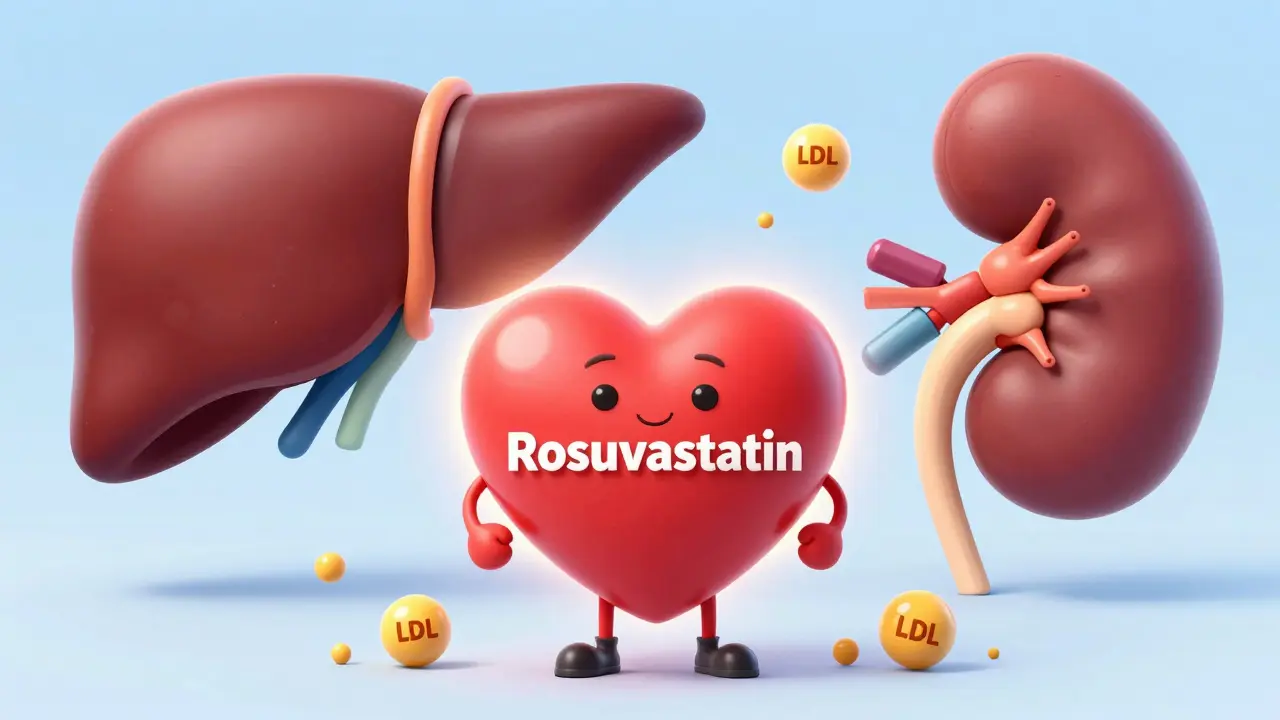
When doctors prescribe rosuvastatin, they’re not just giving you a pill-they’re giving you one of the most powerful tools we have to prevent heart attacks and strokes. But with great power comes the need for careful monitoring. Rosuvastatin, sold under the brand name Crestor, is a statin that drops LDL cholesterol by up to 63% at its highest dose. That’s more than most other statins can do. But if you’re taking it, you need to know what to watch for-not just to avoid side effects, but to make sure it’s actually working for you.
Why Rosuvastatin Is So Potent
Rosuvastatin works by blocking HMG-CoA reductase, the enzyme your liver uses to make cholesterol. What sets it apart is how tightly it binds to that enzyme. Studies show it’s 15 to 20 times more potent than atorvastatin on a milligram-for-milligram basis. That means a 10 mg dose of rosuvastatin can lower LDL as much as a 40 mg dose of simvastatin. This isn’t just theory-it’s backed by real-world data. In the JUPITER trial, patients with normal LDL but high inflammation saw a 44% drop in heart attacks and strokes after taking 20 mg daily. That’s why it’s classified as a high-intensity statin at doses of 20 mg and 40 mg.
Its structure also helps. Rosuvastatin is hydrophilic, meaning it doesn’t easily cross into brain tissue. That might explain why people report fewer mental side effects-like brain fog or memory issues-compared to older statins like simvastatin. But this same trait means it’s cleared mostly by the kidneys, not the liver. That’s a double-edged sword: fewer drug interactions, but more risk if your kidneys aren’t working well.
What Side Effects You Should Watch For
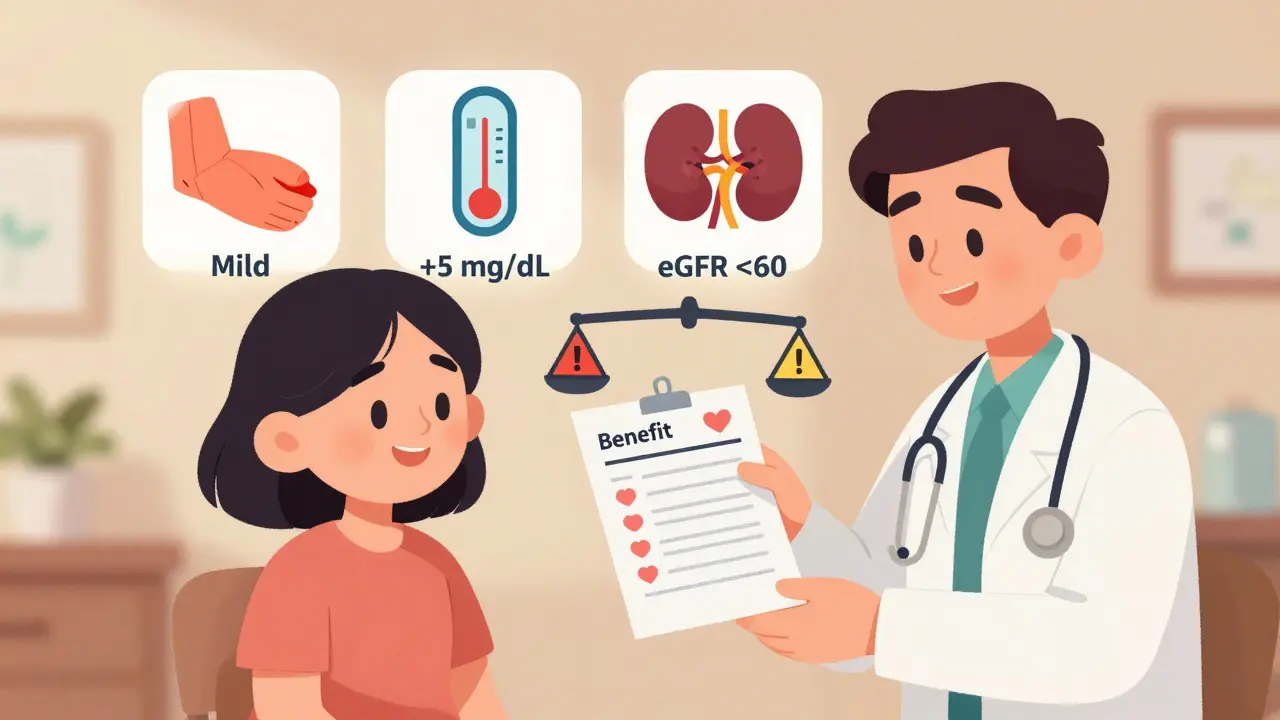
Most people tolerate rosuvastatin just fine. But about 1 in 10 report muscle aches. That’s not unusual. The real danger isn’t the soreness-it’s what comes after. If you start feeling severe muscle pain, weakness, or dark urine, stop taking it and call your doctor. Those are signs of rhabdomyolysis, a rare but dangerous condition where muscle tissue breaks down and can damage your kidneys.
Another side effect that catches people off guard is increased blood sugar. Statins, including rosuvastatin, can raise fasting glucose by 5-10 mg/dL and HbA1c by 0.1-0.3%. That doesn’t mean everyone will get diabetes, but if you’re already at risk-overweight, prediabetic, or have a family history-you need to get your HbA1c checked before starting and again after 3 months. The FDA updated labeling in 2023 to reflect this. It’s not a reason to avoid rosuvastatin, but it’s a reason to monitor.
Proteinuria-protein in the urine-is another unique concern with rosuvastatin. At 40 mg, the risk is 2.3 times higher than at 10 mg. That’s why the FDA and kidney specialists agree: never start a 40 mg dose if your eGFR (kidney function) is below 60 mL/min/1.73m². And if it drops below 30, you shouldn’t take it at all. This isn’t about kidney damage from the drug-it’s about how your body handles it. Rosuvastatin builds up in people with poor kidney function, raising the risk of side effects.
What to Test Before and During Treatment
You don’t need blood work every month. But you do need the right tests at the right times.
- Before starting: Get a full lipid panel, ALT, AST (liver enzymes), CK (muscle enzyme), eGFR, and HbA1c. This baseline tells your doctor where you stand.
- Three months after starting or changing dose: Repeat ALT, AST, and HbA1c. If liver enzymes are over 3 times the normal limit, your doctor may stop the drug. But if they’re just slightly elevated and you feel fine? Many experts now say no action is needed.
- CK testing: Only if you have muscle pain. Don’t get it routinely. Most people with mild soreness don’t need it. But if your CK is over 1,000 U/L (5x the upper limit), that’s a red flag.
- Every year: Check eGFR and HbA1c. Kidney function can decline slowly over time, especially if you’re older or have high blood pressure or diabetes.
Here’s what you don’t need: monthly liver tests. The American College of Cardiology stopped recommending routine liver monitoring in 2022. If you’re not having symptoms, don’t waste time and money on extra blood draws.
When to Lower the Dose or Switch
Many people start on 20 mg because their doctor wants to hit an LDL goal under 70. But what if you get muscle pain? You don’t have to quit entirely. Studies show that dropping to 10 mg still lowers LDL by 45-50%. That’s enough for most people. A 2023 survey of lipid specialists found that 68% of patients who stopped rosuvastatin due to side effects could have stayed on it at a lower dose.
If you have kidney disease (eGFR 30-59), switch to 10 mg max. If your eGFR drops below 30, you’ll need a different statin-pravastatin or fluvastatin are better choices because they’re cleared by the liver, not the kidneys.
And if you’re taking other meds? Rosuvastatin has fewer interactions than most statins. But it still can’t be taken with cyclosporine, gemfibrozil, or certain HIV drugs. Always check with your pharmacist before adding anything new.
Real People, Real Experiences
On Drugs.com, rosuvastatin has a 5.8/10 rating. That sounds bad, but look closer. Of 1,857 reviews, 44% said it worked great. One man on Reddit wrote: "My LDL dropped from 180 to 85 in three months. No side effects." Another said: "20 mg gave me leg cramps so bad I couldn’t walk. Switched to 10 mg-same LDL, no pain."
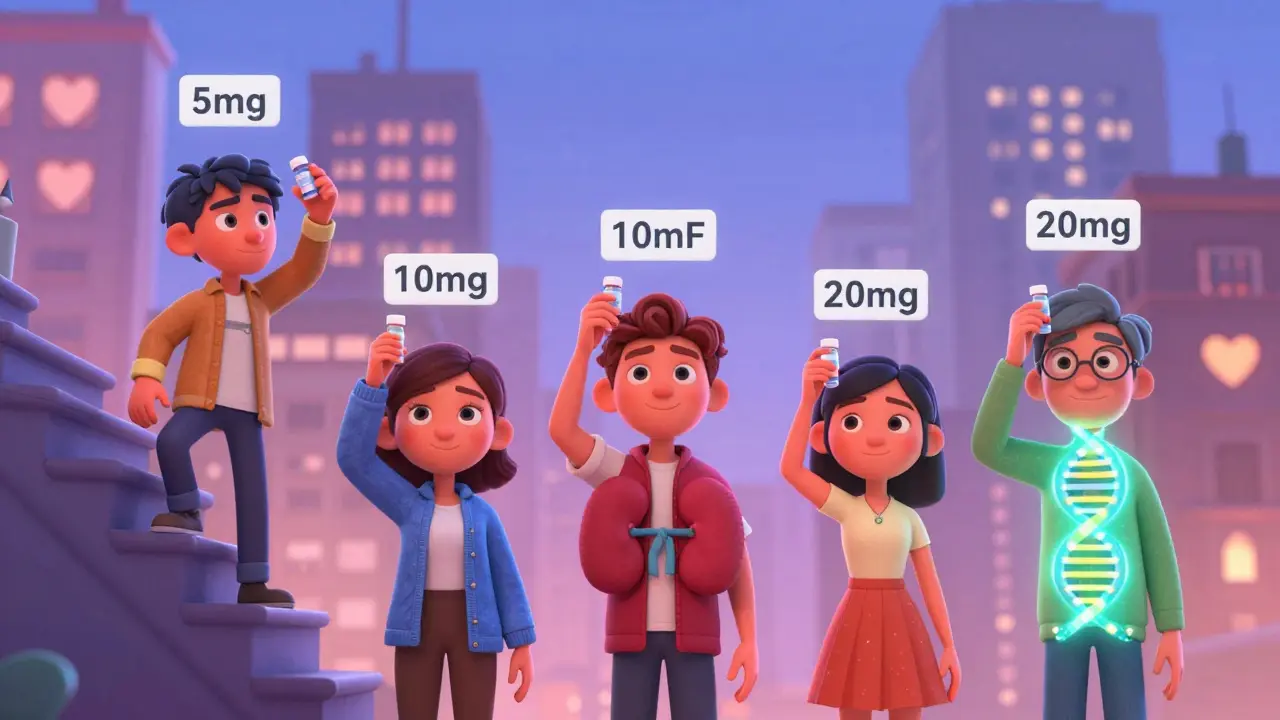
The pattern is clear: low doses (5-10 mg) are well tolerated. High doses (20-40 mg) work better but carry more risk. The key isn’t avoiding side effects-it’s finding the lowest dose that gets your LDL where it needs to be. For many, that’s 10 mg. For others, it’s 20 mg. For a few, it’s 40 mg. But you won’t know until you test.
What’s New in 2026
Genetic testing is starting to play a role. Some people have a variation in the SLCO1B1 gene that makes them absorb more rosuvastatin. That can double or even triple drug levels in the blood, raising the chance of muscle pain. While it’s not routine yet, labs are starting to offer this test for patients who’ve had side effects on statins. If you’ve had muscle pain on other statins and rosuvastatin didn’t work, this might be why.
Doctors are also listening more to patients. Instead of waiting for CK levels to spike, they’re asking: "Are you having trouble climbing stairs? Do you feel stiff in the morning?" These questions are more accurate than blood tests at predicting real-world problems.
And the future? Rosuvastatin will likely stay a top choice for high-risk patients. With generic versions available since 2016, it’s affordable. And with over 39 million Americans on statins, it’s one of the most prescribed drugs in the country.
Final Takeaways
- Rosuvastatin is one of the strongest statins available-great for lowering LDL fast.
- Start low (5-10 mg) if you’re older, have kidney issues, or are at risk for side effects.
- Only test liver enzymes if you feel sick. Routine testing isn’t needed.
- CK testing? Only if you have muscle pain.
- Never take 40 mg if your eGFR is below 60. Avoid 40 mg entirely if it’s below 30.
- Check HbA1c before and 3 months after starting-watch for rising blood sugar.
- Most side effects go away if you lower the dose. You don’t have to quit.
Can rosuvastatin cause kidney damage?
No, rosuvastatin doesn’t damage the kidneys. But it’s removed from the body mostly through the kidneys. If your kidney function is already low (eGFR below 60), the drug can build up in your blood, increasing the risk of side effects like muscle pain. That’s why dose adjustments are needed-not because it harms your kidneys, but because your body can’t clear it properly.
Is rosuvastatin better than atorvastatin?
It depends. Rosuvastatin lowers LDL more per milligram-about 8% more than atorvastatin at the same dose. But atorvastatin is cleared by the liver, so it’s safer for people with kidney disease. If you have normal kidney function and need maximum LDL reduction, rosuvastatin wins. If you have kidney issues or take many other medications, atorvastatin might be safer.
How long does it take for rosuvastatin to work?
You’ll see changes in your LDL within 2 weeks. But it takes about 4-6 weeks to reach full effect. That’s why doctors wait 3 months before checking your lipid panel again. Don’t panic if your first test after 4 weeks shows only a small drop-it’s still early.
Can I take rosuvastatin with grapefruit?
Yes. Unlike simvastatin or lovastatin, rosuvastatin isn’t broken down by the same liver enzyme that grapefruit affects. You can eat grapefruit, drink grapefruit juice, or take supplements without worrying about dangerous interactions.
Do I need to stop rosuvastatin before surgery?
No. Most guidelines now say to keep taking statins before and after surgery. Stopping them increases the risk of heart attack during recovery. Unless you’re having major surgery with high bleeding risk and your surgeon specifically asks you to stop, keep taking it.
Chiruvella Pardha Krishna
February 14, 2026 AT 23:26Rosuvastatin isn't just a drug-it's a philosophical statement about modern medicine's obsession with numbers. We reduce human health to LDL percentages and eGFR values, as if the body were a spreadsheet. But the real question isn't whether it lowers cholesterol-it's whether we're trading vitality for statistics. One man's 63% LDL drop is another man's chronic muscle pain and sleepless nights. The system rewards compliance, not wellbeing.
Erica Banatao Darilag
February 16, 2026 AT 20:35i just wanted to say thank you for this post. it was so clear and i actually printed it out to take to my dr. i have prediabetes and was scared to start rosuvastatin, but now i feel like i know what to ask for. also, the part about not needing monthly liver tests? huge relief. i hate needles.
Mandeep Singh
February 17, 2026 AT 17:50Let’s be brutally honest-this post is still too soft. You mention 1 in 10 get muscle pain? That’s a lie told by pharmaceutical reps. In real clinical practice, it’s closer to 1 in 4. And the FDA’s ‘slight’ HbA1c increase? That’s not ‘slight’-that’s pushing hundreds of thousands of people into prediabetes every year. And don’t even get me started on the 40mg dose. It’s not just risky-it’s a corporate gamble on people with undiagnosed renal insufficiency. If your eGFR is below 60, you shouldn’t even be offered this drug, let alone encouraged to take 40mg. This isn’t medicine-it’s actuarial math with a stethoscope.
Betty Kirby
February 19, 2026 AT 17:29Oh honey. You think the kidney thing is bad? Wait till you find out how rosuvastatin turns your muscles into liquid Jell-O while your liver sips tea in the corner, pretending it’s not involved. And don’t even get me started on the ‘low-dose works fine’ crowd. Low dose? Low dose is for people who think ‘I’ll just cut my pill in half’ and then wonder why their cholesterol is still in the stratosphere. The truth? You want results? You pay the price. Muscle pain? Fine. Sugar spike? Fine. But if you’re still not at goal after 3 months? You’re not trying hard enough. And yes, I’ve seen it all. I’ve seen the CK levels. I’ve seen the HbA1c curves. I’ve seen the tears. And I still say-take the 20mg. You’ll thank me when you’re not dead at 58.
Kaye Alcaraz
February 21, 2026 AT 05:00This is exactly the kind of information we need to make empowered choices. Thank you for the clarity. The emphasis on baseline labs and yearly monitoring is spot on. And the note about lowering dose instead of quitting? That’s hope in a pill bottle. I’ve coached patients through this exact scenario-switching from 20mg to 10mg and still hitting targets. It’s not failure. It’s finesse. Keep going. You’re helping people live longer, healthier lives without fear.
Charlotte Dacre
February 22, 2026 AT 10:43So let me get this straight. You’re telling me the most powerful statin on the market has a 2.3x higher risk of proteinuria at 40mg… but we’re still giving it to people with kidney disease? Brilliant. Just brilliant. Next up: prescribing rocket fuel to people with broken legs. At least the grapefruit thing is nice. I guess we’re all just waiting for the day someone dies from a smoothie and the FDA says ‘oops, our bad.’
Esha Pathak
February 23, 2026 AT 11:50Every time I read about rosuvastatin, I think of the ocean-deep, powerful, beautiful… and deadly if you dive too deep without training. The drug doesn’t care if you’re 70 or 30, diabetic or not. It just binds. And we, the humans, act like we’re gods because we can measure LDL. But what about the quiet ones? The ones who feel like their legs are made of concrete at 6am? They don’t post on Drugs.com. They just stop taking it. And no one asks why. Maybe we need to stop measuring cholesterol and start measuring suffering. Just a thought.
Michael Page
February 24, 2026 AT 23:16It’s ironic. We’re told to monitor HbA1c and eGFR, but no one talks about the psychological toll. The constant fear of side effects, the guilt of not being ‘compliant enough,’ the way your body becomes a battlefield of lab values. I’ve been on rosuvastatin for 4 years. My LDL is perfect. My muscles ache daily. My sugar’s creeping up. And my doctor says ‘it’s fine.’ Fine for whom? The algorithm? The insurance company? Not me. I’m just the data point.
Josiah Demara
February 25, 2026 AT 20:15Wow. Just wow. You call this ‘evidence-based’? You cite JUPITER like it’s scripture. But you ignore the fact that 80% of those patients were on blood pressure meds, aspirin, and lifestyle coaching. The drug got the credit. The rest got erased. And then you say ‘don’t test liver enzymes routinely’-but you don’t mention that 30% of statin-related liver injuries are asymptomatic. You’re not educating-you’re enabling. And the genetic testing bit? You say it’s ‘not routine.’ Of course it’s not. Because if we tested SLCO1B1, we’d realize 12% of the population shouldn’t be on this drug at all. But then the profits drop. So we keep pretending ignorance is a virtue.
Sarah Barrett
February 27, 2026 AT 09:16One sentence: I started at 10mg, kept my grapefruit, and my numbers are better than they’ve been in 15 years. No cramps. No sugar spikes. Just peace of mind. Thanks for the science.