Medicare Part D Formularies: How Generic Coverage Works in 2026
 Jul, 12 2026
Prescription drug costs used to be a guessing game for millions of Americans on Medicare. You’d pick up your pills, hand over your card, and hope the price wasn’t higher than last month. That uncertainty has changed dramatically with the updates to Medicare Part D, which is the federal program that provides prescription drug coverage to Medicare beneficiaries through private insurance plans. Since its launch in 2006, Part D has served over 51 million people, but the way it handles generic drugs-the workhorses of modern medicine-has evolved significantly.
In 2026, the rules are clearer, and the savings are real. Thanks to changes from the Inflation Reduction Act, there is now a hard cap on what you pay out of pocket. But to actually save money, you need to understand how formularies, which are the specific lists of covered medications maintained by each Medicare Part D plan, work. Specifically, you need to know where generic drugs sit on those lists and how the tiered pricing structure affects your wallet.
What Is a Formulary and Why Do Tiers Matter?
Think of a formulary as a menu. Each Medicare Part D plan creates its own menu of covered drugs. This isn't random; it’s carefully designed to balance cost and access. The key feature of this menu is the "tier" system. Tiers group drugs based on their cost to the plan and, consequently, your share of the bill.
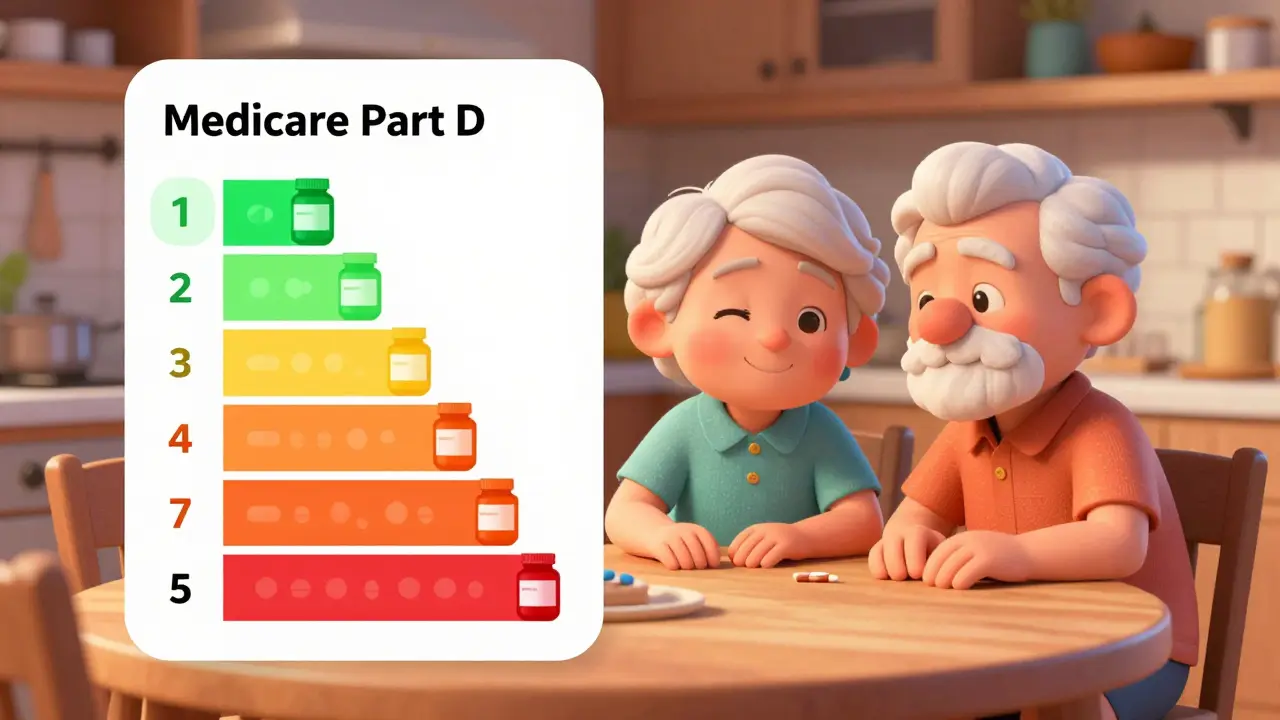
Generic drugs almost always live in the lowest tiers. Here is how the typical 2026 structure looks:
- Tier 1 (Preferred Generics): These are the cheapest options. You usually pay a small fixed copay, often between $0 and $15 for a 30-day supply.
- Tier 2 (Non-Preferred Generics): These are still generics, but they might cost slightly more for the insurer to buy. You might pay a percentage of the cost (coinsurance) or a higher fixed fee, sometimes up to $40.
- Tier 3 (Preferred Brand-Name Drugs): Brand names that the plan has negotiated good rates for.
- Tier 4 (Non-Preferred Brand-Name Drugs): More expensive brands with higher copays.
- Tier 5 (Specialty Drugs): High-cost medications, often injected or infused, requiring special handling.
The goal is simple: if a generic version exists, the plan wants you to take it because it saves everyone money. By placing generics in Tier 1 and 2, plans incentivize you to choose them over pricier brand-name alternatives.
The 2026 Cost Structure: Deductibles and Caps
Understanding the tiers is only half the battle. You also need to know how much you pay at each stage of the year. The financial landscape shifted heavily in 2025 and continues into 2026 due to the Inflation Reduction Act. Let’s break down the phases for 2026.
| Phase | Description | Your Typical Cost for Generics |
|---|---|---|
| Deductible Phase | You pay 100% of drug costs until you hit the annual deductible. | $0 - $590 (depending on your plan's deductible) |
| Initial Coverage | After the deductible, you and the plan share costs until you hit the out-of-pocket threshold. | 25% coinsurance or fixed copay (e.g., $10-$20) |
| Catastrophic Coverage | You have spent enough out-of-pocket for the year. Costs drop significantly. | $0 for generics |
The biggest change is the out-of-pocket cap, which is a limit on the total amount a beneficiary pays for covered drugs in a calendar year. In 2026, once you spend $2,100 out of pocket (this includes deductibles, copays, and coinsurance), you enter catastrophic coverage. From that point on, you pay $0 for your generic prescriptions for the rest of the year. This eliminates the old "donut hole" anxiety where costs would spike unexpectedly.
Note that the deductible for 2026 is expected to remain around $590, though some plans offer $0 deductibles. If you take multiple generics, a $0 deductible plan can save you hundreds of dollars right at the start of the year.

How Plans Decide Which Generics to Cover
You might wonder, "Why does my plan cover Generic A but not Generic B, even though they treat the same condition?" It comes down to negotiations and committee decisions.
Every Part D plan has a Pharmacy and Therapeutics (P&T) Committee. This group consists of practicing physicians and pharmacists who review drugs based on safety, efficacy, and cost. They decide which generics go into Tier 1 versus Tier 2. Often, this depends on which manufacturer the plan has secured the best bulk price from.
However, the government sets strict guardrails. Under federal regulations (42 CFR §423.120), plans must include at least two chemically distinct drugs in every therapeutic class. For six protected classes-including antidepressants, antipsychotics, and immunosuppressants-plans must cover 100% of available generics. This ensures you aren't left without essential mental health or transplant medications just because one brand was cheaper for the insurer.
Common Pitfalls with Generic Substitution
Even with clear rules, confusion happens. One common issue is "therapeutic interchange." Sometimes, a pharmacist will substitute one generic for another equivalent one. While medically safe, this can cause billing issues if the substituted generic is on a different tier or not on your formulary at all.
For example, you might be prescribed a generic blood pressure medication. Your doctor writes for Brand X Generic. The pharmacy swaps it for Brand Y Generic because it’s in stock. If your plan only covers Brand X in Tier 1, but Brand Y is Tier 2 or excluded, you could face a surprise charge. Always check the bottle label against your plan’s formulary list. If there’s a mismatch, call your plan’s customer service immediately before paying full price.
Another pitfall is ignoring the Annual Notice of Change (ANOC). Every fall, plans send this letter detailing any changes to their formularies for the coming year. Data shows that about 37% of plans adjust at least one generic’s tier placement annually. If your favorite $10 generic moves to Tier 2, your cost could double. Reviewing this document is crucial for budgeting.

Strategies to Maximize Your Savings
So, how do you use this knowledge to keep more money in your pocket? Here are actionable steps tailored for 2026.
- Use the Plan Finder Tool Early: Don’t wait until enrollment season opens. Go to Medicare.gov’s Plan Finder tool. Enter your specific generic medications. Compare plans not just by premium, but by the estimated yearly cost for your drugs. Research suggests beneficiaries who use this tool save an average of $427 annually.
- Look for $0 Deductible Plans: If you take daily generics, find a plan with no deductible. You’ll start sharing costs immediately rather than paying full price until you hit $590.
- Request a Coverage Determination: If your necessary generic isn’t on the formulary, don’t give up. You can request a coverage determination. Historically, about 83% of these requests result in approval, especially if your doctor supports the medical necessity.
- Check for Mail-Order Options: Many plans offer lower copays for 90-day supplies sent via mail-order pharmacies. If you’re stable on your generics, switching to mail order can reduce administrative fees and per-pill costs.
- Monitor Authorized Generics: Some brand-name companies sell "authorized generics"-the exact same pill sold under a generic name. These can sometimes be confusingly placed on formularies. Verify if your plan treats them as true generics (Tier 1) or as brands (Tier 3+).
Looking Ahead: What’s Changing in Generic Coverage?
The landscape is shifting toward greater transparency and lower costs. Starting in 2026, CMS requires plans to include a "generic price comparison tool" in their member portals. This helps you instantly see if a cheaper therapeutic alternative exists for your condition.
Furthermore, the Medicare Drug Price Negotiation Program, mandated by the Inflation Reduction Act, is beginning to impact the market. While direct negotiations for specific generics start rolling out more broadly in later years, the pressure is forcing manufacturers to lower prices proactively. Analysts project that by 2027, nearly 95% of Part D beneficiaries will have access to $0 copays for at least half of commonly prescribed generics.
For now, your best defense is information. Know your tiers, watch your out-of-pocket spending relative to the $2,100 cap, and never assume a generic is covered without checking your specific plan’s formulary. Small adjustments in plan selection can lead to significant savings over time.
What is the difference between Tier 1 and Tier 2 generics?
Tier 1 generics are "preferred" by your insurance plan, meaning they have negotiated the lowest prices. You typically pay a low fixed copay (e.g., $5-$15). Tier 2 generics are non-preferred; they may cost the plan more to purchase, so you pay a higher copay or a percentage of the drug's cost (coinsurance).
Is there a cap on how much I pay for generic drugs in 2026?
Yes. Due to the Inflation Reduction Act, there is a hard out-of-pocket cap of $2,100 in 2026. Once your total spending (deductibles, copays, and coinsurance) reaches this amount, you enter catastrophic coverage and pay $0 for generics for the rest of the year.
Can my plan refuse to cover a generic drug?
Generally, no. Federal rules require plans to cover most commercially available generics, especially in protected classes like antidepressants and immunosuppressants. However, they can exclude certain drugs if they meet specific regulatory criteria, such as being used primarily for cosmetic purposes. If your drug is excluded, you can appeal via a coverage determination.
Why did my generic drug move to a higher tier?
Plans update their formularies annually based on new contracts with manufacturers. If a plan secures a better deal for a different generic in the same class, they may move your current drug to a higher tier to encourage switching. Check your Annual Notice of Change (ANOC) each fall for these updates.
Do I have to pay the deductible for generic drugs?
It depends on your plan. Most plans have a deductible (around $590 in 2026) that you must pay before coverage kicks in. However, many plans offer $0 deductibles specifically for Tier 1 preferred generics. Look for these plans if you want to avoid upfront costs.
Kieran Healy
July 12, 2026 AT 21:15Thanks for breaking this down so clearly. It really helps to see the tiers laid out like that because it’s usually just a confusing list of numbers on my plan documents. I’m glad the cap is finally here, though I worry about people who don’t check their formularies in time.
Patrick Plummer
July 13, 2026 AT 07:41Oh, please!! Let's not act like this is some grand humanitarian gesture!! It is simply basic arithmetic and regulatory compliance!!! The insurance companies have been skimming off the top for decades!!! Now they are forced to show their cards!!! And yet we are supposed to be grateful??? Absolutely not!!!
Bobby Christiansen
July 15, 2026 AT 07:03I am so tired of hearing everyone praise these changes as if they are miracles :/ My mom spent three hours on hold last week trying to figure out why her blood pressure med was suddenly Tier 2 instead of Tier 1. She almost didn't fill it. This system is still designed to punish regular people for being confused. It's disgusting how little effort these plans put into making it simple.
anna arifiana
July 15, 2026 AT 18:24While I appreciate the detailed breakdown of the phases, one must consider the broader implications of the P&T committee decisions which often seem arbitrary and disconnected from the actual patient experience; furthermore, the reliance on mail-order options introduces logistical nightmares for those without reliable internet access or transportation, thereby creating a two-tiered system within the tiered system itself, which is profoundly inequitable and needs addressing before we can truly celebrate any cost savings.
Marie-Gladys Darcelin
July 16, 2026 AT 11:30It is imperative that individuals take responsibility for their own healthcare navigation. The resources provided by Medicare.gov are comprehensive and accessible. To claim ignorance of formulary changes is negligent. One must review the Annual Notice of Change with diligence. Failure to do so results in financial consequences that are entirely self-inflicted. Education is the key to navigating this complex landscape effectively.
Kyle Bonnette-Lykens
July 18, 2026 AT 06:21the math doesnt add up for most ppl. premiums go up while copays stay low but you hit the deductible faster. its a trap. generic substitution is a nightmare too. my pharmacist swapped my pill and i had to pay full price because the new one wasnt on the list. stupid system.
Jasmine Agito
July 19, 2026 AT 12:38One critical point often overlooked is the distinction between authorized generics and true generics. Many beneficiaries assume all non-brand pills are treated equally, but plans frequently place authorized generics in higher tiers despite identical chemical compositions. Always verify the specific manufacturer code on your prescription against your plan’s formulary PDF. If there is a discrepancy, request a coverage determination immediately rather than paying out of pocket.
Tony Malvagna
July 20, 2026 AT 02:59hey guys lets look at the big picture here! life is short and health is wealth right? dont let the stress of billing ruin your vibe. just call the pharmacy and ask them to help you find the cheapest option. they want to help you too! keep smiling and stay positive about the process. it gets better every year i promise!
Jamie Rogers
July 20, 2026 AT 07:52You guys need to hear this: YOU HAVE POWER! Don't let these insurance giants bully you into silence! Call your doctor, demand a therapeutic switch if needed, and use that Plan Finder tool NOW! I saved $600 last year just by switching to a mail-order plan for my statins. You can do it too! Fight for your health and your wallet! Let's get those savings rolling!
Angie Lara
July 21, 2026 AT 07:12i totally get the confusion here. in my family we always check the formulary together during open enrollment. it takes an hour but it saves so much money later. also try asking your pharmacist if they know of any local coupons or assistance programs for specific drugs. sometimes there are hidden resources that aren't listed online. hope this helps!
Ed Ostrego
July 22, 2026 AT 10:03Let's crush this! Knowing your rights is half the battle. Use that $2,100 cap to your advantage. Track your spending monthly so you aren't surprised. If you're close to the catastrophic threshold, talk to your provider about stocking up on generics if appropriate. Stay proactive and stay healthy! You've got this!
Ambarish Pal
July 24, 2026 AT 04:06This entire system is a farce! A absolute joke! They tell you generics are cheap but then they move them to Tier 2 overnight! Why should we trust these corporations? They care about profits, not patients! It is outrageous that we have to play detective just to get our medicine! The whole structure is broken beyond repair!
Andrew Donovan
July 25, 2026 AT 14:36Consider the philosophical shift here: we are moving from reactive payment to proactive management. The transparency tools introduced in 2026 are akin to giving navigational instruments to sailors previously lost at sea. While the storms of bureaucracy remain, having a clear view of the horizon allows for better course correction. Embrace the data, understand the tiers, and steer your health journey with intention and clarity.