Manufacturing Challenges for Biosimilars: Complex Production Explained
 Jan, 4 2026
When you take a generic pill for high blood pressure, you know exactly what’s inside - the same chemical formula, made the same way, every time. But when it comes to biosimilars, that simplicity vanishes. These aren’t copies in the traditional sense. They’re living products, grown in cells, shaped by temperature, pH, and nutrient levels. And getting them right? It’s like trying to recreate a Michelin-star dish without knowing the chef’s recipe, the oven settings, or even what ingredients were used.
Why Biosimilars Aren’t Like Generics
Generics are small molecules. They’re made in labs using chemical reactions that produce identical structures every time. If you mix the same chemicals under the same conditions, you get the same molecule. Simple. Predictable. Repeatable. Biosimilars are different. They’re large, complex proteins - sometimes made up of thousands of atoms arranged in intricate 3D shapes. These proteins are produced inside living cells - usually Chinese hamster ovary (CHO) cells - that act like tiny biological factories. The cells don’t just assemble the protein; they modify it. They add sugar chains called glycans, fold the protein into the right shape, and attach other molecules that affect how it behaves in the body. This is where the core rule kicks in: the process defines the product. Change the temperature by half a degree. Swap out a nutrient in the growth medium. Adjust the oxygen level in the bioreactor. And suddenly, the protein’s structure shifts. Not drastically - but enough to change how the body responds. That’s why biosimilars can’t be exact copies. They have to be highly similar - and proving that similarity is the biggest hurdle in manufacturing.The Glycosylation Problem
One of the most stubborn challenges is glycosylation. These sugar attachments aren’t just decoration. They control how long the drug stays in your bloodstream, how strongly it binds to its target, and whether your immune system reacts to it. A single missing sugar molecule can make the drug clear from your body faster. Too many sugars? It might trigger an unwanted immune response. The problem? Glycosylation is controlled by the cell’s internal machinery - and that machinery is sensitive. It reacts to everything: the type of cell line used, the pH of the culture, the feeding schedule, even the agitation speed in the bioreactor. The originator company spent years optimizing these conditions. The biosimilar maker has to reverse-engineer it - without access to any of those details. To match the reference product, manufacturers run hundreds of small-scale experiments. They tweak one variable at a time, then use advanced mass spectrometry to map the exact glycan profile. It’s like trying to match a fingerprint using only a blurry photo. And if the glycosylation pattern drifts even slightly during scale-up? The whole batch might be rejected.Scaling Up Without Breaking the Product
Getting a biosimilar to work in a 10-liter lab bioreactor is one thing. Getting it to work in a 2,000-liter commercial tank is another. At larger scales, mixing becomes uneven. Oxygen doesn’t distribute the same way. Heat builds up in spots. Cells in one corner of the tank experience different conditions than those in another. These differences might seem tiny - a 0.1% change in dissolved oxygen, a 2-second delay in nutrient feed - but they can alter protein folding, increase unwanted variants, or reduce yield. That’s why scale-up isn’t just about bigger tanks. It’s about re-engineering the entire process to account for physics that don’t matter at small scale. Many manufacturers struggle with this. Smaller companies often lack the capital to invest in multiple pilot-scale bioreactors for testing. Without that, they’re flying blind. One wrong move in scale-up can mean months of lost time and millions in wasted materials.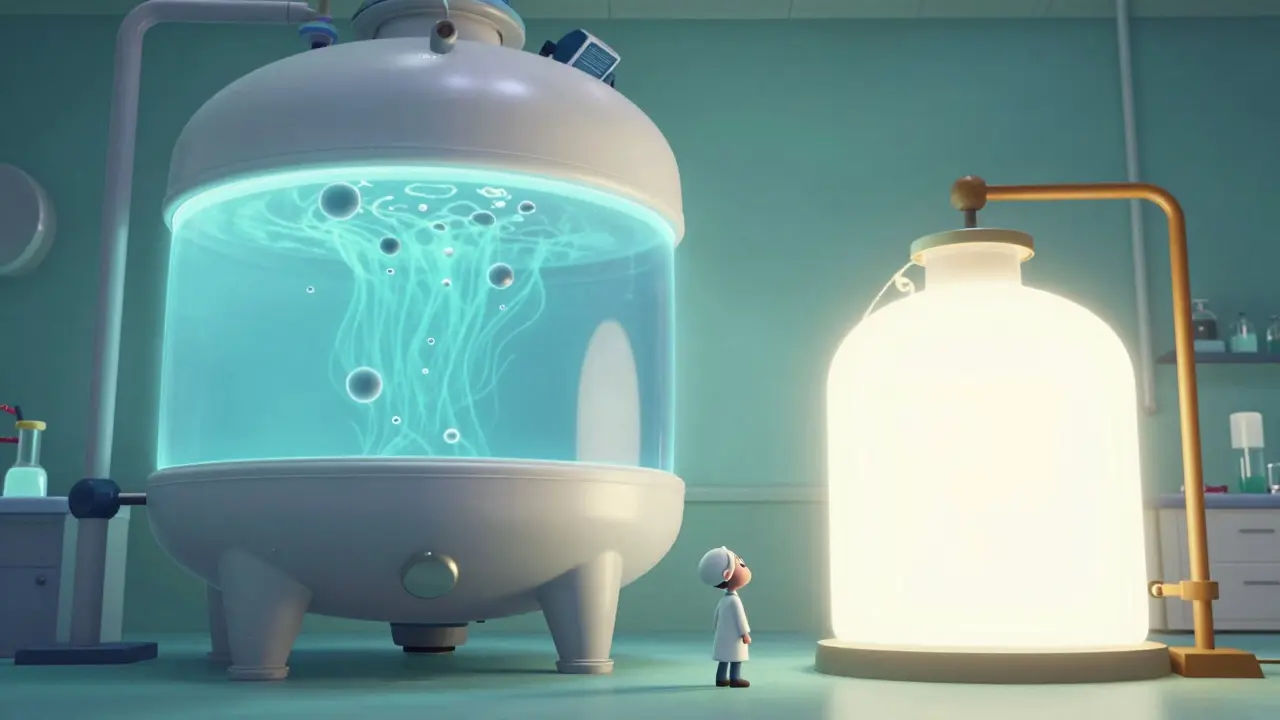
The Cold Chain Nightmare
Biosimilars don’t just need careful production - they need careful handling after. These proteins are fragile. If they get too warm, too cold, or are shaken too hard during transport, they can denature - losing their shape and function. That means every step after production - from filling vials to shipping to hospital storage - must happen in a tightly controlled cold chain. Temperature sensors, insulated containers, real-time tracking: all non-negotiable. One broken refrigerated truck can wipe out an entire batch. And because biosimilars are often used for chronic conditions like rheumatoid arthritis or cancer, a supply disruption doesn’t just cost money - it can delay life-saving treatment.Regulatory Hurdles and the Data Burden
Regulators don’t accept “it looks similar.” They demand proof. That means manufacturers must run exhaustive analytical tests - comparing over 100 critical quality attributes (CQAs) between their biosimilar and the originator product. These include protein sequence, charge variants, aggregation levels, glycosylation profiles, and biological activity. Each test requires expensive equipment and highly trained scientists. Not every lab can do this. Many biosimilar developers partner with specialized CROs (contract research organizations) just to run the required analytics. And the rules aren’t the same everywhere. The FDA, EMA, and Health Canada all have slightly different requirements. What passes in Europe might need more data in the U.S. That means manufacturers can’t just make one version and sell it globally. They often need multiple manufacturing lines or regulatory submissions - adding cost and complexity.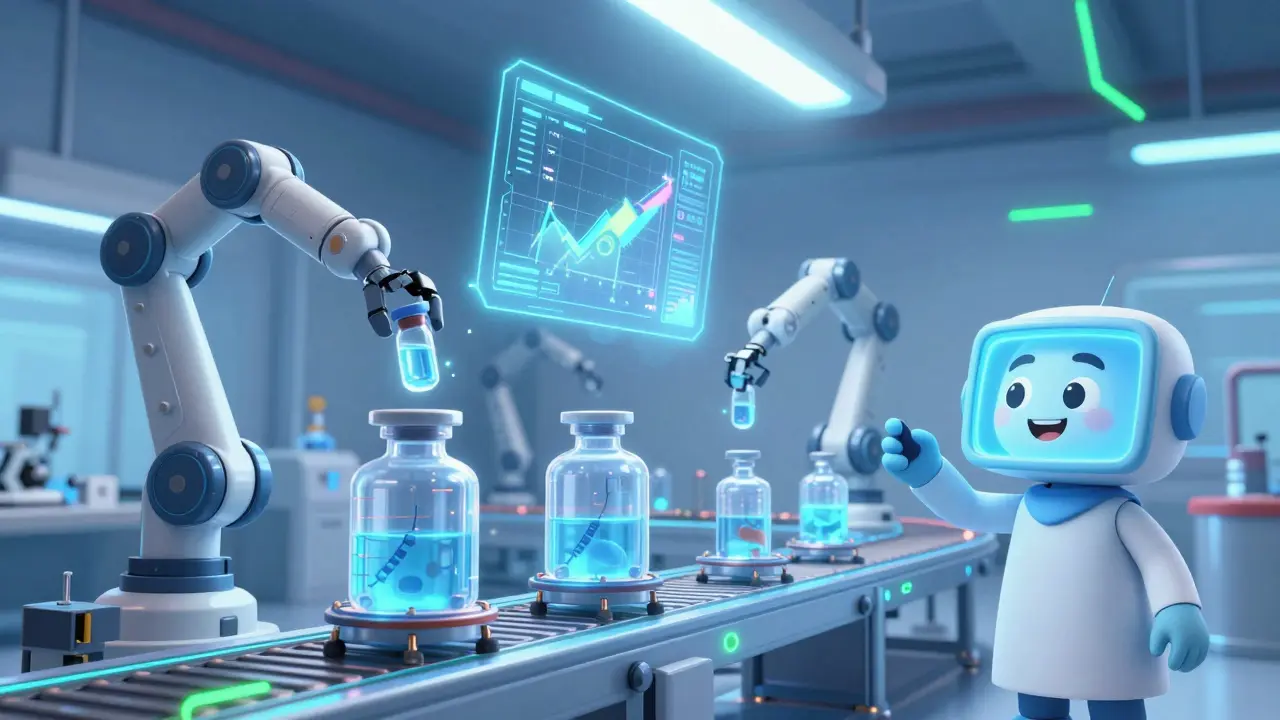
How Manufacturers Are Fighting Back
To cut through this complexity, smart manufacturers are turning to technology. Single-use bioreactors are replacing stainless steel tanks. Why? No cleaning validation. No cross-contamination risk. Faster changeovers between products. They’ve become the new standard, especially for mid-sized producers. Process analytical technology (PAT) lets companies monitor key parameters in real time - pH, dissolved oxygen, cell density - and adjust automatically. If a parameter drifts, the system corrects it before the product quality is affected. Automation reduces human error. Closed, robotic systems handle filling, labeling, and packaging. Fewer people touching the product means fewer contamination risks and less variability. And now, AI and machine learning are stepping in. Companies are feeding years of manufacturing data into algorithms that predict which process changes will cause quality issues before they happen. It’s like having a crystal ball for bioprocessing.The Market Is Growing - But Only for Those Who Can Survive
The global biosimilars market is expected to hit $58 billion by 2030. That’s huge. But only a fraction of companies will make it. Why? Because the cost to develop and manufacture a single biosimilar can exceed $100 million. The technical barriers are high. The regulatory path is long. And the margin for error is razor-thin. Smaller players are getting squeezed out. Big pharma companies with decades of biologics experience, deep pockets, and global supply chains are dominating. The ones that survive are those who treat manufacturing not as a cost center, but as their core competitive advantage.What’s Next?
The future belongs to continuous manufacturing - where the product flows through the system in real time, instead of in batches. This reduces variability, cuts production time, and improves consistency. Complex biosimilars - like antibody-drug conjugates or bispecific antibodies - will be the next frontier. These aren’t just single proteins. They’re engineered hybrids. Each one adds another layer of complexity: extra purification steps, refolding challenges, unstable linkers. But the biggest challenge won’t be technical. It’ll be staying ahead. The reference biologics they’re copying are aging. Newer ones are coming. And as patents expire, the race to launch will get fiercer. The companies that win won’t be the ones with the cheapest production. They’ll be the ones who understand that in biosimilars, every step matters.Why can’t biosimilars be exact copies like generics?
Biosimilars are made from living cells, not chemicals. These cells naturally vary in how they produce proteins - adding sugars, folding them differently, or attaching other molecules. Even tiny changes in temperature or nutrients alter the final product. Unlike generics, which replicate a fixed chemical structure, biosimilars must match a dynamic, living molecule. That’s why they’re "highly similar," not identical.
What’s the biggest manufacturing hurdle for biosimilars?
The biggest hurdle is controlling glycosylation - the sugar chains attached to the protein. These structures are extremely sensitive to production conditions and directly affect how the drug works in the body. Replicating them without knowing the originator’s exact process requires hundreds of experiments and advanced analytical tools, making it one of the most time-consuming and expensive parts of development.
Why is scale-up so difficult for biosimilars?
Moving from a small lab bioreactor to a large commercial one changes how fluids mix, how oxygen is delivered, and how heat spreads. These physical differences can alter cell behavior and protein quality. What works in a 10-liter tank might fail in a 2,000-liter one. Manufacturers must rebuild the entire process to account for these scale effects - without access to the original manufacturer’s methods.
How do regulators ensure biosimilars are safe?
Regulators require extensive testing of over 100 critical quality attributes - including protein structure, purity, glycosylation, and biological activity. Manufacturers must prove their product is nearly identical to the reference biologic through analytical, preclinical, and sometimes clinical studies. Each agency (FDA, EMA, etc.) has its own standards, so companies often need separate submissions for different markets.
Are biosimilars cheaper to make than original biologics?
Not necessarily. While biosimilars cost less to develop than new biologics, their manufacturing is still extremely complex and expensive. The cost to build a biosimilar facility can exceed $100 million. The real savings come from competition - once multiple biosimilars enter the market, prices drop. But the upfront investment remains a major barrier for new players.
What technologies are helping improve biosimilar manufacturing?
Single-use bioreactors reduce contamination and cleaning costs. Process analytical technology (PAT) monitors quality in real time. Automation minimizes human error. AI predicts process failures before they happen. These tools help manufacturers achieve tighter control, reduce batch failures, and speed up production - all critical for staying competitive.
Doreen Pachificus
January 4, 2026 AT 12:38Wow, this is way more complicated than I thought. I always assumed biosimilars were just cheaper versions of the same drug, but now I get it-they’re more like trying to clone a symphony than copying a recipe.
Allen Ye
January 4, 2026 AT 19:10It’s wild how we treat biological molecules like they’re widgets off an assembly line. But they’re not. They’re living artifacts shaped by micro-environments we barely understand. The glycosylation issue? That’s not a manufacturing flaw-it’s a metaphysical one. We’re trying to replicate a process that’s inherently chaotic, governed by cellular intuition, not engineering blueprints. And yet, we demand perfection. We want identical outcomes from inherently non-identical systems. It’s like demanding two clouds look exactly the same because they both formed over the ocean. The math doesn’t care. The cells don’t care. Only regulators and shareholders do.
Michael Rudge
January 5, 2026 AT 13:54So let me get this straight-we spend $100M to make a drug that’s ‘close enough,’ while Big Pharma charges $500K per patient for the original? And we call this capitalism? 😂
Cassie Tynan
January 6, 2026 AT 15:15Let’s be real-this whole system is a rigged game. The originators lock down their processes like state secrets, then patent the *idea* of the drug for 20 years. Meanwhile, biosimilar companies play 3D chess with sugar chains and bioreactors, just to get slapped with a ‘not similar enough’ stamp from the FDA. It’s not innovation-it’s bureaucratic torture with a side of protein folding.
Rory Corrigan
January 7, 2026 AT 17:17AI predicting bioprocess failures? That’s like giving a toddler a telescope to watch the stars… but at least they’re trying 😅
Chris Cantey
January 8, 2026 AT 12:03It’s not just the science. It’s the silence. No one talks about how many brilliant scientists burn out trying to replicate what’s deliberately obfuscated. The originators don’t just protect IP-they protect ignorance. And the biosimilar folks? They’re just trying to fix a broken system with their bare hands.
Uzoamaka Nwankpa
January 9, 2026 AT 05:57This reminds me of how our village elders used to make palm wine-every batch tasted different because of the moon, the soil, the wind. But now, we want it to taste exactly the same every time, even if we don’t know how they did it. We forget: some things are meant to be imperfect.
Jack Wernet
January 11, 2026 AT 04:25The cold chain issue is deeply underappreciated. A single refrigeration failure doesn’t just waste product-it delays treatment for patients with autoimmune diseases who rely on weekly infusions. This isn’t just a technical challenge; it’s a public health imperative. We need infrastructure investment as much as we need scientific breakthroughs.
mark etang
January 12, 2026 AT 20:07It is imperative to recognize that the development and commercialization of biosimilars represent a monumental achievement in modern biopharmaceutical science. The precision, rigor, and multidisciplinary collaboration required to achieve regulatory compliance and clinical equivalence cannot be overstated. This field demands unwavering dedication to quality, safety, and scientific integrity.
Terri Gladden
January 14, 2026 AT 04:58ok so i just read this whole thing and im crying?? like why is this so hard?? i just want my cheap medicine!! 😭😭😭 why do they have to make it so complicated??
Ethan Purser
January 14, 2026 AT 09:43You know what’s worse than the science? The fact that people still think this is about ‘saving money.’ It’s not. It’s about control. Who gets to decide what life-saving medicine looks like? The scientists? The patients? Or the shareholders who want a 40% margin? We’re not just making drugs-we’re making moral choices with every bioreactor run. And most of us don’t even know we’re voting with our prescriptions.