How to Prevent Liver Injury from Acetaminophen Combination Products
 Feb, 21 2026
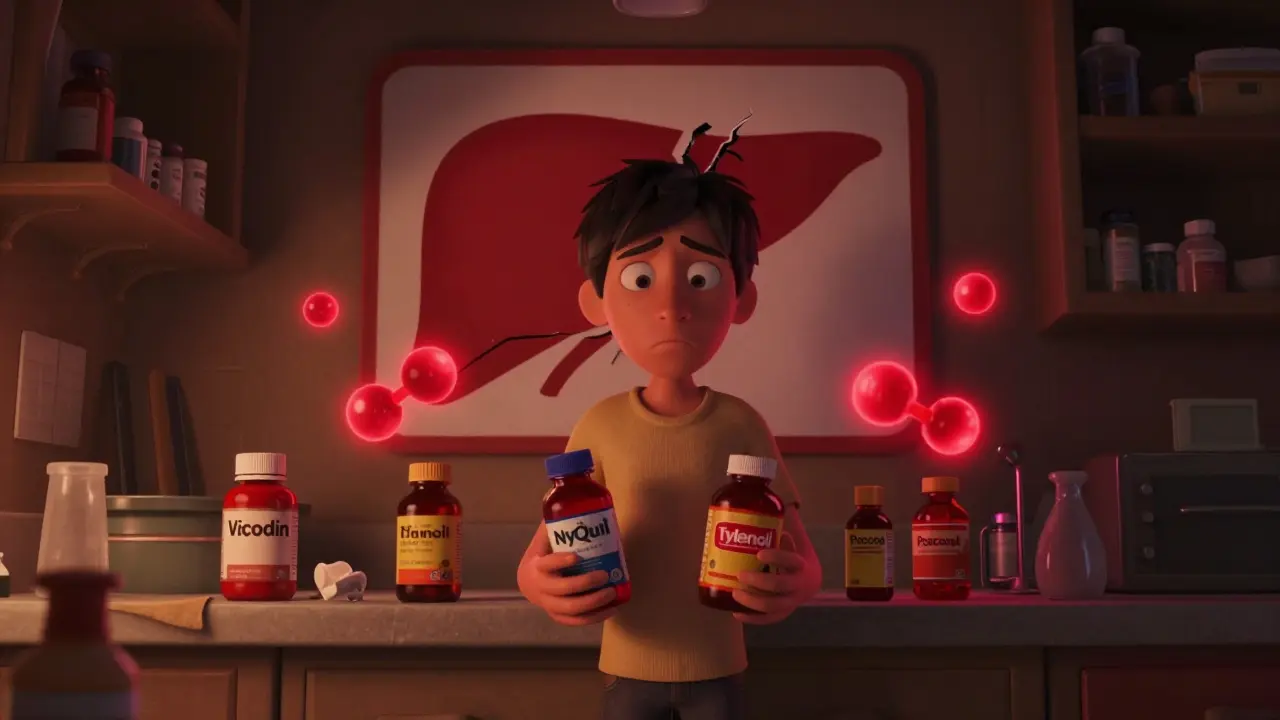
Every year, thousands of people end up in the hospital with serious liver damage-not from alcohol, not from viruses, but from a common painkiller they thought was safe: acetaminophen. The problem isn’t the drug itself. It’s how it’s used. Many people don’t realize that the pain reliever in their prescription painkiller, cold medicine, or sleep aid is the same one in Tylenol. And when you take more than one, you’re at risk of a silent, deadly overdose.
Why Combination Products Are Dangerous
Acetaminophen is often combined with opioids like hydrocodone or oxycodone in prescription painkillers such as Vicodin, Percocet, and Norco. These combinations work well for pain, but they come with a hidden trap. Patients think they’re only taking the opioid for pain relief, not realizing that each pill contains 325 mg of acetaminophen. That’s the same amount you’d find in a single Extra Strength Tylenol tablet. If someone takes two of these pills every 4 hours, they’re hitting 3,900 mg of acetaminophen in a day-close to the 4,000 mg safety limit. Add in a few extra Tylenol for a headache, and suddenly, they’re over the edge.In 2011, the U.S. Food and Drug Administration (FDA) found that acetaminophen was the top cause of acute liver failure in the country. Nearly 40% of those cases came from unintentional overdoses of combination products. Even today, studies show these products still cause about 27% of all acetaminophen-related liver injuries. And in two out of three of those cases, the person didn’t mean to overdose. They just didn’t know.
How the Body Gets Hurt
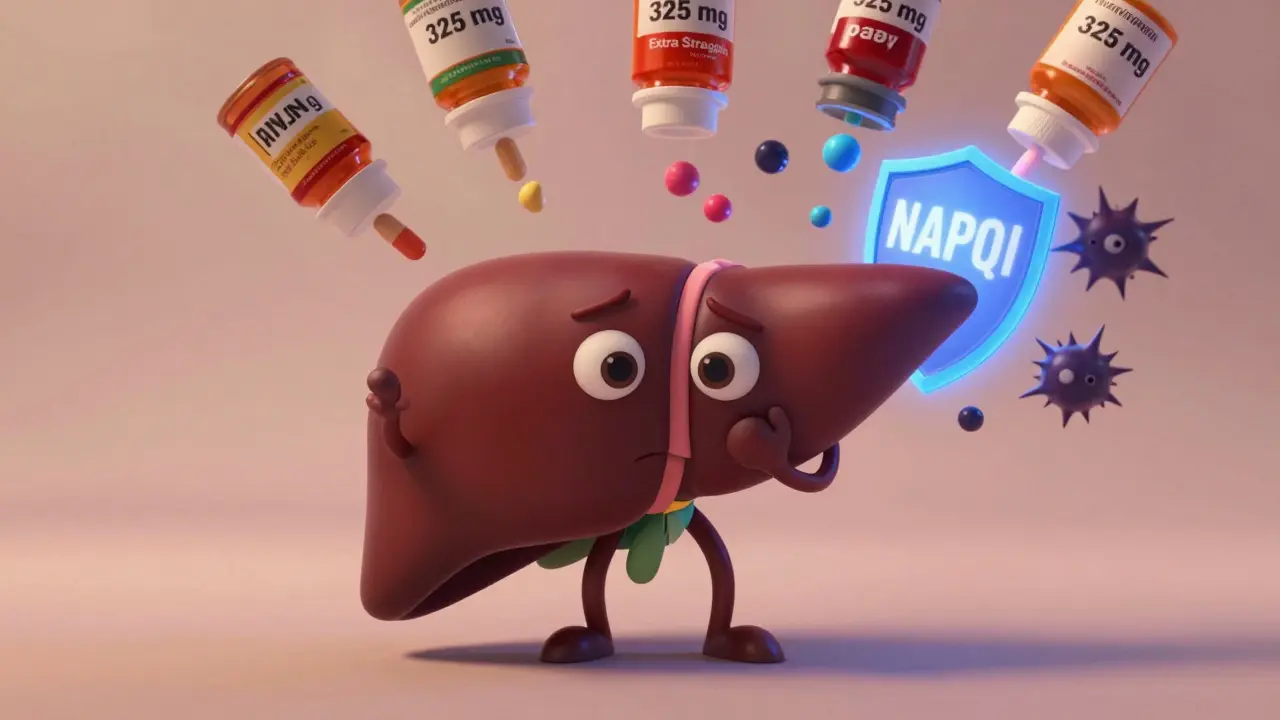
At normal doses, acetaminophen is broken down safely in the liver. Most of it gets turned into harmless waste and flushed out. But when you take too much, the liver’s backup system kicks in, producing a toxic byproduct called NAPQI. Normally, your liver has enough glutathione-a natural antioxidant-to neutralize it. But when you flood the system with acetaminophen, glutathione runs out. NAPQI starts attacking liver cells, especially the mitochondria, which power your cells. That’s when damage begins.Studies show liver injury happens when glutathione drops below 30% of normal levels. Once that happens, oxidative stress builds up, triggering a chain reaction that kills liver cells. The damage can be silent. You might feel fine for hours, even a full day, before nausea, vomiting, or jaundice shows up. By then, it’s often too late.
What’s Been Done to Fix This
In 2014, the FDA required all prescription combination products to contain no more than 325 mg of acetaminophen per dose. That cut the risk, but didn’t eliminate it. The European Medicines Agency followed suit in 2013. Packaging got better too. New bottles now have bold red warnings. Some even list the total daily acetaminophen limit right on the label.But the real problem isn’t the packaging-it’s the awareness. A 2021 Consumer Reports survey found that only 37% of people knew acetaminophen was the active ingredient in Tylenol. And only 28% knew the daily maximum was 4,000 mg. On Reddit, over 60% of users admitted they’d taken multiple acetaminophen-containing meds without realizing it. That’s not ignorance. It’s a systemic failure.
How to Protect Yourself
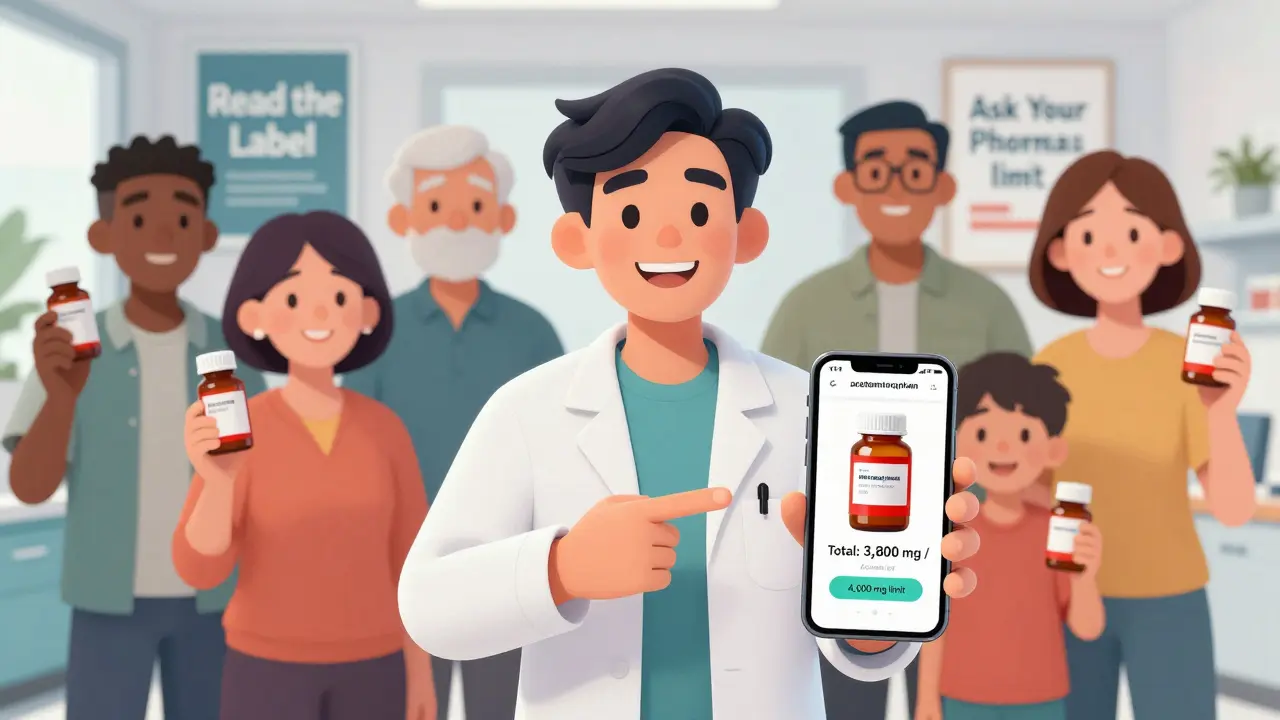
1. Always read the label. Look for “acetaminophen” on the ingredient list. It might also be listed as APAP. If you see it on any pill, tablet, or liquid, you’re taking acetaminophen. 2. Know your total daily dose. Never exceed 4,000 mg in 24 hours. If you have liver disease, drink alcohol regularly, or are underweight, cut that to 2,000-3,000 mg. Your liver doesn’t have the same buffer. 3. Don’t mix painkillers. If you’re on a prescription painkiller with acetaminophen, don’t take Tylenol, Excedrin, NyQuil, or any cold medicine unless your doctor says it’s safe. Many of these contain acetaminophen too. 4. Talk to your pharmacist. Pharmacists are trained to catch these overlaps. Ask them: “Does this medicine have acetaminophen? And what’s the total amount I’m getting from all my meds?” A 2021 study showed pharmacist counseling cut unintentional overdoses by 41%. 5. Use a medication tracker. New apps now scan barcodes on pill bottles and calculate your total acetaminophen intake. One beta-tested app from the Acetaminophen Hepatotoxicity Prevention Consortium was 89% accurate across 150 different products. If you take multiple meds, this is a game-changer.What Doctors and Pharmacists Should Do
Healthcare providers need to stop assuming patients know what’s in their pills. The CDC now recommends that electronic health records automatically track acetaminophen across all prescriptions. As of early 2023, 87% of Epic EHR systems have this feature. But it only works if doctors use it.Studies show that even after training, only 62% of patients fully understand their acetaminophen risk after a doctor’s warning. That means education has to be repeated, written down, and reinforced. Multilingual medication guides-now available in 14 languages-are helping, especially for Spanish-speaking patients, who are 2.3 times more likely to overdose due to language barriers.
What Happens If You Overdose
If you suspect an overdose-whether you took too many pills, or just feel off-get help immediately. Don’t wait for symptoms. The antidote, N-acetylcysteine (NAC), works best if given within 8 hours. It replenishes glutathione and protects liver cells. It’s given intravenously in hospitals, but oral forms are also effective.Even if you wait longer, NAC still helps. Studies show it can reduce liver damage even up to 48 hours after ingestion. A newer form, extended-release NAC tablets, now lasts 12 hours in the bloodstream instead of 4, making it easier to stick to the treatment. In late 2021, the FDA also approved fomepizole as an add-on treatment. It blocks the enzyme that turns acetaminophen into NAPQI, offering protection when liver damage is already starting.
The Bigger Picture
Prescriptions for opioid/acetaminophen combos have dropped 43% since 2010, partly because of the opioid crisis, but also because more people are learning about the liver risk. The OTC acetaminophen market is growing, but safety packaging is improving too. Sixty-five percent of OTC products now use child-resistant, dose-tracking bottles.Still, over 1,200 lawsuits have been filed against manufacturers since 2010, with $1.2 billion in settlements. That’s not just about money-it’s about accountability. And in Europe, mandatory pharmacist counseling for these products cut hospitalizations by 31% since 2017.
What’s Coming Next
Researchers are exploring new ways to prevent damage before it starts. One promising compound, emodin from rhubarb, reduced liver injury by 57% in animal studies by activating the body’s natural antioxidant defenses. Another idea: adding Nrf2-activating compounds like sulforaphane directly into combination products to create a protective buffer. But experts warn this could backfire. If people think the drug protects them, they might take more.The real solution isn’t a new ingredient. It’s better education, clearer labels, and smarter systems. Until everyone knows that “acetaminophen” is in their medicine-and how much is too much-people will keep getting hurt.
Can I take acetaminophen if I drink alcohol?
If you drink alcohol regularly, your liver’s ability to handle acetaminophen is reduced. Chronic alcohol use depletes glutathione, the liver’s main defense against acetaminophen toxicity. Experts recommend limiting acetaminophen to 2,000 mg per day if you drink alcohol daily. Avoid taking acetaminophen while drinking or within 24 hours of heavy drinking.
Is it safe to take acetaminophen for a week straight?
Taking acetaminophen for more than 10 days in a row without medical supervision increases your risk of liver damage, even if you stay under the daily limit. Long-term use can lower your body’s natural antioxidant defenses. If you need pain relief for more than 10 days, talk to your doctor. There may be safer alternatives.
Do all cold medicines contain acetaminophen?
No, but many do. Products like NyQuil, DayQuil, Theraflu, and Zicam often include acetaminophen to relieve fever and pain. Always check the “Active Ingredients” section on the label. If you see “acetaminophen” or “APAP,” it’s there. If you’re unsure, ask a pharmacist.
What should I do if I accidentally take too much acetaminophen?
Call poison control immediately (1-800-222-1222 in the U.S.) or go to the nearest emergency room. Don’t wait for symptoms. Even if you feel fine, liver damage can start without warning. Bring the medication bottles with you so doctors can see exactly what you took and how much.
Can children overdose on acetaminophen from combination products?
Yes, but not from combination products meant for adults. Pediatric formulations are different and strictly dosed by weight. However, children can accidentally ingest adult doses if medications aren’t stored safely. Always keep all medicines out of reach. Never give adult painkillers to a child, even if they seem like a smaller dose.
Anil bhardwaj
February 22, 2026 AT 13:58Been taking Tylenol for my back pain for years. Never knew it was in my cold meds too. Just took NyQuil last week for a cold and didn’t think twice. Scary stuff.
Now I check every bottle like a hawk. Learned the hard way.
lela izzani
February 24, 2026 AT 06:36This is one of those topics that should be taught in high school. Not just ‘don’t mix meds’-but *why* it’s dangerous. I work in a pharmacy and see people every day who don’t know APAP = acetaminophen. The labeling needs to be way clearer. Maybe even color-code the ingredients.
Joanna Reyes
February 25, 2026 AT 13:36I used to think if I didn’t feel sick after taking extra Tylenol, it was fine. Then my cousin ended up in the ER after taking Vicodin and NyQuil for a week straight. She didn’t even realize they had the same active ingredient. The liver doesn’t scream until it’s too late. I now use a medication tracker app-it’s dumb simple, but it saved me from accidentally overdosing last month. If you take more than one pill a day, get an app. It’s not paranoia, it’s self-preservation.
Vanessa Drummond
February 26, 2026 AT 06:40Ugh. I hate how companies hide this. They put ‘acetaminophen’ in tiny print and call it ‘APAP’ like it’s some secret code. My mom took 3 Advil Cold & Sinus last night because she ‘thought it was just for congestion.’ She’s fine now, but I almost lost it. This isn’t just ignorance-it’s corporate negligence.
William James
February 26, 2026 AT 16:56It’s wild how we treat our bodies like machines that never break down. We’ll drive 100 miles over the speed limit and call it ‘just a little extra.’ But when it comes to our liver? We treat it like it’s indestructible. It’s not. It’s quiet. It doesn’t yell. It just… stops. And then we wonder why we’re in the hospital.
Maybe we need a ‘liver awareness month.’ Or a public service ad with a liver that talks. ‘I’m not a backup battery. I’m your core.’
Haley Gumm
February 27, 2026 AT 09:42Let’s be real-this isn’t about education. It’s about profit. Companies make more money selling combo packs than plain acetaminophen. They know people won’t read labels. They count on it. The FDA’s 325mg cap? A PR move. Not a safety win.
Nerina Devi
February 28, 2026 AT 01:53I’m from India, and here, people use paracetamol (same thing) like candy. Grandmas give it to kids for fever, teens take it for headaches after parties, and no one checks the total. We need community health workers to explain this in local languages. Not just posters. Real conversations.
David McKie
March 1, 2026 AT 00:13Pathetic. People can’t even read a label? You think a warning on a bottle will stop someone who’s already popping pills like M&Ms? The real problem is that we’ve turned medicine into a free-for-all. If you can’t handle basic self-care, maybe you shouldn’t be medicating yourself at all. This isn’t a public health crisis-it’s a personal responsibility crisis.
Dinesh Dawn
March 1, 2026 AT 18:57My uncle died from this. He took his pain meds and a cold syrup because he ‘just wanted to feel better.’ He didn’t know. No one told him. The hospital said he had 48 hours to live after they found out. I still think about it every time I pick up a bottle. Don’t be like him. Check. Always check.
Nick Hamby
March 3, 2026 AT 04:18There’s a deeper philosophical layer here: we’ve outsourced our bodily awareness to pharmaceutical packaging. We trust the label more than our own intuition. But the liver doesn’t care about your trust-it only responds to chemistry. The solution isn’t just better labeling, it’s rebuilding a culture of bodily literacy. We need to teach people how to listen to their bodies, not just read their bottles.
kirti juneja
March 4, 2026 AT 18:02Y’all need to stop treating medicine like snack food. I grew up in a household where ‘if it helps, take more’ was the rule. Then I got a job at a clinic and saw the liver transplants. One girl, 22, took 12 pills over three days because she ‘felt worse.’ She didn’t know the bottle said ‘acetaminophen’ twice. Now I hand out laminated cards with the ingredients spelled out. Simple. Colorful. Can’t miss it. I call them ‘Liver Lifelines.’
Southern Indiana Paleontology Institute
March 5, 2026 AT 07:16It's not rocket science. Read the label. If you can't, don't take it. Stop blaming Big Pharma. People are lazy. And now they want apps and government fixes. Just use your brain. If you're not sure, ask a pharmacist. It's not hard. And for god's sake, don't drink and pop pills. Ever. I've seen too many dumb deaths.