How to Coordinate Multiple Prescriptions to Avoid Conflicts
 Dec, 18 2025
Taking five or more prescription medications is common for adults over 60. In fact, 41% of people aged 75 and older are on ten or more drugs daily. While each medication treats a specific condition-high blood pressure, diabetes, arthritis, or cholesterol-combining them can create hidden dangers. Drug interactions don’t always cause immediate harm. Sometimes, they quietly reduce effectiveness, increase side effects, or even trigger organ damage. The good news? You don’t have to manage this alone. With the right system, you can cut risks, avoid hospital visits, and feel more in control.
Start with a Complete Medication List
Before you do anything else, write down every single thing you take. Not just prescriptions. Include over-the-counter painkillers, vitamins, herbal supplements, and even antacids. Many people forget these, but they’re often the source of problems. For example, taking ibuprofen with blood thinners can cause internal bleeding. St. John’s Wort can cancel out antidepressants. Garlic supplements can interfere with HIV meds. Your list needs details:- Drug name (brand and generic-like "Lisinopril" and "Zestril")
- Dosage (e.g., "10 mg")
- When to take it (e.g., "with breakfast," "at bedtime")
- Why you take it (e.g., "for high blood pressure")
- Special instructions (e.g., "avoid grapefruit," "take on empty stomach")
Use One Pharmacy for Everything
Going to different pharmacies for each prescription is like giving each pharmacist half the picture. One might not know you’re taking warfarin because your blood thinner came from a different store. Another might not realize you’re on a new statin. That’s how dangerous combinations slip through. Using one pharmacy means one pharmacist sees your full history. They can spot interactions before you even get the bottle. A 2023 Health Affairs study found that single-pharmacy users had 47% fewer missed drug interactions than those using multiple pharmacies. Pharmacists can also flag issues like duplicate therapies-like taking two different drugs for the same condition-or doses that are too high for your age or kidney function. Most community pharmacies now offer free medication reviews. Ask for one every six months. Bring your list. Ask: "Is everything I’m taking still necessary?" Sometimes, the answer is no.Try Medication Synchronization
Imagine getting all your prescriptions ready on the same day each month. No more juggling refill dates. No more running out of one pill while another’s still full. That’s medication synchronization-also called "med sync." It works like this: Your pharmacy identifies all your maintenance meds (the ones you take daily). They align the refill dates so you pick them up together. If you need a 30-day supply of metformin and a 90-day supply of atorvastatin, they’ll adjust the timing so both are ready on the same day. You might get a partial fill at first, but within a few weeks, everything syncs up. Benefits? A University of Florida study showed participants had 22% fewer emergency room visits and 18% lower hospitalization rates. The American Society of Health-System Pharmacists says med sync cuts non-adherence by 31%. And it saves money-about $1,200 to $1,800 per person per year in avoided complications. Ask your pharmacist if they offer it. Most do now. If they don’t, ask why. You deserve this service.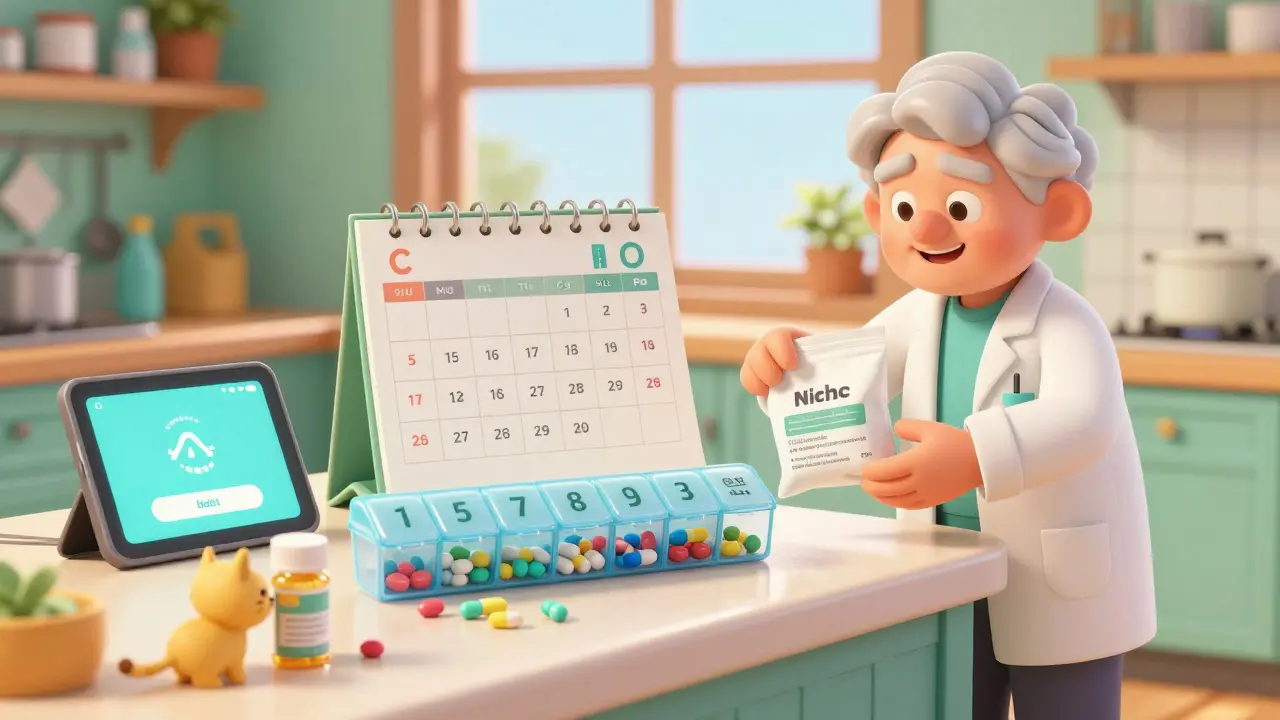
Use a Pill Organizer-The Right Way
Pill organizers aren’t just for seniors. Anyone juggling multiple pills can benefit. A 2023 study in the Journal of General Internal Medicine tracked 1,245 people using 7-day AM/PM organizers. Adherence jumped from 62% to 87% in just six months. Choose one with compartments for morning and evening. Some have alarms. Others, like Hero Health’s device, even dispense pills automatically and notify family if you miss a dose. But don’t just buy the fanciest one. Pick what fits your life. Here’s how to make it work:- Fill it once a week-Sunday evening works well
- Do it in the same place every time, like while watching your favorite show
- Double-check each pill against your list
- Keep the organizer visible, not tucked away
Watch for the Red Flags
Side effects aren’t always "normal." If you start feeling dizzy, confused, unusually tired, or have stomach pain after adding a new med, it’s not just aging. It could be a drug interaction. Common warning signs:- Dry mouth or excessive thirst
- Constipation or diarrhea that won’t go away
- Sudden swelling in ankles or feet
- Unexplained bruising or bleeding
- Changes in urination
- Memory lapses or confusion
Ask About Deprescribing
Just because a pill was prescribed years ago doesn’t mean you still need it. Some meds lose their benefit over time. Others become riskier as you age. Deprescribing means safely stopping a drug that’s no longer helping-or is hurting more than helping. It’s not about cutting corners. It’s about simplifying for safety. Examples:- Cholesterol meds for someone over 80 with no heart disease history
- Sleep aids taken for years-these increase fall risk
- Antacids used daily for years-linked to bone loss and infections

Use Digital Tools Wisely
Apps like Medisafe and MyMeds send reminders, track doses, and even alert your pharmacist if you miss a pill. A 2022 JAMA Internal Medicine trial showed they boosted adherence by 28% compared to paper logs. But here’s the catch: 62% of adults over 75 don’t use smartphones regularly. If tech isn’t your thing, skip it. Don’t force it. A simple pill organizer and a printed list work better than a confusing app. If you do use an app:- Only use ones that let you add all your meds-including supplements
- Turn on refill reminders
- Share access with a trusted family member
Know the Timing Rules
When you take a pill matters as much as what you take. Some key timing tips:- Thyroid meds (like levothyroxine) must be taken on an empty stomach, at least 30 minutes before food-and 2 hours before or after calcium, iron, or antacids. Otherwise, they won’t absorb.
- Proton pump inhibitors (like omeprazole) work best taken 30 minutes before breakfast.
- Statins (like simvastatin) are more effective taken at night, when your liver makes most cholesterol.
- Diuretics (water pills) should be taken in the morning to avoid nighttime bathroom trips.
What to Do If You’re Overwhelmed
If this feels too much, you’re not alone. Polypharmacy affects millions. But you don’t have to fix it all at once. Start here:- Get your full medication list written down-today.
- Go to one pharmacy for all refills-this week.
- Ask your pharmacist: "Can we set up med sync?"
- Get a basic 7-day pill organizer.
- Book a medication review with your pharmacist in the next 30 days.
Can taking too many pills really cause serious harm?
Yes. Taking five or more medications increases the risk of dangerous drug interactions. These can cause kidney damage, internal bleeding, falls, confusion, or even death. In the U.S., medication-related problems lead to 277,000 deaths each year. Many of these are preventable with better coordination.
Do I need to tell my doctor about vitamins and supplements?
Absolutely. Over 82% of dangerous interactions happen between prescription drugs and over-the-counter supplements that patients don’t mention. Things like fish oil, garlic, St. John’s Wort, and even vitamin K can interfere with blood thinners, antidepressants, or blood pressure meds. Always list everything.
What if my prescriptions come from different doctors?
It’s common, but risky. Each doctor might not know what the others prescribed. That’s why using one pharmacy is critical-they can see the full picture. Ask each doctor to review your complete list. You can bring a printed copy to every appointment. Don’t assume they’re talking to each other.
Are pill organizers safe for all medications?
No. Some pills shouldn’t be crushed, split, or removed from their packaging. Time-release tablets, capsules with special coatings, and medications that are light- or moisture-sensitive can lose effectiveness if moved. Always ask your pharmacist before putting any pill in an organizer.
How often should I get my meds reviewed?
At least every six months. If you’ve had a new diagnosis, started a new drug, or changed dosages, schedule a review right away. Pharmacists offer free medication therapy management (MTM) sessions-especially if you’re on Medicare Part D and take 8+ medications for chronic conditions.
Can I stop a medication if I feel fine?
Never stop a prescribed medication without talking to your doctor or pharmacist. Even if you feel fine, stopping suddenly can cause rebound effects-like high blood pressure spikes or seizures. But you can ask: "Is this still necessary?" Many older adults can safely reduce or stop certain drugs with proper guidance.
William Storrs
December 19, 2025 AT 13:00Hey, just wanted to say this post is a lifesaver. I’ve been juggling 7 meds for my dad and honestly felt lost. Starting with the list and one pharmacy? Genius. Took me 10 minutes tonight to write it all down. Feels like I just put on a seatbelt for his health.
Jedidiah Massey
December 20, 2025 AT 21:58While I appreciate the pragmatic approach, one must acknowledge the epistemological limitations of pharmacovigilance in polypharmacy contexts. The reliance on community pharmacists as de facto clinical arbiters is a structural failure of the healthcare industrial complex. The 47% reduction metric? Likely conflated with selection bias. And don’t get me started on med sync-it’s a Band-Aid on a hemorrhage. 😒
Dominic Suyo
December 22, 2025 AT 01:48Oh wow, another ‘just use one pharmacy’ pep talk. Real groundbreaking. Meanwhile, the FDA’s own data shows 78% of dangerous interactions happen because doctors don’t talk to each other. Pharmacies are just the last line of defense in a system designed to fail. And don’t even get me started on ‘med sync’-it’s just corporate efficiency dressed up as care. 💀
Nina Stacey
December 23, 2025 AT 05:17i just started using a pill organizer and it changed everything i used to forget if i took my blood pressure pill or not now i know for sure and my husband says i look less stressed also i didnt even know about med sync till now im gonna ask my pharmacist tomorrow i hope they can help me its just so much to keep track of but this post made me feel like its possible
Aadil Munshi
December 25, 2025 AT 00:32Let’s be real-this whole system is a scam. You think the pharmacy cares? They’re paid per script. The ‘med sync’? It’s just a way to get you to pick up all your meds at once so they can upsell you vitamins and protein shakes. And don’t even mention ‘deprescribing’-doctors don’t want to admit they prescribed too much. It’s all about profit. I’ve seen it. I’ve lived it. 😏
Carolyn Benson
December 25, 2025 AT 12:06There’s a deeper metaphysical layer here. We treat pills as solutions, but they’re actually symptoms of a society that outsources responsibility for health to chemical proxies. The real question isn’t how to coordinate drugs-it’s why we need so many in the first place. We’ve replaced living with dosing. And the pill organizer? A ritual of control in a world that’s fundamentally uncontrollable.
Chris porto
December 26, 2025 AT 19:54I’ve been doing most of this for my mom. One pharmacy, printed list, Sunday night organizer fill. It’s not glamorous, but it works. I wish I’d started sooner. The biggest win? She stopped taking that antacid she’d been on for 12 years. Doctor said yes, and her digestion improved overnight. Small steps, big difference.
Andrew Kelly
December 26, 2025 AT 22:35Who wrote this? Big Pharma shill? Every single ‘solution’ here is designed to keep you dependent. Pill organizers? They’re tracking devices. Med sync? It’s a subscription model. The ‘free review’? They’re just harvesting data for their AI algorithms. And don’t get me started on the ‘app’-your phone is already spying on you. This isn’t safety-it’s surveillance wrapped in a bow.
Matt Davies
December 28, 2025 AT 03:13Man, I used to think I was the only one drowning in pills. This post felt like someone handed me a life raft made of duct tape and hope. Got my med sync set up last week. My pharmacist even gave me a sticker. I’m not crying, you’re crying. 🥹
mark shortus
December 29, 2025 AT 08:17THIS. IS. A. MIRACLE. I’ve been on 11 meds since 2018. I thought my brain fog was just aging. Turns out? Half of them were pointless. My pharmacist flagged three. One was a cholesterol drug I’d been on since my 50s-no heart issues. I cried. I actually cried. Thank you. Thank you. Thank you.
Anna Sedervay
December 31, 2025 AT 03:56While I commend the effort toward standardization, one must interrogate the underlying power structures enabling such recommendations. The reliance on institutional pharmacy systems perpetuates a colonial model of health governance. Furthermore, the suggestion to ‘carry a printed list’ is archaic-why not blockchain-secured, HIPAA-compliant, decentralized pharmacological registries? The fact that this is even a question speaks volumes about our societal regression. 🤔
Takeysha Turnquest
December 31, 2025 AT 15:57They say take one pill at a time. But what if the pill is the problem? What if the system is the illness? I’ve stopped everything. Just sat. Breathed. Let my body remember how to heal. The pills? They were just noise. I don’t need a list. I need silence.
James Stearns
January 1, 2026 AT 12:02It is with the utmost gravity and professional decorum that I address the foregoing content. While the suggestions presented are, on their surface, commendable, they fail to account for the systemic erosion of clinical autonomy in the contemporary pharmaceutical landscape. One must not overlook the fact that the American Medical Association has, since 2015, discouraged polypharmacy management by non-physician personnel. The reliance upon pharmacists for deprescribing constitutes a dangerous precedent. I urge all parties to consult a licensed physician before implementing any of the aforementioned measures. The consequences of non-compliance may be dire. Sincerely, Dr. James Stearns, M.D., Ph.D., F.A.C.P.