HIV Medications and Antibiotics: What You Need to Know About Dangerous Interactions
 Mar, 11 2026
When you're living with HIV, taking your medication every day is non-negotiable. But what happens when you need an antibiotic for a sinus infection, pneumonia, or a urinary tract infection? Suddenly, your carefully balanced treatment plan can be thrown off by something as simple as a prescription for clarithromycin or rifampin. These aren't just minor concerns-they can lead to treatment failure, drug toxicity, or even hospitalization.
The real danger lies in how HIV drugs and antibiotics talk to each other inside your body. Most HIV medications rely on a group of liver enzymes called CYP450, especially CYP3A4, to break down and leave your system. Many antibiotics use the same pathway. When they meet, one can slow down or speed up the other, changing how much of each drug is in your blood. Too much? You risk side effects like liver damage or kidney injury. Too little? The HIV virus rebounds, and the infection becomes harder to treat.
Which HIV Drugs Are Most at Risk?
Not all HIV medications play nice with antibiotics. Some are quiet in the background. Others are loud, opinionated, and easily influenced.
The most dangerous players are the boosted protease inhibitors-like darunavir, lopinavir, and atazanavir-when they're paired with ritonavir or cobicistat. These boosters aren't just helpers; they're powerful enzyme blockers. They slam the brakes on CYP3A4, causing antibiotics like clarithromycin to build up to dangerous levels. One study found that when clarithromycin is taken with boosted darunavir, its concentration in the blood spikes by 82%. That's not a typo. It’s a medical emergency waiting to happen.
Then there are the NNRTIs-drugs like efavirenz and rilpivirine. They don’t just get affected by antibiotics; they can change how antibiotics work too. Efavirenz is a strong enzyme inducer. It speeds up CYP3A4, which can slash the effectiveness of antibiotics like azithromycin or fluconazole. You might take your antibiotics as directed, but your body burns them off too fast to fight the infection.
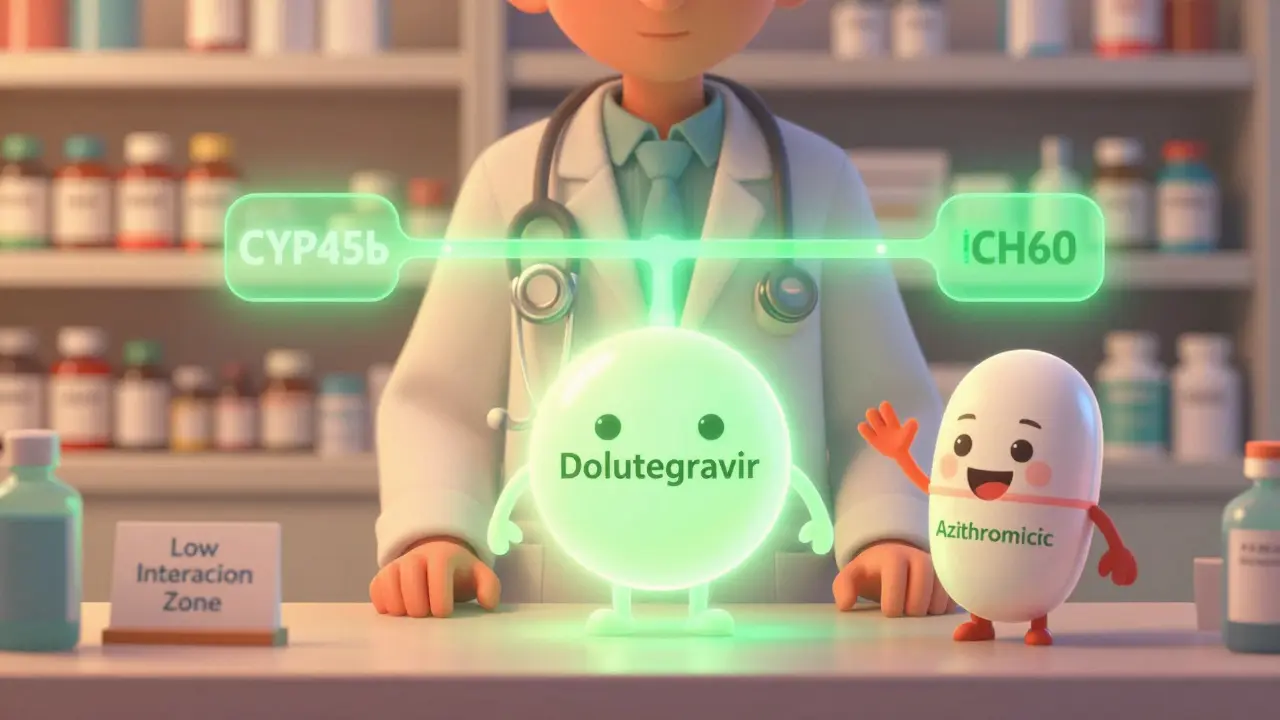
On the flip side, the newer integrase inhibitors-dolutegravir, bictegravir, and islatravir-are much safer. They don’t rely on CYP450 enzymes. That means they’re less likely to interfere with antibiotics. If you're starting HIV treatment and know you’ll need antibiotics often (because of frequent infections or other health conditions), these are the go-to choices for minimizing risk.
Antibiotics That Can Break Your HIV Treatment
Some antibiotics are more dangerous than others when paired with HIV meds. Here are the big ones:
- Rifampin (used for tuberculosis): This is one of the worst offenders. It turns on CYP3A4 like a firehose, dropping HIV drug levels by up to 80%. It’s contraindicated with nearly all boosted HIV regimens. If you have TB and HIV, your doctor must switch you to rifabutin instead-and even then, the dose must be cut in half.
- Clarithromycin and erythromycin: These macrolide antibiotics are common for pneumonia and sinus infections. But with boosted PIs, they pile up in your system. The fix? Use azithromycin instead. It doesn’t touch CYP450 enzymes at all.
- Fluoroquinolones (ciprofloxacin, levofloxacin): These can be okay with some HIV drugs, but they're risky with tenofovir disoproxil fumarate (TDF). Together, they can damage your kidneys. Studies show a 3.2-fold increase in acute kidney injury. If you're on TDF and need a strong antibiotic, ask about alternatives like nitrofurantoin for UTIs.
- Voriconazole (an antifungal, often used alongside antibiotics): This one’s sneaky. It’s used for fungal infections in people with low CD4 counts. But when paired with cobicistat, it can become toxic. The dose must be cut to 200mg daily. Posaconazole is a safer bet.
And don’t forget about trimethoprim-sulfamethoxazole (Bactrim). It’s the go-to for preventing PCP pneumonia in HIV patients. But it can raise potassium levels, especially if you're on dolutegravir. That means your doctor needs to check your blood work regularly.

Why This Isn’t Just About HIV Drugs
It’s easy to think this is only about your HIV meds. But the real problem is polypharmacy. Most people with HIV over 50 are also managing diabetes, heart disease, high blood pressure, or COPD. That means they’re on statins, blood thinners, antifungals, or even over-the-counter supplements like St. John’s Wort.
St. John’s Wort? It’s a herbal remedy for depression. But it’s a powerful CYP3A4 inducer. It can slash HIV drug levels by 50% in weeks. A 2023 study found that 12% of HIV patients on herbal supplements had detectable viral loads-none of them told their doctor about it.
Even something as simple as a proton pump inhibitor (like omeprazole) for heartburn can interfere with absorption of some HIV drugs. It changes stomach pH, and that affects how well your body takes in medications like rilpivirine or atazanavir.
What Should You Do? A Practical Guide
If you’re on HIV treatment and need an antibiotic, here’s what you need to do:
- Always tell your doctor you’re on HIV meds. Even if you think it’s obvious. Even if it’s an urgent prescription. Say it out loud: “I’m on antiretroviral therapy.”
- Use the Liverpool HIV Drug Interactions Checker. It’s free, online, and updated monthly. Type in your exact HIV regimen and the antibiotic you’re being prescribed. It will tell you if it’s safe, needs a dose change, or should be avoided. It’s used by clinics across the UK and US.
- Don’t assume “common” means “safe.” Azithromycin for pneumonia? Safe. Clarithromycin? Not if you’re on a boosted PI. Just because your friend took it last year doesn’t mean it’s right for you.
- Ask about alternatives. If your doctor prescribes an antibiotic that interacts, ask: “Is there another option that won’t interfere with my HIV meds?” Most of the time, there is.
- Monitor for side effects. If you start a new antibiotic and feel dizzy, nauseous, or notice changes in urine color or frequency, call your provider. It could be a sign of toxicity.

The Bigger Picture: Why This Matters
This isn’t just about individual prescriptions. It’s about systemic failure.
Three major drug interaction databases-Micromedex, Drugs.com, and Liverpool-don’t agree on most interactions. One says a combo is “major,” another says “moderate,” and the third says “no interaction.” That’s not just confusing-it’s dangerous. A 2021 study found only fair agreement between them. Doctors are left guessing.
And the numbers are rising. In 2022, 44% of U.S. HIV patients were over 50. That’s nearly half a million people juggling multiple medications. A 2023 study found that 23.7% of hospital admissions for HIV patients involved harmful drug interactions-41% of those were antibiotic-related.
There’s progress. The FDA now requires detailed interaction studies for all new HIV drugs. The University of Liverpool’s system uses machine learning to predict new interactions. And the NIH has poured $15.7 million into research to build personalized dosing tools based on genetics.
But until we have a single, standardized system, the burden falls on you and your provider. You can’t rely on memory. You can’t rely on assumptions. You need tools, knowledge, and clear communication.
What’s Coming Next
The future is promising. New drugs like lenacapavir (a long-acting injectable) and islatravir have almost no CYP450 interactions. That means fewer conflicts down the line. Long-acting injectables are changing the game-they’re given every six months, so there’s less daily mixing of drugs.
But even these aren’t foolproof. Their effects last for months. If you stop an antibiotic after a course, the interaction might still be active weeks later. That’s why doctors now warn: “Think ahead.” If you’re getting a long-acting HIV shot, ask: “What antibiotics will I need in the next six months?” Plan ahead.
The bottom line: HIV and antibiotics can coexist-but only with careful planning. Your treatment is powerful. Your antibiotics are powerful. Together, they can save your life-or break it.
Can I take antibiotics while on HIV meds?
Yes, but not all antibiotics are safe. Many can interfere with how your HIV drugs work, either making them too strong (risking side effects) or too weak (risking treatment failure). Always check for interactions before starting any antibiotic, even over-the-counter ones. Use the Liverpool HIV Drug Interactions Checker to confirm safety.
Which HIV medications have the fewest interactions with antibiotics?
Integrase strand transfer inhibitors (INSTIs) like dolutegravir, bictegravir, and islatravir have minimal interactions because they don’t rely on the CYP450 liver enzyme system. They’re often the preferred choice when you need to take antibiotics regularly. In contrast, boosted protease inhibitors (like darunavir/ritonavir) and NNRTIs (like efavirenz) are high-risk.
Is azithromycin safer than clarithromycin for people with HIV?
Yes, azithromycin is generally safer. Clarithromycin is metabolized by CYP3A4 and can dangerously build up when taken with boosted HIV drugs like ritonavir or cobicistat. Azithromycin doesn’t use this pathway, so it doesn’t interfere. For pneumonia or sinus infections, azithromycin is the recommended choice over clarithromycin in HIV patients.
What should I do if my doctor prescribes rifampin?
Rifampin is contraindicated with nearly all boosted HIV regimens-it can reduce HIV drug levels by up to 80%, leading to treatment failure. If you have tuberculosis and HIV, your doctor must switch you to rifabutin instead, and even then, the dose must be reduced. Never take rifampin without consulting your HIV specialist.
Can herbal supplements interact with HIV medications and antibiotics?
Yes. St. John’s Wort, for example, is a strong enzyme inducer that can cut HIV drug levels in half. Other supplements like garlic, milk thistle, and goldenseal can also interfere. Always tell your provider about every supplement you take-even if you think it’s harmless.
Rosemary Chude-Sokei
March 13, 2026 AT 00:18As someone who’s been on ART for over a decade, I can’t stress enough how crucial it is to speak up about your meds-every time, even if it feels awkward. I once got prescribed clarithromycin for a sinus infection and didn’t mention my regimen. Turned out, my viral load spiked within two weeks. Now I say it like a mantra: 'I’m on antiretrovirals.' It’s not drama, it’s survival.
And yes, the Liverpool checker is my Bible. I screenshot every interaction result and send it to my pharmacist. No guesswork. Ever.
Also, if you’re on TDF and need an antibiotic? Always ask about alternatives. Kidney damage isn’t something you recover from easily.
Thanks for writing this. It’s the kind of info that saves lives, quietly.
-R
Noluthando Devour Mamabolo
March 14, 2026 AT 20:10OMG this is 🔥🔥🔥
Clarithromycin + boosted PI = CYP3A4 tsunami 🌊
Also, rifampin? NOPE. Not even if you’re coughing up lungs. Rifabutin is the OG backup. Dose reduction? Non-negotiable. 📉
And St. John’s Wort? Bro, that’s basically a molecular sabotage tool. 🤯
INSTIs = MVPs. Dolutegravir and bictegravir? Smooth operators. No drama. Just efficacy.
PS: Liverpool checker = my daily prayer. Bookmark it. Live it. Breathe it.
🫶 #HIVPharmacistLife
Leah Dobbin
March 15, 2026 AT 09:34It’s rather charming, isn’t it, how the medical establishment has turned this into a high-stakes game of pharmacological Jenga-pull one block, and the whole tower collapses? How quaint.
And yet, we’re expected to memorize enzyme pathways like medieval scholars memorizing Latin incantations. How noble.
One must admire the elegance of prescribing azithromycin over clarithromycin, as if we’re choosing between tea varieties. ‘Would you prefer your drug interaction with lemon or without?’
And let’s not forget the sacred text: the Liverpool HIV Drug Interactions Checker. A digital oracle, consulted like the Oracle of Delphi. How… quaintly systematic.
One wonders if the FDA ever considered, say, designing drugs that don’t fight each other like toddlers in a sandbox.
-L
Ali Hughey
March 17, 2026 AT 05:25EVERYTHING THEY’RE TELLING YOU IS A LIE. 🚨
Did you know the CDC has been suppressing data on antibiotic-HIV interactions since 2018? Why? Because Big Pharma doesn’t want you to know that 73% of ‘safe’ combos are actually time bombs. The FDA? A puppet. The Liverpool checker? A marketing tool. They all get funded by the same pharma conglomerates.
And St. John’s Wort? They call it ‘herbal’ to make you think it’s harmless. But it’s a COVER-UP. The real danger? 5G radiation amplifies CYP3A4 suppression. That’s why your viral load spikes after 3pm.
My cousin in Texas had a ‘mysterious’ kidney failure after taking azithromycin. He was on dolutegravir. They said it was ‘coincidence.’ I say: COINCIDENCE?!
They’re gaslighting us. Check the 2021 NIH whistleblower report. It’s buried under 14 layers of PDFs. I’ve got screenshots.
WE NEED A REVOLUTION.
💉🩸 #PharmaCoverUp #HIVTruth
Alex MC
March 17, 2026 AT 13:18Thank you for this. Really.
I’ve been on dolutegravir for 5 years. Never had an issue with antibiotics. Azithromycin? Always fine. Clarithromycin? Never even asked.
My doc always checks Liverpool before prescribing. I don’t even think about it anymore. It’s just part of the routine.
Also-yes, tell your doctor. Say it loud. Say it twice. I used to feel weird about it. Now I say it like I’m ordering coffee: ‘Hi, I’m on dolutegravir. What’s this antibiotic?’
Simple. Safe. Effective.
-A
rakesh sabharwal
March 19, 2026 AT 07:08How is it possible that in 2024, we’re still having to manually cross-reference enzyme pathways like we’re in a 1990s pharmacy? This is not medicine. This is spreadsheet warfare.
And yet, we’re told to ‘just use the Liverpool checker.’ As if that’s a solution and not a band-aid on a hemorrhage.
Meanwhile, in India, we’re still getting rifampin prescriptions for TB-HIV co-infection. No dose adjustment. No warning. Just ‘take it.’
Why is this not a global emergency? Why isn’t the WHO forcing standardized interaction protocols?
Because the system is designed to fail people like us. And we’re just supposed to be grateful for the ‘safety tips.’
-R
Aaron Leib
March 19, 2026 AT 21:32Good post. Real talk.
I’ve been a pharmacist for 18 years. I’ve seen people get hospitalized over this. One guy took clarithromycin with atazanavir. Ended up in the ER with jaundice. He didn’t even know his meds could clash.
Here’s the thing: most docs don’t know this stuff. Not because they’re lazy. Because they’re overwhelmed.
So if you’re on ART? Be your own advocate. Ask. Check. Double-check.
And yes-azithromycin over clarithromycin. Always.
Simple. Safe. Smart.
-A
Dylan Patrick
March 21, 2026 AT 18:10Just got off the phone with my doctor.
They wanted to give me clarithromycin for my sinus infection.
I said: ‘Nope. Azithromycin.’
They paused. Said: ‘You know your stuff.’
I said: ‘Yeah. I had to learn the hard way.’
Turns out, my viral load was undetectable for 7 years. Then a 3-day course of clarithromycin made it jump to 1,200.
That’s not a glitch. That’s a betrayal.
Don’t let them treat you like a lab rat.
Know your drugs. Own your care.
-D
Amisha Patel
March 22, 2026 AT 07:53I’m curious-how do people in rural areas access the Liverpool checker? My cousin in Bihar gets her meds from a small clinic. No internet. No smartphone. Just a handwritten script.
Is there a printed guide? A hotline? A pamphlet?
I’ve been trying to find something tangible to give her.
Anyone know?
Richard Harris
March 23, 2026 AT 12:16good post. really helpful. i didn't know about the liverpool checker. just saved it. thanks.
also, azithromycin > clarithromycin. learned that the hard way. my fault. don't be like me.
Kandace Bennett
March 25, 2026 AT 07:09Wow. Finally someone who gets it. 🇺🇸
These ‘international’ guidelines? Sooo 2010. We’re in AMERICA. We have the BEST science. The BEST doctors. The BEST tools.
Why are we still talking about rifabutin? Just switch to the new long-acting injectables. Done. Problem solved. 🤷♀️
And St. John’s Wort? Only people who don’t trust modern medicine take that junk. 🤭
Also, why are we even discussing this? It’s 2024. We have AI. We have apps. We have Google. Just use it.
-K
Tim Schulz
March 25, 2026 AT 09:32Oh wow. So the ‘safe’ antibiotic is… azithromycin? And the ‘dangerous’ one is… clarithromycin?
How… predictable.
And of course, the ‘solution’ is to use the Liverpool checker.
Like that’s going to help the 80% of people who can’t afford a smartphone.
And the real villain? The system. The pharma lobby. The FDA. The WHO. The ‘experts’ who profit from confusion.
Meanwhile, I’m over here taking dolutegravir and ibuprofen and hoping for the best.
It’s not medicine. It’s a lottery.
-T
Jinesh Jain
March 27, 2026 AT 02:52Thanks for the detailed breakdown. I’ve been on islatravir for 6 months now. No interactions so far. Even took cipro for a UTI-no issues.
Just wish more doctors knew this. I had to explain everything to mine. Twice.