Blood Pressure Targets: 120/80 vs. Individualized Goals
 Jun, 3 2026
Your blood pressure number is more than just a statistic on a medical chart; it is one of the most powerful predictors of your long-term heart and kidney health. Yet, if you have visited different doctors or read recent medical news, you might feel confused. One doctor says you need to be under 130/80 mm Hg, while another suggests that 140/90 mm Hg is perfectly fine for someone your age. This isn't just bureaucratic disagreement-it represents a fundamental shift in how we treat hypertension a chronic condition characterized by persistently elevated arterial blood pressure. With major organizations releasing updated guidelines in 2025, understanding which target applies to you is critical for avoiding both stroke risk and unnecessary medication side effects.
The Great Divide: Uniform Low Targets vs. Conservative Approaches
The core of the debate lies in two competing philosophies. On one side, you have the aggressive approach championed by the American Heart Association (AHA) a national nonprofit organization dedicated to fighting heart disease and stroke and the American College of Cardiology (ACC) a professional association representing cardiologists and cardiac surgeons. Their 2025 guideline update recommends a systolic blood pressure target below 130 mm Hg for all adults with hypertension, encouraging levels below 120 mm Hg when feasible. They argue that high blood pressure is the most common modifiable risk factor for heart disease, and lowering it universally saves lives.
On the other side stands the American Academy of Family Physicians (AAFP) the largest family medicine organization in the United States. In their December 2022 systematic review, they recommended a primary target of 140/90 mm Hg. Their reasoning is practical: lower targets offer similar reductions in mortality but come with significantly more adverse effects, such as dizziness, fainting, and kidney strain. For many patients, especially older adults, the risk of falling due to low blood pressure outweighs the marginal benefit of squeezing those last few millimeters of mercury out of their readings.
This divide creates a real-world dilemma. If you are 75 years old with stable hypertension, does chasing a 120 systolic reading protect your brain from dementia, or does it increase your chance of breaking a hip after a fall? The answer depends entirely on which guideline your provider follows and how well they individualize your care.
Global Perspectives: Japan and Europe Join the Conversation
The controversy isn't limited to the United States. International guidelines add further nuance to the discussion. The Japanese Society of Hypertension (JSH) the leading professional body for hypertension management in Japan released its 2025 guidelines (JSH2025) in January, taking a surprisingly uniform stance. They recommend a single target of <130/80 mm Hg for all hypertensive patients, regardless of age or comorbidities. This marks a sharp departure from their previous leniency for patients over 75. The JSH bases this on meta-analyses showing that each 5-mmHg reduction in systolic pressure lowers major cardiovascular event risk by approximately 10%, even in older populations up to age 84.
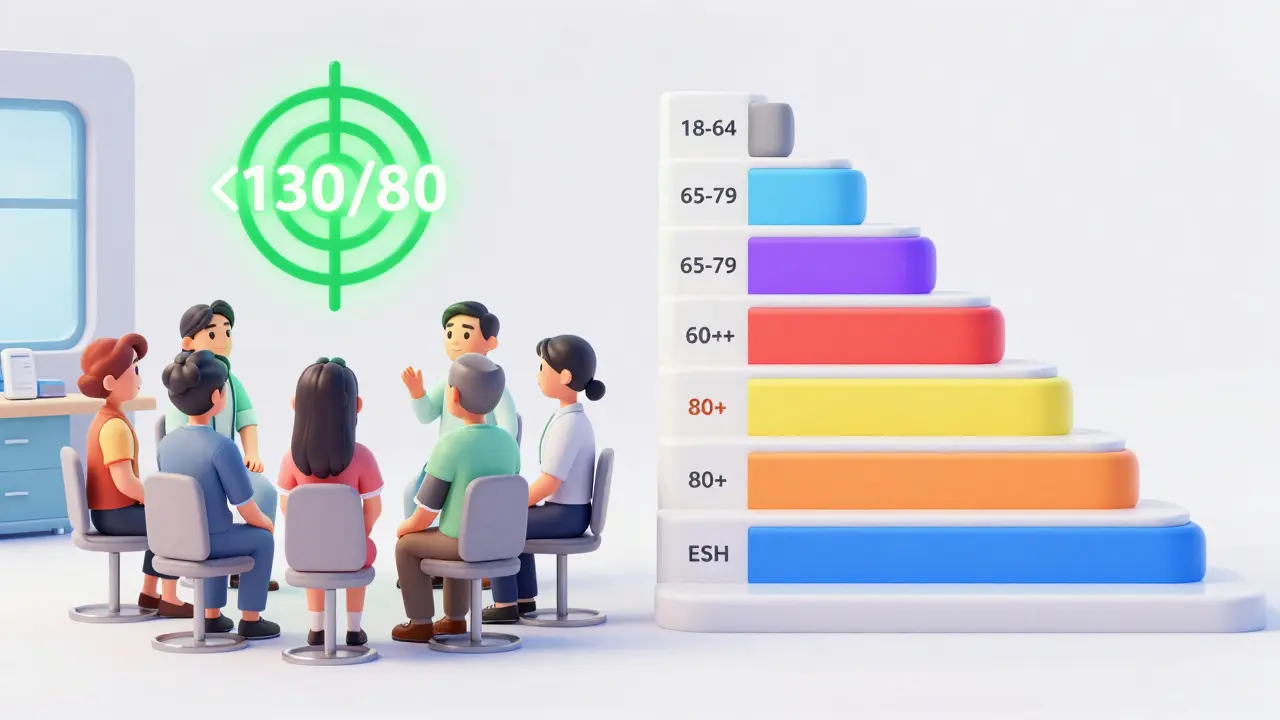
In contrast, the European Society of Hypertension (ESH) a European scientific society focused on the prevention and treatment of hypertension adopts a tiered, age-based approach. They recommend 120-129/70-79 mm Hg for adults aged 18-64, 130-139 mm Hg for those aged 65-79, and 140-150 mm Hg for those aged 80 and older. This middle ground acknowledges that younger bodies tolerate aggressive treatment better than older ones, offering a pragmatic compromise between the AHA’s aggressiveness and the AAFP’s conservatism.
| Organization | Primary Target | Key Philosophy | Risk Focus |
|---|---|---|---|
| AHA/ACC (USA) | <130/80 mm Hg (aim for <120) | Aggressive reduction prevents events | Cardiovascular mortality |
| AAFP (USA) | 140/90 mm Hg | Minimize harm and medication burden | Adverse drug events/falls |
| JSH (Japan) | <130/80 mm Hg (Universal) | Uniform benefit across all ages | Stroke and heart failure |
| ESH (Europe) | Age-dependent (120-150 range) | Tailored to physiological tolerance | Quality of life + longevity |
Understanding the Evidence: SPRINT and Beyond
To understand why these guidelines differ, you must look at the data they interpret. The AHA/ACC heavily relies on the SPRINT trial Systolic Blood Pressure Intervention Trial, a landmark study published in 2015. This study involved 9,361 participants and found that targeting systolic blood pressure below 120 mm Hg reduced fatal and nonfatal major cardiovascular events by 25% compared to a target of 140 mm Hg. It also showed a 27% reduction in overall mortality. These numbers are compelling enough to drive aggressive treatment protocols.
However, critics point out that the SPRINT population was highly selected. Patients with diabetes were excluded, as were those with a high risk of falls. This means the trial did not reflect the typical primary care patient, who often has multiple conditions. The AAFP cites multicenter trials with over 8,500 participants that showed similar mortality outcomes between lower and standard targets, but with a higher "number needed to harm" (NNH). Specifically, the AAFP notes an NNH of 33 over 3.7 years for adverse events like syncope (fainting) and hypotension. In plain English, for every 33 people treated aggressively to lower their BP, one person experienced significant negative side effects without gaining extra survival benefit.
Risk Stratification: Who Needs Lower Numbers?
Not everyone fits into a single box. Modern guidelines increasingly use risk calculators to determine intensity. The AHA/ACC 2025 guidelines utilize the PREVENT risk score Predicting Risk of CVD EVENTs, a tool to estimate 10-year cardiovascular risk. If your blood pressure is ≥130/80 mm Hg and you have established cardiovascular disease, diabetes, chronic kidney disease, or a PREVENT score ≥7.5%, medication is strongly recommended. For low-risk stage 1 hypertension patients (130-139/80-89 mm Hg) with no other conditions, lifestyle changes alone may suffice initially.
This stratification is crucial. A 45-year-old smoker with high cholesterol needs a much stricter target than a 45-year-old athlete with slightly elevated readings due to stress. The concept of individualized goals tailoring blood pressure targets based on patient-specific factors like age, comorbidities, and tolerance bridges the gap between rigid guidelines. It allows doctors to say, "Your number is 135/85, but because you are healthy otherwise, we will watch it closely rather than immediately prescribing three drugs."

Implementation Challenges: Medications and Monitoring
Achieving lower targets is not free-either financially or physiologically. The AAFP emphasizes that meeting targets below 130/80 mm Hg often requires an average of one additional medication. This increases cost, pill burden, and the complexity of regimens. To combat adherence issues, the AHA/ACC recommends initiating two first-line antihypertensive agents in a single-pill, fixed-dose combination for stage 2 hypertension. This simplifies the routine but still exposes the patient to more pharmacological intervention.
Monitoring becomes equally important. The JSH2025 guidelines mandate careful monitoring for adverse events, particularly symptomatic hypotension (dizziness, lightheadedness) and acute kidney injury. This requires more frequent office visits and laboratory testing. For patients living far from healthcare centers or those with limited mobility, this intensive monitoring can be a barrier to following aggressive guidelines. Shared decision-making is therefore not just a buzzword; it is a clinical necessity. You and your doctor must weigh the inconvenience and side effects against the statistical reduction in stroke risk.
Future Directions: Personalized Medicine and New Trials
The debate is far from over. In March 2025, the National Institutes of Health (NIH) announced the SPRINT-2 trial a new multi-center study funded through 2028 to evaluate intensive blood pressure control in diverse populations. Unlike the original SPRINT, this trial will include patients with diabetes and higher fall risks, providing data that reflects real-world primary care. Results are expected to clarify whether aggressive targets are safe for broader populations.
Additionally, emerging research explores machine learning algorithms that integrate genetic markers, biomarkers, and social determinants of health. The goal is to predict individual responses to different blood pressure targets. Imagine a future where your DNA tells your doctor exactly how low your blood pressure should go before the harms outweigh the benefits. Until then, the best approach remains a collaborative one. Understand your baseline, know your risk factors, and ask your provider: "Is my target set to save my life, or just to hit a number?"
What is the ideal blood pressure target for a healthy adult under 60?
Most guidelines, including the AHA/ACC 2025 and ESH, recommend a target below 130/80 mm Hg for healthy adults under 60. Some experts encourage aiming for 120/80 mm Hg if achievable without side effects, as this provides optimal long-term cardiovascular protection.
Why do some doctors prefer a target of 140/90 mm Hg?
The AAFP supports 140/90 mm Hg because studies show it reduces mortality similarly to lower targets but with fewer adverse effects like dizziness, falls, and kidney strain. This approach prioritizes quality of life and minimizes medication burden, especially for older adults.
Does age change my blood pressure goal?
Yes, depending on the guideline. The European Society of Hypertension raises targets for those over 65 and 80. However, the Japanese Society of Hypertension (2025) maintains a universal <130/80 mm Hg target for all ages. Your doctor will consider your fall risk and overall frailty when deciding.
What is the PREVENT risk score?
The PREVENT score is a calculator used by the AHA/ACC to estimate your 10-year risk of cardiovascular disease. It helps determine if you need medication for stage 1 hypertension. A score of 7.5% or higher typically triggers a recommendation for drug therapy alongside lifestyle changes.
Are there risks to lowering blood pressure too much?
Yes. Excessively low blood pressure can cause symptomatic hypotension, leading to dizziness, fainting (syncope), and increased fall risk. It can also reduce blood flow to kidneys, potentially causing acute kidney injury. Careful monitoring is essential when targeting very low numbers.
How does the SPRINT trial influence current guidelines?
The SPRINT trial showed that targeting systolic BP <120 mm Hg significantly reduced cardiovascular events and death compared to <140 mm Hg. This evidence drives the aggressive recommendations of the AHA/ACC and JSH, though critics note its exclusion of diabetic and fall-prone patients.
What is the difference between Stage 1 and Stage 2 hypertension?
Stage 1 hypertension is defined as 130-139/80-89 mm Hg, while Stage 2 is ≥140/≥90 mm Hg. Stage 2 usually requires immediate medication, often two drugs in combination. Stage 1 may start with lifestyle changes unless other risk factors are present.