TSA Guidelines for Flying with Prescription Medications: What You Need to Know in 2025
 Dec, 5 2025
When you’re flying with prescription medications, the last thing you want is to get held up at security because your pills don’t look right or your liquid insulin gets flagged. You’re not alone. Nearly 70% of U.S. adults take at least one prescription drug, and many of them fly regularly - for work, family, or medical care. The TSA doesn’t want to stop you. They just need to know what you’re carrying. Here’s how to make it smooth, legal, and stress-free.
Prescription Medications Are Allowed - No Limits
The TSA lets you bring as much prescription medication as you need, no matter the form. Pills, liquids, creams, patches, inhalers, injectables - all are allowed in your carry-on. That includes insulin pens, nebulizer solutions, eye drops, and even topical creams for eczema or psoriasis. Unlike the 3-1-1 liquid rule that limits toiletries to 3.4 ounces in a quart-sized bag, medications are completely exempt. You don’t have to fit them in that bag. You don’t have to limit the amount. You can bring a week’s supply or a month’s - it doesn’t matter.
But here’s the catch: you still have to declare them. When you get to the security checkpoint, tell the TSA officer you have medication. If it’s liquid, remove it from your bag so they can see it clearly. They won’t always ask, but if they do, be ready. Most of the time, they’ll just wave it through. But if they’re unsure, they might swab it for testing or ask for a label. Don’t panic. That’s normal.
You Don’t Need Original Bottles - But It Helps
TSA doesn’t require your meds to be in their original pharmacy bottles. That’s a common myth. You can transfer pills to a pill organizer, put liquids in travel-sized containers, or carry patches in a small case. But here’s the real advice: keep them labeled if you can.
Why? Because 78% of delays at security in 2023 happened because the name on the bottle didn’t match the name on your ID. Even a missing middle initial or a typo can cause a 10-minute hold-up. If you’re using a pill organizer, bring a copy of your prescription or a note from your doctor. It’s not required, but it saves time. If you’re flying internationally, this becomes even more critical. Some countries treat even common U.S. prescriptions like Adderall or Xanax as illegal drugs. A doctor’s letter can prevent arrest or deportation.
Never Pack Medications in Checked Luggage
United Airlines, Delta, American, and every major U.S. carrier now strongly recommend - and many require - that you keep all medications in your carry-on. Why? Because checked bags get lost, stolen, or damaged. In 2022, a passenger’s life-saving insulin was destroyed when their bag was mishandled. That’s not hypothetical. It happened. And it could happen to you.
Even if you don’t think you’ll need your meds during the flight, keep them with you. Time zones change. Delays happen. Your flight might land at 3 a.m. and your next dose is due at 4 a.m. If your bag is stuck in Atlanta, you’re out of luck. Carry-on is your safety net.
CBD and THC Products Are a Minefield
This is where things get messy. If you’re bringing CBD oil, gummies, or topical creams, check the label. If it contains more than 0.3% THC, it’s illegal under federal law - no exceptions. That’s true even if it’s legal in your state, even if your doctor prescribed it, even if the bottle says “hemp-derived.” TSA follows federal law, not state law.
And here’s the kicker: TSA officers aren’t trained to test THC levels. They see a bottle labeled “CBD oil” and they don’t know if it’s compliant. So they confiscate it. In 2023, over 14,000 CBD products were seized - and later found to be legal. That’s not a mistake. That’s a system gap. The Government Accountability Office confirmed it. If you’re traveling with CBD, bring proof: a certificate of analysis (COA) showing the THC content is below 0.3%. Even then, be prepared for delays. Some officers just say no.
International Travel? Check Before You Go
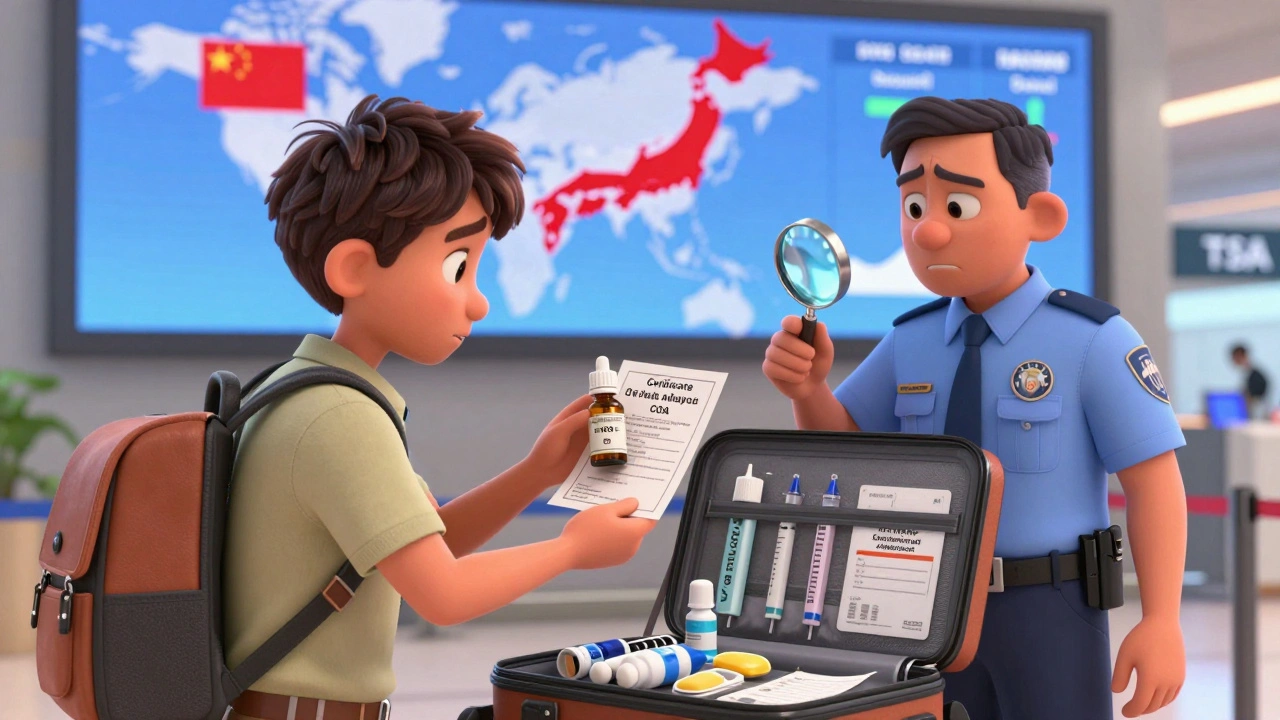
Flying to Japan? Don’t bring Adderall. It’s a controlled substance there. Going to Dubai? Even small amounts of codeine or melatonin can get you arrested. The U.S. State Department and CDC warn travelers every year: what’s legal at home might be a felony abroad.
Before you book your flight, check the rules of your destination country. The TSA’s app now includes a link to the IAMAT database, which lists medication restrictions in over 200 countries. You can also check the U.S. Embassy website for your destination. If you’re carrying a controlled substance - anything with a DEA schedule (II through V) - get a letter from your doctor. It should list the medication, dosage, reason for use, and your doctor’s contact info. Some countries require this in advance.
Also, don’t bring more than a 90-day supply unless you have special permission. Customs and Border Protection may question large quantities, even if they’re yours. If you’re moving abroad or staying long-term, you’ll need to apply for a medical import permit - but that’s a whole other process.
Medical Devices: Insulin Pumps, CGMs, and More
If you use an insulin pump, continuous glucose monitor (CGM), or other medical device, you can bring it through security. TSA allows these devices in carry-on luggage and won’t X-ray them unless you agree. You can request a visual inspection instead. Just tell the officer before you go through the scanner.
For complex devices, you can contact TSA Cares at 1-855-787-2227. You need to call at least 72 hours before your flight. They’ll assign a specialist to help you through security. You can also wear a Sunflower Lanyard - a discreet sign that you may need extra time or assistance. It’s available at 45 major U.S. airports now, including JFK, LAX, and Chicago O’Hare.
Don’t try to remove your device for screening. That could damage it. TSA’s guidelines say: leave it on. They’ll screen around it.
Temperature-Sensitive Meds? Bring Frozen Gel Packs
Need to keep your insulin cool? You can bring frozen gel packs in your carry-on - but they must be completely frozen solid. If they’re slushy, TSA might confiscate them. Once they’re frozen, you can pack them with your meds. No limit on the number. Just make sure they’re not leaking. If you’re worried, wrap them in a plastic bag.
Some travelers use insulated pouches or cooling wallets. Those are fine too. Just don’t pack ice cubes or loose ice - those count as liquids and are subject to the 3-1-1 rule. Frozen gel packs are allowed because they’re considered medical supplies.
What to Pack: A Quick Checklist
- Keep all medications in your carry-on
- Bring original prescriptions or doctor’s notes (especially for controlled substances)
- Match your name on ID with the name on prescriptions
- Declare all medications to TSA officers
- Don’t bring CBD products with more than 0.3% THC
- Check your destination country’s rules before you fly
- Use frozen gel packs for temperature-sensitive meds - but only if solid
- Call TSA Cares if you need help with medical devices
- Don’t decant pills into unlabeled containers - it increases risk of confusion
What Happens If You Get Stopped?
If a TSA officer questions your medication, stay calm. You’re not in trouble. You’re just being checked. Show them your prescription, your doctor’s note, or the COA for CBD. If they still aren’t satisfied, ask to speak to a supervisor. You have the right to request a private screening. You can also ask for a copy of the incident report.
Don’t argue. Don’t get angry. Don’t lie. Most delays are caused by miscommunication, not bad intent. A polite, clear response gets you through faster.
What’s Changing in 2025?
There are no new TSA rules for 2025 - yet. Some YouTube videos claim “2025 guidelines” are coming, but those are misleading. TSA hasn’t announced any changes. The current rules, updated in 2023, still stand.
But change is coming. TSA is testing biometric verification for medication declarations at eight airports. That means you might soon scan your ID and have your meds automatically flagged in their system. IATA and the WHO are also working on a global standard for medical travel documents - expected by mid-2025. That could make international travel with meds easier. But for now, stick with what works: be prepared, be clear, and be honest.
Medication isn’t the problem. Uncertainty is. The TSA isn’t trying to block you. They’re trying to keep everyone safe. If you know the rules, you’ll breeze through security - no stress, no surprises.
Can I bring my prescription pills in a pill organizer?
Yes, you can. TSA doesn’t require medications to be in original bottles. But if you use a pill organizer, bring a copy of your prescription or a doctor’s note that lists your medications and dosages. This helps avoid delays if TSA officers need to verify what’s inside.
Is CBD oil allowed on planes?
Only if it contains 0.3% THC or less by dry weight. Anything higher is illegal under federal law, even if it’s legal in your state. Many travelers get their CBD confiscated because officers can’t tell the difference. To reduce risk, carry a Certificate of Analysis (COA) showing the exact THC content. Still, expect possible delays or confiscation - enforcement is inconsistent.
Do I need a doctor’s note for my prescription meds?
Not for domestic flights within the U.S., but it’s highly recommended - especially for controlled substances like opioids, ADHD meds, or anxiety medications. For international travel, many countries require a letter from your doctor. It should include your name, the medication, dosage, reason for use, and your doctor’s contact information.
Can I bring insulin pens and needles on a plane?
Yes. Insulin pens, syringes, and lancets are allowed in carry-on luggage. You don’t need to declare them unless asked. TSA allows you to keep your insulin pump on during screening. If you’re carrying extra needles, bring them in their original packaging or a labeled container. A doctor’s note helps if there are questions.
What if my medication is confiscated at security?
If your medication is taken, ask for a receipt or incident report. You can file a complaint with TSA’s Traveler Support team at 1-866-289-9673. For CBD products, many confiscations are later found to be legal - but you won’t get your item back. Prevention is better: always carry proof of THC content and avoid bringing CBD unless absolutely necessary.
Can I bring my medication in checked luggage?
TSA allows it, but no major airline recommends it. Checked bags can be lost, delayed, or stolen. If you need your meds during the flight - or in an emergency - you won’t have them. Always keep medications in your carry-on. It’s the safest choice.
Are there limits on how much liquid medication I can bring?
No. Prescription and over-the-counter liquid medications are exempt from the 3-1-1 rule. You can bring a 10-ounce bottle of cough syrup, a 4-ounce bottle of eye drops, or a 12-ounce bottle of insulin - no bag, no limit. Just declare it at the checkpoint and remove it from your bag for screening.
Can I bring medication for someone else?
You can bring medication for a family member or dependent if you’re traveling with them. But you must be able to prove it’s for them - like a doctor’s note or prescription with their name. Don’t carry someone else’s meds unless you’re responsible for them. Carrying unclaimed prescriptions can raise red flags.
Mayur Panchamia
December 6, 2025 AT 08:35Let me get this straight-TSA lets you bring a MONTH’S worth of insulin but gets all up in arms over a CBD gummy? What a joke. India’s got stricter rules than this, and we don’t even have a TSA! You people treat medicine like it’s a magic wand while treating natural remedies like contraband. This isn’t safety-it’s corporate-controlled paranoia. And don’t even get me started on how they confiscate 14,000 legal CBD products and call it ‘enforcement’-it’s just a tax on the sick!
Chris Park
December 6, 2025 AT 23:39Did you know the TSA’s ‘guidelines’ are just suggestions written by lobbyists? The real rule is: if your meds look too expensive, they’re suspicious. If they’re from a pharmacy you’ve never heard of, they’re ‘unverified.’ If you’re brown, they’ll swab your pill organizer three times. The 0.3% THC limit? That’s a relic from 1970s fearmongering. The GAO report they cite? It was buried under a 400-page audit nobody reads. They’re not protecting you-they’re protecting Big Pharma’s monopoly on what you can carry. And don’t even think about bringing your ayurvedic herbs. They’ll call it ‘unapproved narcotics.’
Saketh Sai Rachapudi
December 8, 2025 AT 08:52Who even cares about all this? Just keep your meds in the original bottle like a normal person!! Why are people trying to be fancy with pill organizers? That’s just asking for trouble!! And CBD? Please. If you’re using that stuff, you’re already on the edge. And why are you flying with so much medicine anyway? Are you trying to start a pharmacy on a plane?? This whole thing is ridiculous. India doesn’t have these problems because we don’t overthink everything. Just carry your pills like a grown-up!!
joanne humphreys
December 9, 2025 AT 03:02I’ve flown with insulin and a CGM for 12 years. The key is calmness and preparation. I always carry my doctor’s note in my wallet, even when I don’t think I need it. I’ve never had a problem when I’ve been clear and polite. The system isn’t perfect, but most officers just want to do their job without incident. If you treat them as people-not obstacles-you’ll get through faster. Also, TSA Cares is a real lifeline. I’ve used it twice. They sent someone to meet me at the gate. It made all the difference.
Nigel ntini
December 11, 2025 AT 00:59Great breakdown. Seriously, this is the kind of info that saves trips-and maybe lives. I’ve seen people panic when asked about their meds, and it turns into a 20-minute standoff. But if you’re ready with your prescription, your COA, your calm? You’re golden. Pro tip: print out the TSA’s official meds page and carry it with you. Even if they don’t ask, having it in hand shows you’re informed. And for international travel? Do the research. A 2-minute Google search can save you from a detention center in Dubai. You’re not a criminal for needing meds-you’re just a responsible traveler. Keep doing this right.
Priya Ranjan
December 11, 2025 AT 01:14Anyone who uses a pill organizer deserves to get stopped. It’s irresponsible. You think you’re being clever, but you’re just making it harder for everyone. And CBD? If you need that, you should be seeing a real doctor-not buying gummies off Instagram. You don’t need to fly with 100 pills. You need to fix your lifestyle. Also, why are you even flying if you’re so dependent on medication? Maybe stay home. Or at least, get your paperwork in order before you embarrass yourself at security. This isn’t a game. People’s lives are at stake.
Gwyneth Agnes
December 11, 2025 AT 15:01Keep meds in carry-on. Don’t bring CBD. Check country rules. That’s it.
Ashish Vazirani
December 11, 2025 AT 17:40They took my grandfather’s insulin once… because it was in a Tupperware. He had a heart attack on the tarmac waiting for a supervisor. They didn’t even apologize. Now I carry three copies of every prescription, a notarized letter, a notarized letter for the notarized letter, and a signed affidavit from my priest. I wear a Sunflower Lanyard, a medical alert bracelet, and a laminated QR code that links to my entire medical history. I’ve been pulled aside 17 times. Every. Single. Time. And they still don’t get it. This isn’t about safety. It’s about control. And I’m done playing nice. If they want to take my meds? Fine. But I’m suing them for emotional distress. And I’m posting the whole thing on YouTube. With captions. In Hindi. And English. And Spanish. And sign language. Because I’m not just fighting for me. I’m fighting for every sick person they’ve ever humiliated.