School Medications: Safe Administration Guidelines for Parents
 Dec, 26 2025
Every year, thousands of children take medications during school hours - from asthma inhalers and insulin shots to ADHD pills and allergy tablets. For many families, this isn’t optional. It’s necessary. But if you’ve ever wondered how to make sure your child gets their medicine safely at school, you’re not alone. Schools aren’t pharmacies. Teachers aren’t nurses. And yet, your child’s health depends on this system working perfectly. The good news? With the right steps, it can.
Why School Medication Rules Exist
More than half of school-aged children in the U.S. take some kind of medication regularly. That’s not just prescription drugs - it includes over-the-counter pain relievers, nasal sprays, and even epinephrine auto-injectors for severe allergies. Without clear rules, mistakes happen. A child gets the wrong dose. The wrong medicine is given. It’s given at the wrong time. These aren’t rare errors. According to the National Association of School Nurses, inconsistent communication between parents, doctors, and schools causes nearly 7 out of 10 medication mistakes in schools.
The solution? The 5 Rights of medication administration. Right student. Right medication. Right dose. Right route. Right time. That’s it. Simple. But only if everyone follows it.
What Parents Must Do Before School Starts
Don’t wait until the first day of school to handle this. Start early - ideally by June. Most districts, including New York City Public Schools, require you to submit all paperwork by June 1 to avoid any gap in care. Here’s what you need to get done:
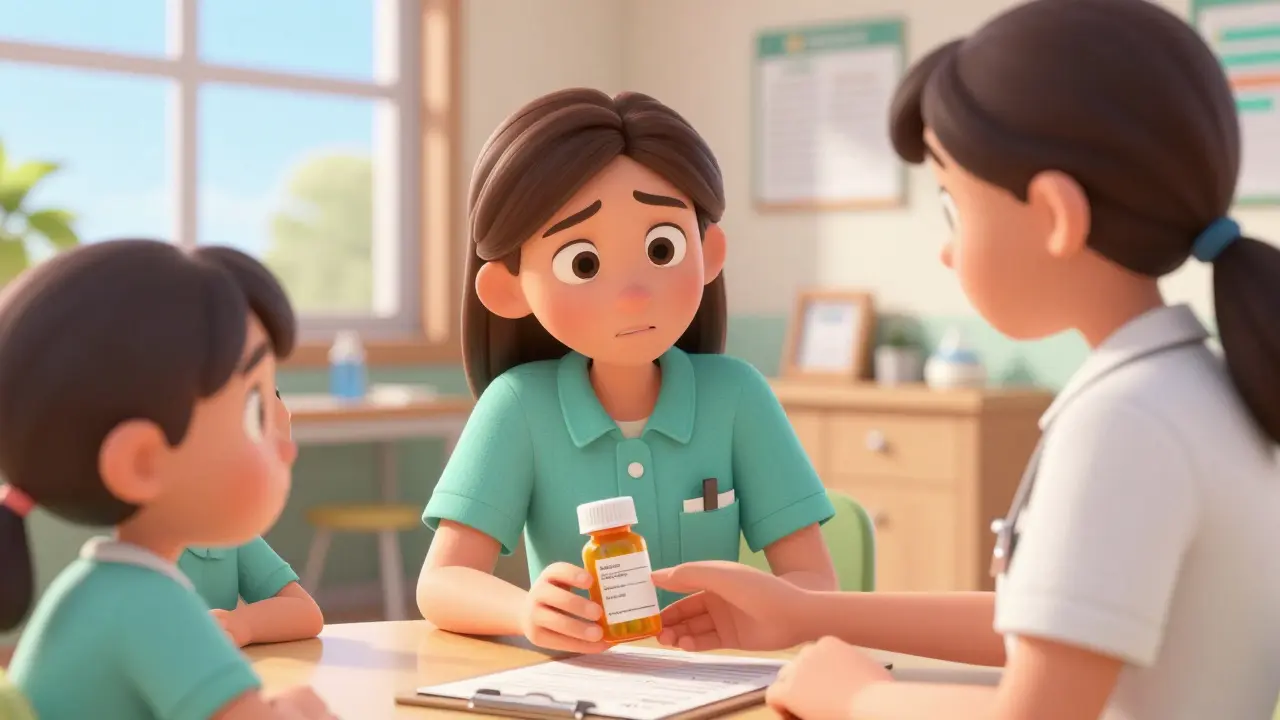
- Get a signed Physician/Parent Authorization Form from your child’s doctor. This isn’t just a note. It needs to include: your child’s full name, the exact name of the medication, the dosage (in milligrams or units), how often to give it, the route (swallowed, inhaled, injected), and any special instructions like ‘take with food’ or ‘watch for drowsiness’.
- The doctor must also include their license number. New York State and several others require this. Without it, the school won’t accept the order.
- Sign the form yourself. Your consent is legally required. Schools cannot give medication without both the doctor’s order and your signature.
And here’s something many parents miss: the medicine bottle label is not enough. The American Academy of Pediatrics says this clearly. A pharmacy label might say ‘Take one tablet daily’ - but it won’t say if it’s for your child, when to give it at school, or if it should be taken with lunch. Only the official form covers all that.
How to Deliver Medication to School
Never let your child carry their medication to school - unless they’re approved for self-administration. Even then, there are rules.
Most schools require you to drop off the medicine in person. In Frederick County, for example, parents must hand the medication directly to the school nurse and sign a receipt. No exceptions. Why? Because kids lose things. Backpacks get left on buses. Medication left in a locker can get mixed up, damaged, or stolen.
Here’s what the medicine container must have:
- The original manufacturer’s label with your child’s full name
- Expiration date (no expired meds allowed)
- Clear dosage instructions matching the form
- Proper storage: refrigerated meds like insulin must be in a locked fridge at 2-8°C (36-46°F), separate from food
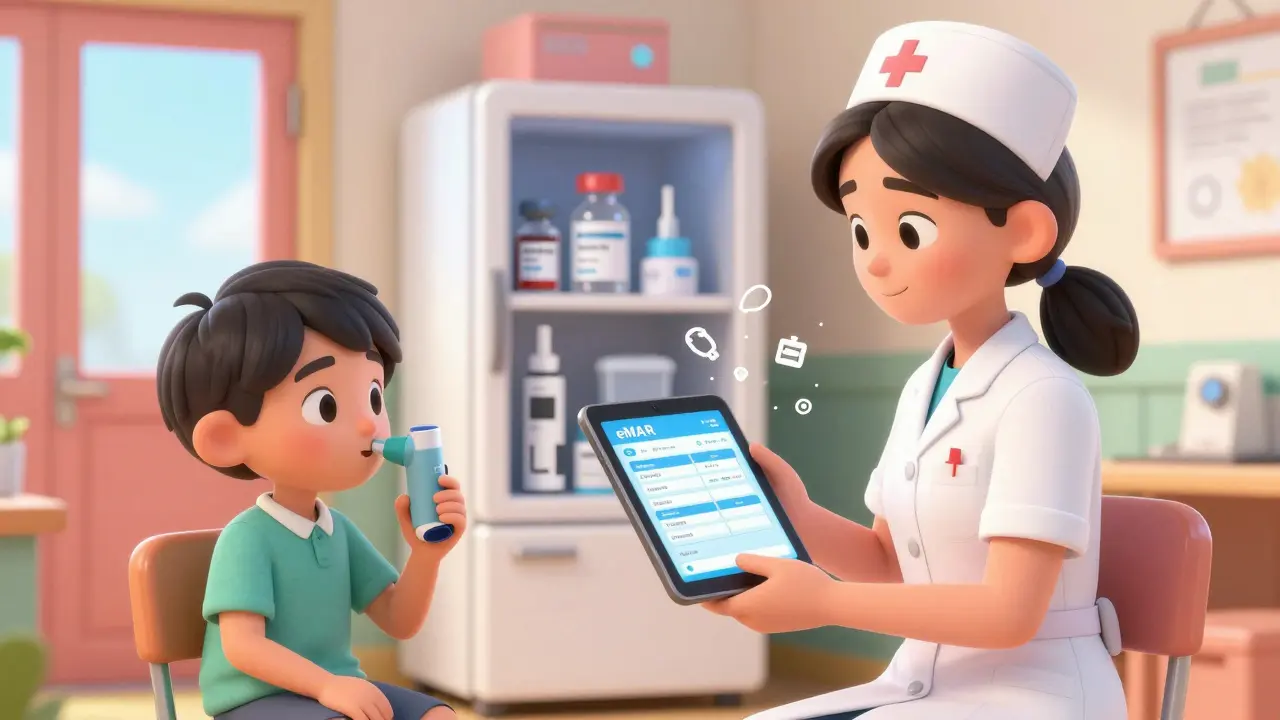
For inhalers, nebulizers, or auto-injectors, make sure the device is labeled and the school has a spare if possible. NYC Public Schools even provide free Albuterol inhalers - but only if your doctor has prescribed them and you’ve filled out the paperwork.
When Your Child Can Self-Administer
Older kids - especially those with asthma, diabetes, or severe allergies - may be allowed to carry and use their own meds. But it’s not automatic.
In New York, a student needs two things: a doctor’s order on a special Self-Medication Release Form and your written permission. In California, they must prove they can use the device correctly - like showing the nurse how to use an inhaler or EpiPen - under supervision.
Even if your child is mature enough, the school will still monitor them. A nurse may check in to confirm the dose was taken. This isn’t distrust. It’s safety.
What Happens During the School Day
Most schools now use electronic medication records (eMARs). That means instead of paper logs, nurses tap a tablet to record when a child gets their medicine. This has cut documentation errors by 57%, according to School Health Corporation data.
Timing matters. Medications are usually given within a 30-minute window before or after the scheduled time - unless the doctor says otherwise. So if your child’s pill is due at 12:00 p.m., it could be given anytime between 11:30 a.m. and 12:30 p.m. This flexibility helps avoid disruptions to class.
For chronic conditions like asthma or seizures, schools have emergency plans. Nurses train staff on what to do if your child has a reaction. But none of that works if you don’t update them.
What to Do When Things Change
Your child’s meds change? They start a new one? They have a side effect? You see them acting differently after school? Tell the school immediately.
Failure to update the school about changes is responsible for nearly 18% of medication errors, according to the National Association of School Nurses. That means if your child’s dosage goes up, or they’re switched to a different brand, you must submit a new form - not just tell the teacher.
Also, if your child refuses to take their medicine at school, the nurse will call you. That’s standard. Don’t be surprised. The school can’t force a child to take medication. They need your help to figure out why.

End-of-Year Cleanup
At the end of the school year, you must pick up all unused medication. No exceptions.
Frederick County Schools says: ‘NO medication will be kept over the summer or until the next school term.’ New York State requires you to collect meds by August 31. After that, they’re destroyed.
Why? Because storing old medicine creates risk. Expired pills, unlabeled bottles, forgotten inhalers - they’re hazards. Schools don’t have space or legal authority to keep them. So when the year ends, go get your child’s meds. Even if they didn’t use them.
What’s Changing in School Medication Policies
More kids are needing psychiatric medications - ADHD, anxiety, depression - and schools are adapting. The AAP reports a 23% rise in requests for these drugs since 2022.
Some states are testing new tools. In California, parents get text alerts when their child takes their medicine. Early results show a 27% drop in parent questions to the school. That’s a win for everyone.
By 2026, many states plan to standardize digital forms. By 2028, some schools may use biometric checks - like fingerprint scans - to make sure the right child gets the right medicine. It sounds high-tech, but it’s just the next step in preventing errors.
Why This Matters More Than You Think
This isn’t just about giving a pill. It’s about keeping kids safe, in school, and learning. Schools with full medication safety programs have 63% fewer medication-related incidents than those that don’t. That’s not a small number. It’s life-changing.
When parents, doctors, and schools work together, kids don’t miss class. They don’t get sick from missed doses. They don’t have panic attacks because their inhaler wasn’t available. They just get to be kids.
Your role isn’t just paperwork. It’s partnership. Stay involved. Ask questions. Double-check forms. Update changes. Show up to drop off meds. These small things add up to big safety.
There’s no magic system. No perfect app. Just clear rules, clear communication, and parents who care enough to follow through.
Bryan Woods
December 27, 2025 AT 12:35It's refreshing to see such a thorough breakdown of school medication protocols. I work in healthcare administration, and I can tell you that consistent documentation is the single biggest factor in reducing errors. The 5 Rights framework is timeless for a reason - it’s simple, scalable, and saves lives. Schools that take this seriously are doing more than following policy; they’re building trust with families.
Ryan Cheng
December 27, 2025 AT 13:11Big up to the schools that actually follow these rules. My kid’s asthma inhaler got lost last year because the teacher ‘thought it was fine’ to let him carry it. Turned into a full-blown emergency. After that, we insisted on the nurse-only drop-off. No exceptions. Seriously, if your kid needs meds, don’t gamble with their safety. Paperwork isn’t bureaucracy - it’s armor.
wendy parrales fong
December 28, 2025 AT 00:33I just want to say thank you to the nurses who do this every day. They’re not just giving pills - they’re holding space for anxious kids, calming panic attacks, and making sure no one slips through the cracks. And parents? You’re not being annoying when you fill out forms. You’re showing up. That matters more than you know.
Jeanette Jeffrey
December 29, 2025 AT 15:01Wow. So now we’re turning schools into medical facilities? Next they’ll be giving insulin shots during recess and fingerprint-scanning kids before lunch. This is overreach. Kids are supposed to learn, not become patients in a bureaucratic maze. Let parents handle meds. Schools shouldn’t be responsible for every pill, every shot, every sigh.
Shreyash Gupta
December 31, 2025 AT 01:43Why do we need all this paperwork? 🤔 In India, kids just bring their meds in a ziplock and the teacher gives it to them. No forms. No labels. No drama. Why is America so scared of a little trust? 🤷♂️ #Overregulated #JustLetKidsBeKids
Ellie Stretshberry
January 1, 2026 AT 17:42i just wanted to say i read this whole thing and it made me cry a little. my daughter has epilepsy and the school nurse saved her life last year. i didnt even know she had a seizure until the call came. thank you for reminding people how important this is. i forgot to pick up her meds last year and they threw them out. i cried for a week. please dont forget to get your meds back. <3
Zina Constantin
January 2, 2026 AT 09:22As a Nigerian-American mom, I’ve seen how this works in both worlds. In Lagos, families manage meds on their own - and it’s beautiful. But here? We have systems for a reason. Not because we distrust parents, but because we care too much to risk it. This isn’t red tape - it’s love in policy form. And yes, I filled out every form by June 1. No excuses.
Dan Alatepe
January 3, 2026 AT 06:07Let me tell you something… the school nurse is the real MVP. Not the teacher. Not the principal. Not even the doctor. She’s the one holding the bottle, checking the label, calling you at 10:47 a.m. because your kid refused to swallow the pill… and still smiling. 🥺 I’m not crying. You’re crying. This system? It’s messy. But it’s human. And that’s worth fighting for.
Angela Spagnolo
January 4, 2026 AT 14:56I… I didn’t realize how much I’d been neglecting this… I thought the school would just… know? I mean, my son’s been on the same meds for two years… I didn’t think I needed to re-submit… Oh my gosh… I just checked the calendar… it’s already August 15th… I need to call the nurse… right now… I’m so sorry…