Physical Therapy for Pain Relief: Effective Exercises and Recovery Guide
 Apr, 26 2026
The Logic Behind Movement-Based Healing
Why does moving a joint that hurts actually help? It comes down to a few biological tricks. First, certain types of exercise trigger the release of endorphins, which act as your body's natural painkillers. This is known as exercise-induced hypoalgesia. Second, physical therapy targets the actual dysfunction-like a weak muscle or a tight ligament-that is causing the pain in the first place. For those dealing with chronic conditions, the goal is to break the "pain cycle." This happens when pain leads to inactivity, which leads to muscle weakness, which then makes any movement more painful. By introducing a graded activity approach-meaning you increase your effort by only 10-15% each week-you can teach your nervous system that movement is safe again. If you use a scale of 0 to 10 to track your pain, a good rule of thumb is to keep your activity level under a 3/10 during the workout and ensure you're back to your normal baseline within an hour of finishing.Choosing the Right Exercise for Your Pain
Not all exercises are created equal. Depending on what hurts, you need a different tool for the job. For instance, if you have osteoarthritis, high-impact jumping or running might feel like torture. In contrast, low-impact options like swimming or cycling can reduce pain by 35-40% because they take the heavy load off your joints. In fact, water-based exercises can cut the load on your knees by half compared to walking on land. If you are dealing with fibromyalgia, traditional aerobics are great, but Tai Chi is often more effective. Research shows it can provide a 30% greater pain reduction than standard aerobic exercise after 12 weeks. On the other hand, if you're an office worker with a stiff neck and shoulders, you don't actually need an hour at the gym. Short, two-minute micro-exercise bursts can be just as effective as 12-minute sessions for relieving upper-body tension.| Exercise Type | Best For | Expected Pain Reduction | Key Attribute |
|---|---|---|---|
| Low-Impact Cardio | Osteoarthritis | 35-40% | Reduced joint loading |
| Tai Chi | Fibromyalgia | ~30% more than aerobics | Mind-body integration |
| Micro-exercises | Neck/Shoulder Pain | ~28-31% | High accessibility |
| Strength Training | Chronic Back Pain | Up to 70% success | Spinal support focus |

Mastering Restorative Stretching and Flexibility
Stretching isn't just about reaching your toes; it's about restoring the range of motion that pain has stolen from you. To actually change the length of a muscle, you can't just bounce for a second. Static stretching involves holding a position for 30 to 60 seconds. When you do this 5 to 7 days a week, you can actually increase your joint range of motion by 15 to 25 degrees in about a month. One common mistake people make is holding their breath. If you stop breathing, your muscles tense up to protect themselves, which defeats the purpose of the stretch. Focus on deep, slow breaths to tell your brain it's okay to let the muscle relax. If you feel a sharp, stabbing pain, stop immediately. Stretching should feel like a "comfortable pull," never a sharp electric shock.Strength Training: Building a Protective Shield
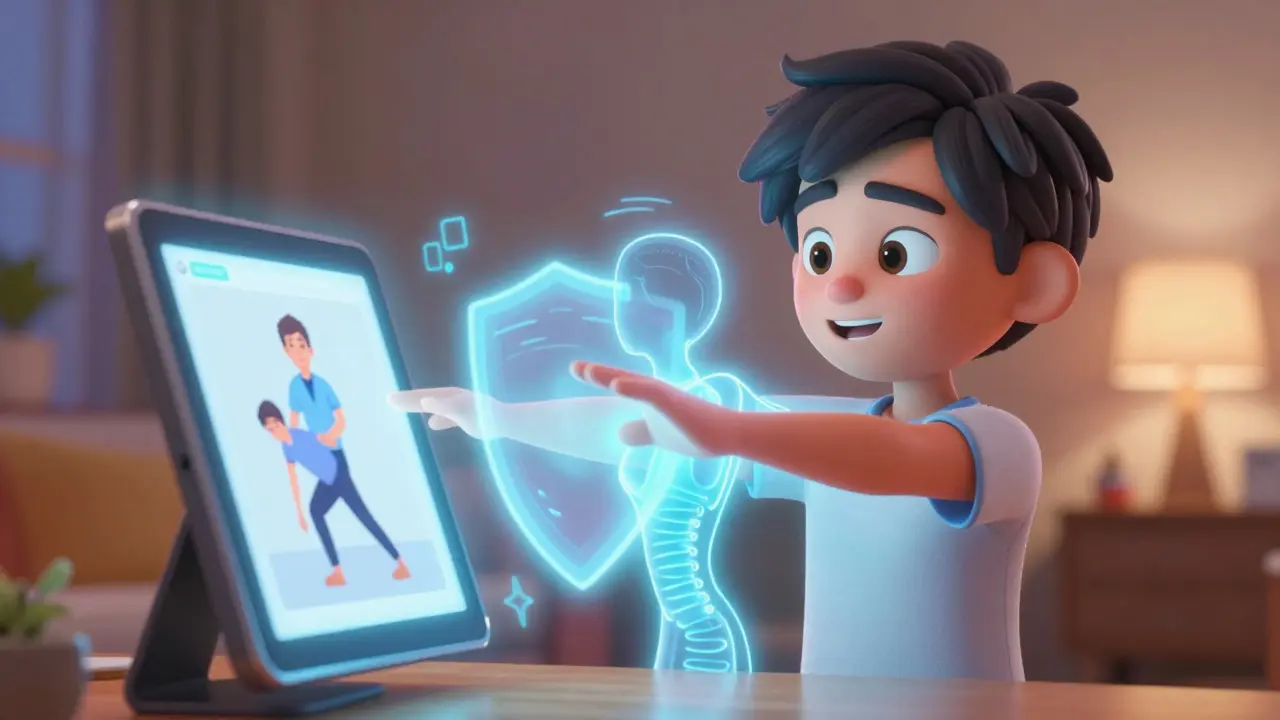
Think of strength training as building a brace out of muscle. For people with chronic back pain, strengthening the muscles that support the spine is the gold standard for long-term relief. A well-executed home program targeting the core and posterior chain can lead to a 70% success rate in reducing chronic back pain. To get the best results without injuring yourself, follow these specific parameters:- Repetitions: Aim for 8 to 15 reps per set.
- Sets: Perform 2 to 3 sets for each major muscle group.
- Intensity: Use a weight that is roughly 60-80% of your one-rep max (the most you can lift once).
- Progression: Only increase the resistance by 5-10% each week.
Creating Your Home Recovery Routine
Consistency is where most people fail. It's easy to be motivated in a clinic, but hard to do it in your living room. One way to boost your success rate is to use video demonstrations instead of just a piece of paper with drawings. Patients who use videos are significantly more likely to stick to their program. If you're feeling overwhelmed, start with the "2-hour pain rule." This is a simple guide to knowing if you've pushed too hard. If you feel a bit more pain during or after your exercise, that's often normal. However, if that pain lasts for more than two hours after you've stopped, you've exceeded your current capacity. Next time, reduce the intensity or the number of reps by 20%. For those with limited time, the Arthritis Foundation has popularized a two-minute routine that targets specific joints. These micro-bouts are perfect for people who work desk jobs and feel their joints seizing up by 2 PM. Even a tiny bit of movement is better than total stillness.The Future of Pain Management
We are moving away from the "pill for every ill" mentality. The global market for non-opioid pain management has exploded, and physical therapy is now a first-line treatment for things like lower back pain, often recommended before any medication is prescribed. We are also seeing a shift toward digital health. Many clinics now use wearables to track your movements in real-time, ensuring your form is correct even when you aren't in the office. The goal is moving toward a personalized algorithm where your exercise plan changes based on how you report your pain each morning.Will physical therapy make my pain worse at first?
It is common to experience some initial soreness, which about 38% of beginners report. However, this should be a "good" soreness, not a sharp pain. Follow the 2-hour rule: if the pain doesn't return to your baseline within two hours of exercise, the intensity was too high and needs to be adjusted.
How long does it take to see results from physical therapy?
While some feel immediate relief through endorphin release, significant functional improvement typically takes 6 to 8 weeks of consistent application. Many patients report a 50-75% reduction in pain within this window if they follow the progressive resistance and stretching protocols.
Can I do these exercises without a therapist?
While general guidelines exist, it is highly recommended to have at least 2-3 supervised sessions. Incorrect form is the leading cause of exercise-induced pain exacerbation. A professional can ensure your alignment is correct before you transition to a home-based program.
What is the difference between static and dynamic stretching for pain?
Static stretching involves holding a position for 30-60 seconds to increase long-term flexibility and range of motion. Dynamic stretching uses movement to prepare the muscles for activity. For chronic pain restoration, static stretching performed 5-7 days a week is typically used to regain lost mobility.
Is Tai Chi really better than walking for fibromyalgia?
Clinical trials suggest that Tai Chi provides roughly 30% greater pain reduction than standard aerobic exercise for fibromyalgia patients over a 12-week period. This is likely due to the combination of gentle movement, balance, and focused breathing.
Jean Robert
April 27, 2026 AT 20:05It is truly heartening to see a comprehensive guide that emphasizes the gradual nature of recovery because so many of us tend to rush the process and end up feeling defeated when we hit a plateau, but the idea of increasing effort by only 10-15% a week is such a gentle, sustainable way to rebuild trust with your own body and mind while ensuring that you aren't triggering a flare-up that could set you back several weeks in your progress. I've seen so many people struggle with the mental toll of chronic pain and having a concrete set of parameters like the 2-hour pain rule can provide that necessary safety net and emotional reassurance that they are actually healing rather than causing more damage, which is just so vital for long-term success and overall well-being in the recovery journey.
Sharon Mathew
April 28, 2026 AT 21:17Absolute nonsense! Who actually believes that moving a joint that hurts is the solution? This sounds like a recipe for a total disaster and I'm honestly shocked anyone thinks Tai Chi is a legitimate medical intervention! Utterly ridiculous!
prince king
April 30, 2026 AT 15:37Love the focus on mind-body connection here! 🧘♂️ It's all about that synergy between the physical and the mental to find true balance. Great tips! ✨
Timothy Brown
May 2, 2026 AT 00:30Most people just lack the discipline to do the micro-exercises. It's not the routine that's the problem, it's the lack of willpower in the average person today.
Jarrett Jensen
May 3, 2026 AT 17:45The presentation of this data is somewhat pedestrian. While the core tenets of physical rehabilitation are present, the lack of deeper citations regarding the specific kinematic analysis of the posterior chain renders the strength training section rather superficial for those of us with a more rigorous academic background in kinesiology.
Trish Perry
May 3, 2026 AT 23:48Thinking about the body as a system that needs retraining rather than just a broken machine is a real shift in perspective. It makes the pain feel less like an enemy and more like a signal we just haven't learned to interpret correctly yet.
Nigel Gosling
May 5, 2026 AT 05:15Oh, please. Another "guide" telling us to move more. How revolutionary. I could have told you that moving helps moving, but no, let's dress it up in a table and call it science. It's all just a way to keep us paying for therapists who tell us to do what we could do in our sleep if we weren't so exhausted by the sheer mediocrity of modern health advice. Truly a tragedy of our era that we've reduced healing to a set of 10-15% increments. How quaint.
Justin Crice
May 7, 2026 AT 05:04The mention of exercise-induced hypoalgesia is pertinent. However, one must consider the specific neuromodulatory pathways involved when discussing the efficacy of low-impact versus high-impact modalities in the context of synovial fluid viscosity and joint articulation.
Peter Minto
May 8, 2026 AT 16:56USA is the only place that does this right! Stop listening to other countries, just trust the american way of fixin stuff!! My back feels great after just one gym sesssion, dont need no fancy tai chi stuff lol
Dale Kensok
May 9, 2026 AT 20:39The systemic failure of the current analgesic paradigm necessitates a pivot toward functional restoration. The cognitive-behavioral aspect of the "pain cycle" is an interesting variable, but the actual biomechanical torque required for spinal stabilization is where the real data lies. Most people fail because they lack the proprioceptive awareness to execute the movements without inducing sheer stress on the vertebrae.
Jenna Riordan
May 10, 2026 AT 18:37I usually just ignore my therapist's advice and do whatever feels right at the moment. If it hurts, I stop. If it doesn't, I keep going. No need for a 2-hour rule when you have common sense.
Michael Yoste
May 12, 2026 AT 15:11I'm so glad you're finding these tools helpful! It really is a journey of self-discovery and learning to be kind to yourself while you heal. Just remember that the pain is just a part of your story and you have the power to change the narrative.
Angela Cook
May 13, 2026 AT 01:41This is exactly why American healthcare is the best in the world! We innovate and we lead! Anyone who says otherwise is just jealous of our efficiency!
Amber McCallum
May 14, 2026 AT 04:23You just need to align your energy first. If your spirit is blocked, no amount of stretching will fix a back that's carrying the weight of your unhealed trauma. It's all about vibration.
Raymond Lipanog
May 14, 2026 AT 13:43It is indeed a delicate balance to maintain. One must approach the physical body with the same patience and respect that one would offer a guest in their own home, ensuring that the boundary between effort and injury is always respected for the sake of long-term harmony.