Night vs Morning Statin Dosing: What Really Matters for Side Effects and Effectiveness
 Dec, 1 2025
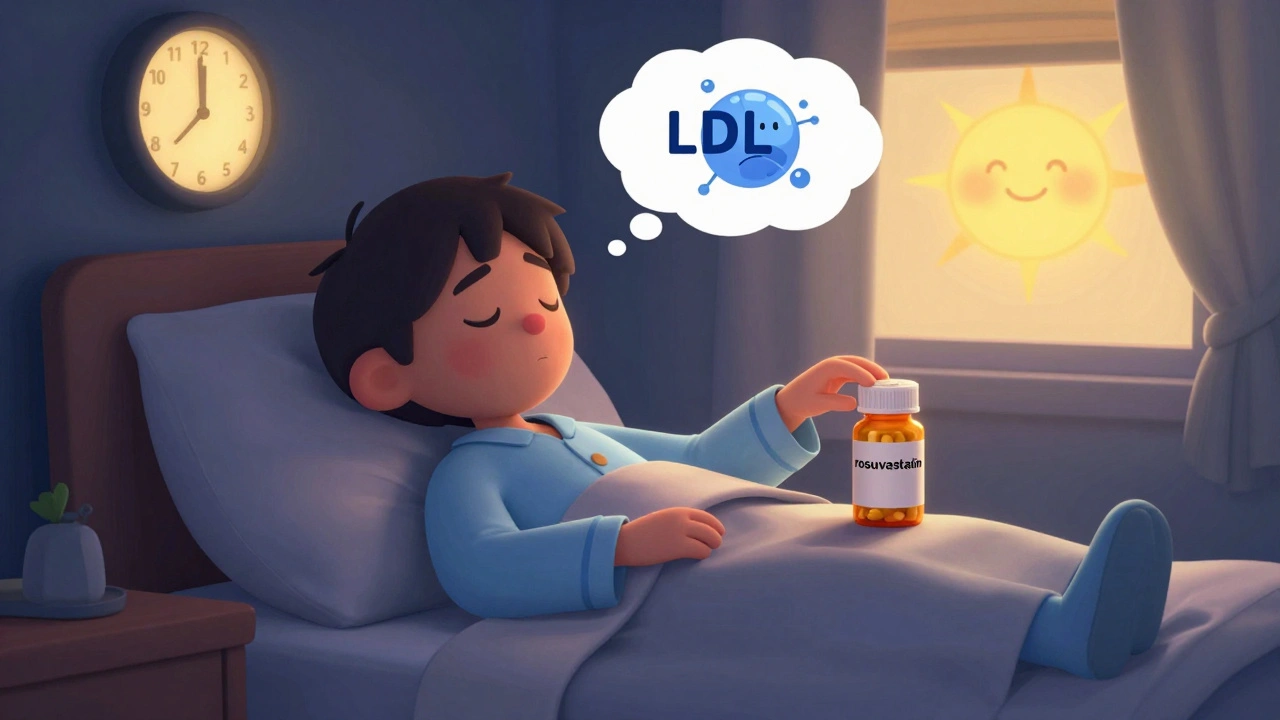
For years, doctors told patients to take their statins at night. The logic was simple: your liver makes most of its cholesterol while you sleep, so hitting it with medication right before bed made sense. But today, that advice is outdated for most people. The real question isn’t whether to take your statin at night or in the morning-it’s whether you’ll actually remember to take it at all.
Why Timing Used to Matter
Back in the 1980s, when statins like simvastatin and lovastatin first hit the market, they didn’t stick around in your body for long. Their half-lives were under 3 hours. That meant if you took them in the morning, the drug was mostly gone by midnight-right when your liver was cranking out the most cholesterol. Studies showed clear differences: one 1995 trial found that taking simvastatin at night lowered LDL cholesterol by 13.4% more than taking it in the morning. Another study with 172 patients showed evening dosing cut cholesterol by 21%, while morning dosing only dropped it by 14%. For those early statins, timing wasn’t just a suggestion-it was critical.But Most Statins Today Are Different
The statin landscape has changed dramatically. Today, about 82% of new prescriptions are for long-acting statins like atorvastatin and rosuvastatin. These drugs stay active in your bloodstream for 14 to 19 hours. That means whether you take them at 7 a.m. or 11 p.m., you’re still covered during your liver’s peak cholesterol-production window. A 2017 analysis of 17 clinical trials found that for these newer statins, the difference in LDL reduction between morning and night dosing was less than 3%. That’s not just small-it’s clinically meaningless. You’d need to lower LDL by 5-7% to see a real impact on heart risk, and these statins barely move the needle based on timing alone.Side Effects Don’t Care About the Clock
Some patients worry that taking statins at night might cause more muscle pain or liver issues. But data says otherwise. A 2021 analysis of over 4.2 million statin prescriptions found no difference in side effects-like muscle aches, elevated liver enzymes, or new-onset diabetes-between morning and evening users. The rates were nearly identical: 8.9% for morning, 8.7% for night. That’s not a fluke. It’s solid evidence that your body handles the drug the same way regardless of when you swallow it. If you’ve had side effects before, changing the time won’t fix it. You need to talk to your doctor about switching statins or adjusting the dose.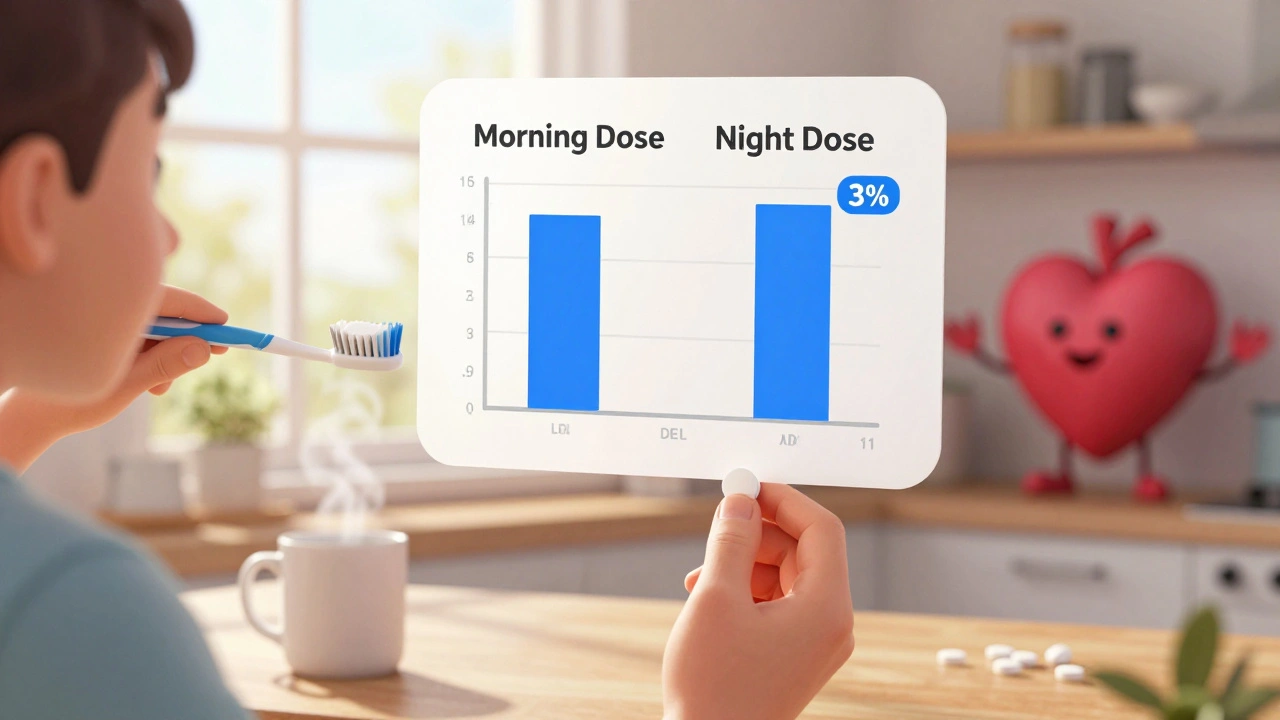
The Real Problem: Forgetting to Take It
Here’s the kicker: the biggest threat to your heart health isn’t when you take your statin-it’s whether you take it at all. A 2019 study of nearly 12,500 statin users found that people told to take their pills at night missed 2.1 more doses per month than those who took them in the morning. Why? Nighttime routines are messy. You’re tired. You’ve had a late dinner. You’re watching TV. You forget. One Reddit user wrote, “I kept forgetting my simvastatin at night, so my doctor switched me to morning rosuvastatin-and my LDL actually improved because I never miss a dose now.” That’s not an anomaly. It’s the rule.What About Short-Acting Statins?
If you’re still on simvastatin, lovastatin, or fluvastatin, timing still matters-sort of. Evening dosing gives you about 8-15% better LDL reduction than morning dosing. But even here, adherence trumps timing. A 2020 study found that patients on simvastatin who took their pill every morning with a phone reminder achieved nearly the same cholesterol drop as those taking it at night without reminders. Why? Because the morning group had a 92% adherence rate. The nighttime group? Only 76%. That 16-point gap wiped out any theoretical benefit of nighttime dosing.What Should You Do?
Don’t overthink this. Here’s the practical advice:- If you’re on atorvastatin, rosuvastatin, pitavastatin, or pravastatin: Take it whenever it fits your routine. Morning is fine. Night is fine. Just be consistent.
- If you’re on simvastatin, lovastatin, or fluvastatin: Evening dosing is still slightly better for lowering cholesterol-but only if you remember to take it. If you keep forgetting, switch to morning. Better to take it consistently at the wrong time than perfectly at the right time and miss half your doses.
- If you’re unsure what statin you’re on: Check your prescription bottle or ask your pharmacist. Don’t guess.
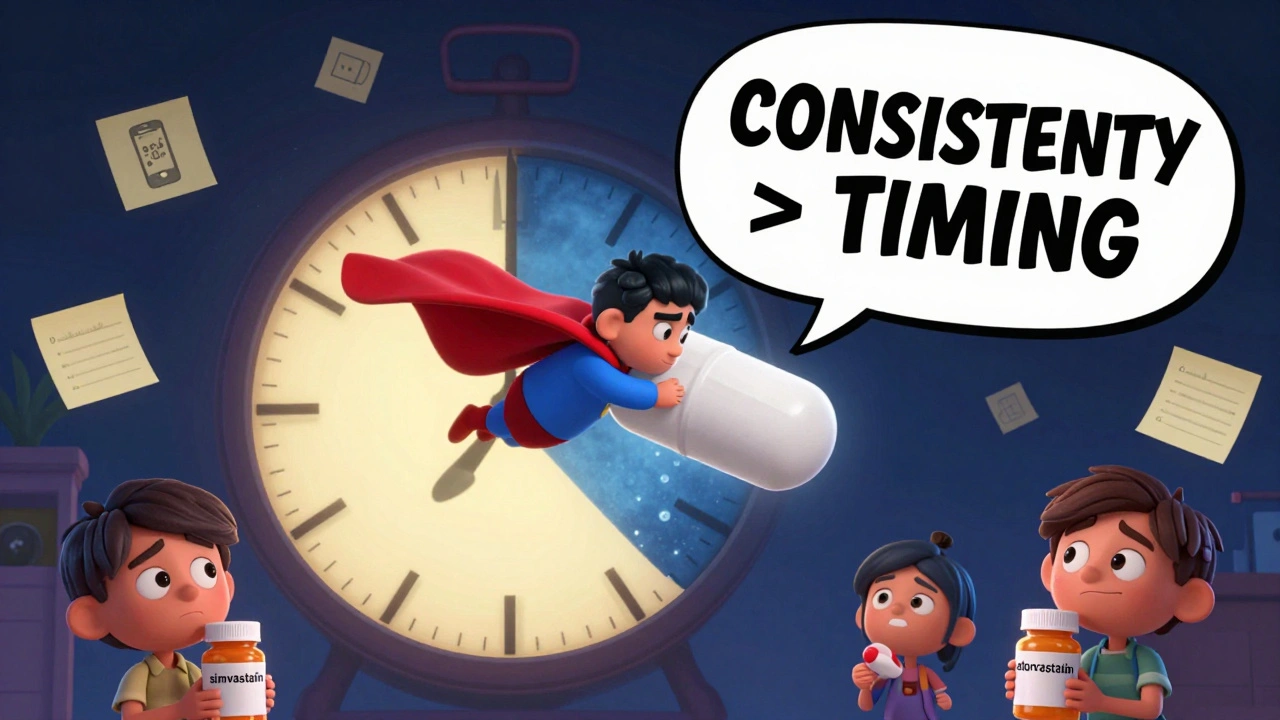
Doctors used to treat statin timing like a science. Now they treat it like a habit. The American College of Cardiology’s 2022 guidelines say it plainly: “Prioritize establishing a consistent daily routine that the patient can maintain long-term.” That’s it. No complex schedules. No midnight alarms. Just a pill, at the same time every day, that you don’t forget.
Why the Guidelines Changed
The shift isn’t just about science-it’s about real life. In 2010, nearly two-thirds of doctors still asked patients about statin timing. By 2022, that number dropped to 18%. Why? Because the data showed it didn’t matter for most people. The FDA updated rosuvastatin’s label in 2015 to remove the “take at night” instruction. The European Medicines Agency did the same for atorvastatin and rosuvastatin in 2021. These aren’t minor tweaks-they’re official acknowledgments that the old advice was based on outdated drugs.What’s Next?
The future of statins isn’t about timing. It’s about making them easier to take. Pfizer is already testing a new version of simvastatin that releases slowly over 12 hours, so you can take it anytime without losing effectiveness. That’s the direction we’re heading: simpler, more forgiving pills that work with your life-not against it.Bottom line: Your statin isn’t a magic bullet that only works if you swallow it at midnight. It’s a tool. And tools work best when you use them regularly-not perfectly. If you’ve been stressing over whether to take it before bed or after breakfast, stop. Focus on making it part of your morning coffee routine, your brushing teeth ritual, or your evening wind-down. That’s what keeps your cholesterol low-and your heart safe.
Should I take my statin at night or in the morning?
It depends on what statin you’re taking. If you’re on a long-acting statin like atorvastatin or rosuvastatin, the time of day doesn’t matter. Take it whenever you’ll remember. If you’re on a short-acting statin like simvastatin or lovastatin, nighttime is slightly better for lowering cholesterol-but only if you take it every night. If you forget at night, switch to morning. Consistency beats timing every time.
Does taking statins at night cause more side effects?
No. Studies tracking over 4 million statin users found no difference in muscle pain, liver issues, or diabetes risk between those who took statins at night versus in the morning. Side effects are linked to the drug itself and your body’s reaction-not the time you take it.
What if I miss my statin dose?
If you miss a dose, take it as soon as you remember-but only if it’s still the same day. If it’s already the next day, skip the missed dose and go back to your regular schedule. Don’t double up. Missing one dose occasionally won’t hurt, but missing several a month raises your heart risk more than taking it at the "wrong" time.
Can I switch my statin from night to morning?
Yes, and you should if it helps you remember. For long-acting statins, it’s perfectly safe. For short-acting ones, talk to your doctor first-but if you’re consistently forgetting at night, switching to morning is better than staying inconsistent. Adherence is the #1 predictor of heart protection.
Do I need to take statins with food?
No. Statins work whether you take them with food or on an empty stomach. Some older statins like lovastatin absorb slightly better with food, but the difference is small and not worth stressing over. Pick a routine that’s easy to stick with.
What to Do Next
If you’re on a statin, here’s your simple action plan:- Check your prescription bottle. What’s the name of your statin?
- If it’s atorvastatin, rosuvastatin, pitavastatin, or pravastatin: You can take it anytime. Pick a time that fits your life.
- If it’s simvastatin, lovastatin, or fluvastatin: Try to take it at night-but only if you remember. If you don’t, switch to morning.
- Set a daily phone reminder. Don’t rely on memory.
- If you’ve been skipping doses, talk to your doctor. There might be a better statin option for you.
Statin therapy isn’t about precision. It’s about persistence. The best time to take your pill is the time you won’t forget.
Chelsea Moore
December 2, 2025 AT 18:51OMG, I CANNOT BELIEVE people are STILL arguing about this?!? Like, seriously?!? I took my simvastatin at night for 5 years, missed like 40% of doses, and my LDL was THROUGH THE ROOF-then I switched to morning with rosuvastatin and now I’m at 82?!? I didn’t even change my diet!! This isn’t science-it’s just common sense!!
ruiqing Jane
December 4, 2025 AT 13:56Thank you for this clear, evidence-based breakdown. So many patients are unnecessarily stressed about timing when the real issue is adherence. The data is unequivocal: consistency trumps chronology. For long-acting statins, the pharmacokinetic profile renders timing irrelevant. For short-acting ones, the marginal benefit of evening dosing is obliterated by poor compliance. This isn’t just medical advice-it’s behavioral psychology in action.
Fern Marder
December 6, 2025 AT 01:40YAS QUEEN 💅 This is the most relatable health post I’ve read in months. I used to set 3 alarms for my simvastatin at night… woke up groggy, forgot, cried, gave up. Now I take my rosuvastatin with my morning coffee ☕️ and I’ve never felt better. My cardiologist high-fived me. Literally. 😭❤️
Carolyn Woodard
December 6, 2025 AT 17:53It’s fascinating how the shift from pharmacological precision to behavioral pragmatism reflects a broader epistemological transition in medicine-from reductionist models to systems-oriented care. The statin timing debate is emblematic of this: the assumption that biological processes can be isolated and optimized linearly is increasingly untenable. Adherence, as a sociocultural and psychological phenomenon, reveals the limits of biomedical determinism. We’re not just treating cholesterol-we’re negotiating human behavior within complex, imperfect routines.
Allan maniero
December 7, 2025 AT 08:49I’ve been on atorvastatin for nearly a decade now, and I’ve taken it at 7 a.m., 11 p.m., and even once at 3 p.m. after a night shift. I didn’t even know the old advice until I read this. My cholesterol’s been stable as a rock. Honestly, I think the whole nighttime thing was just a relic of early marketing and lazy prescribing. The real win here is that doctors are finally starting to treat patients like humans, not lab rats.
Anthony Breakspear
December 7, 2025 AT 23:45Let me tell you something real-my grandma took her statin with her morning donut and never missed a day. She’s 84, walks 3 miles a day, and her doc says she’s got the heart of a 50-year-old. You think she cared about liver cycles? Nah. She cared about not dying. That’s the whole damn point. Stop overcomplicating it. Take it when you ain’t gonna forget. Done.
Elizabeth Farrell
December 8, 2025 AT 23:17As someone who’s been on statins for 12 years, I want to say how much I appreciate this post. I used to feel guilty every time I missed my night dose. I’d lie awake thinking I was sabotaging my health. But once I switched to morning and set a phone alert, my numbers improved. It’s not about perfection-it’s about showing up. And that’s something we can all do.
Sheryl Lynn
December 9, 2025 AT 10:36How quaint. The masses are being told to abandon pharmacological nuance because they can’t be bothered to follow a simple bedtime ritual. Meanwhile, the real science-long half-life pharmacokinetics, circadian hepatic metabolism, and the 1995 simvastatin RCTs-is being drowned out by a chorus of ‘I forgot at night so I moved it to morning’ anecdotes. This isn’t patient-centered care-it’s therapeutic nihilism dressed in motivational posters.
Paul Santos
December 10, 2025 AT 10:54Heh. The FDA removed the nighttime instruction? How very… bureaucratic. 😏 I suppose now we’ll be told to take our blood pressure meds with breakfast and insulin with TikTok videos. The decline of medical authority is not just inevitable-it’s delightful. The real statin isn’t the pill-it’s the placebo of control we used to cling to. Now we’re free. 🍷
Eddy Kimani
December 10, 2025 AT 16:13Just a quick note: for patients on simvastatin who switch to morning, it’s worth monitoring lipid panels for 6–8 weeks. While adherence improves, there may be a transient 5–7% rise in LDL before it stabilizes-depending on individual CYP3A4 activity. Not a dealbreaker, but worth tracking. Also, if you’re on grapefruit juice, don’t do that with any statin. Ever.
John Biesecker
December 11, 2025 AT 08:29im not a doctor but i took my statin at 3am once bc i woke up and now i think i’m immortal? 😅 just kidding. but seriously, i switched to morning and haven’t missed one. my dog reminds me now. he sits by my coffee mug like ‘bro, you forgot again?’ 🐶❤️