Medication Mistakes in Pediatric Emergencies: Real Cases and How to Prevent Them
 Dec, 23 2025
Every year, thousands of children end up in emergency rooms because of a simple mistake: the wrong dose of medicine. Not because parents are careless. Not because doctors are negligent. But because the system is built for adults, and kids don’t fit.
In pediatric emergencies, medication errors happen more than twice as often as in adults. One study found that 31% of pediatric medication orders contain some kind of error-compared to just 13% in adults. And nearly one in seven of those errors actually hurt the child. That’s not rare. That’s routine.
Why Kids Are at Higher Risk
Adults get pills. Kids get liquids. And liquids are where things go wrong.
Most pediatric medications are dosed by weight-milligrams per kilogram. That means a 10-pound baby needs a completely different amount than a 60-pound child. One wrong decimal point, one misread label, one confused syringe, and you’ve given ten times too much.
Here’s what happens in real life: A mother gives her 10-kilogram child 5 milliliters of liquid acetaminophen, thinking it’s the right amount. But the bottle says 160 mg per 5 mL. The correct dose? 10 mg per kg-that’s 100 mg total, or 3.1 mL. She gave 160 mg. That’s a 60% overdose. She didn’t mean to. She just didn’t know the difference between milliliters and milligrams.
And it’s not just parents. Even trained staff make mistakes. A nurse grabs the wrong concentration of epinephrine. A doctor writes a dose in mg instead of mcg. A pharmacy dispenses a liquid with a different strength than expected. In emergency rooms, where time is tight and stress is high, these tiny slips become big dangers.
The Most Common Mistakes
Not all errors are the same. Some are simple. Others are systemic. Here’s what actually goes wrong:
- Wrong dose (13% of errors): Too much or too little. Often because the weight wasn’t recorded correctly-or was guessed.
- Wrong medication (4%): Confusing similar-sounding drugs like morphine and midazolam. Or giving adult-strength liquid to a child.
- Wrong route or timing (3%): Giving an oral medicine intravenously. Or giving a dose every 4 hours when it should be every 6.
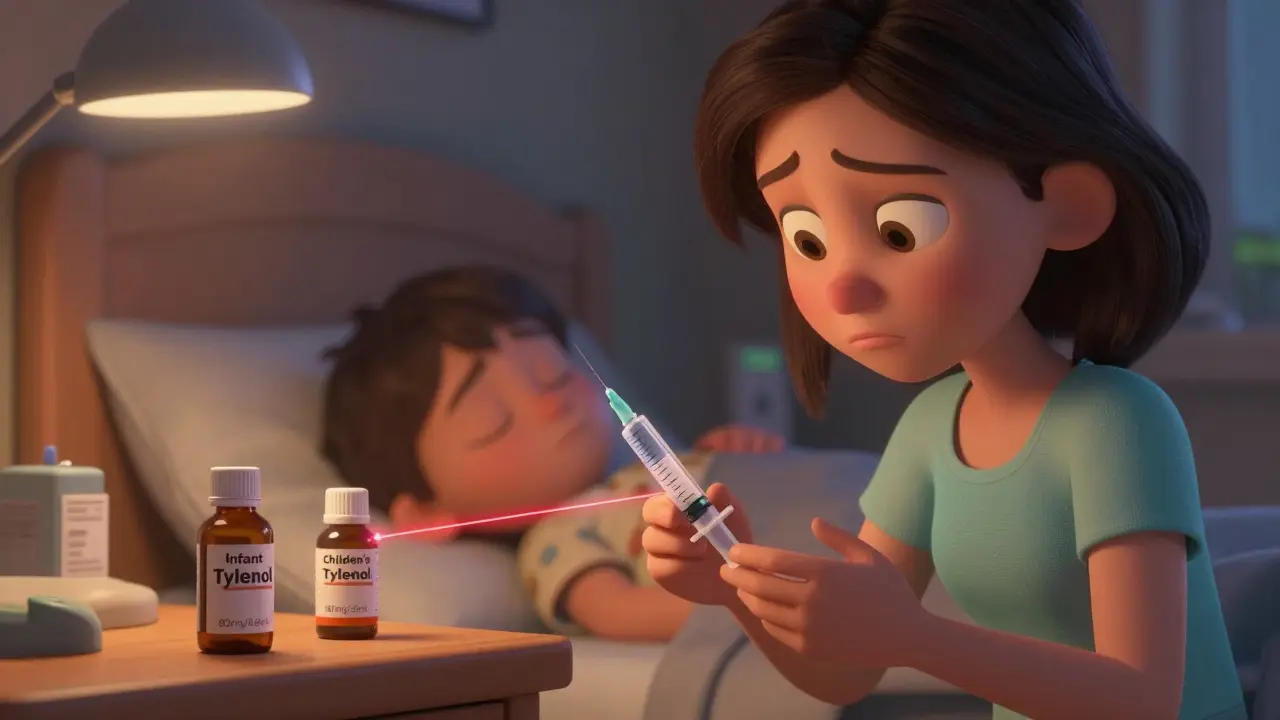
- Wrong concentration (up to 80% of home errors): This is the silent killer. Children’s Tylenol comes in two strengths: 160 mg/5 mL for kids, and 80 mg/0.8 mL for infants. Parents mix them up. One mom on Reddit said she gave her 2-year-old the infant concentrate thinking it was the same as the kids’ version. The pediatrician called her back because the child was at risk of liver damage.
- Duplicate dosing (15-25% of cases): Mom gives medicine at home. Dad gives more at the ER. No one checks what was already given.
And here’s the scary part: most of these errors never get reported. Studies show that for every one error that shows up in a hospital log, at least three others slip through. Why? Because no one notices. Or because no one knows how to report it. Or because the system doesn’t track it.
Who’s Most at Risk?
It’s not random. Certain families are hit harder-and it’s not because they’re less caring.
Parents with limited health literacy make medication errors 2.3 times more often than those with higher literacy. That’s not about intelligence. It’s about access to clear information. If you don’t understand what “mg” or “mL” means, you’re already behind.
Non-English-speaking families face even higher risks. One study found that Spanish-speaking parents had a 45% error rate at home-compared to 28% for English speakers. Language isn’t just about words. It’s about instructions, labels, and visual cues.
And it’s not just about language. Children on Medicaid are 27% more likely to have a medication error than those with private insurance. Why? Because safety nets are stretched thin. Fewer pharmacists. Fewer follow-ups. Less time to explain.
Children with chronic conditions like epilepsy or cancer are at the highest risk. One study found that 40% of kids with long-term illnesses have had a dosing error outside the hospital. For kids on chemotherapy, 1 in 10 parents misread the dose at home.
What’s Being Done-And What’s Working
It’s not all bad news. Some hospitals are fixing this-and proving it can be done.
Nationwide Children’s Hospital in Columbus, Ohio, cut harmful medication events by 85% over five years. How? They didn’t hire more staff. They didn’t buy fancy tech. They changed how they talk to families.
They started using the MEDS intervention: simple discharge instructions with pictures, clear dosing charts, and a “teach-back” system. Instead of just handing a parent a paper, they ask: “Can you show me how you’ll give this medicine?” If they get it wrong, they try again. It takes 90 seconds per patient. But it cuts dosing errors by nearly half.
They also made all pediatric orders go through pharmacy double-checks. Every dose for a child under 12 gets reviewed by a pharmacist before it’s given. That’s not standard in most ERs-but it should be.
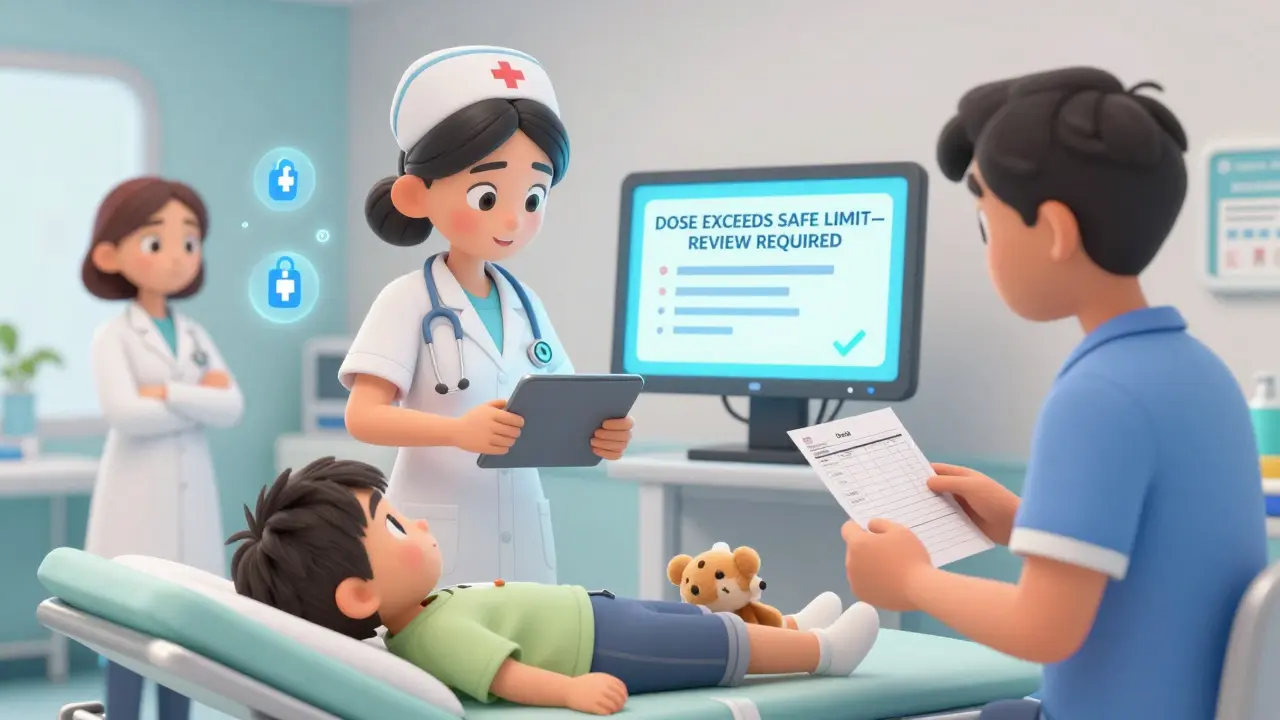
And they switched to electronic systems with built-in pediatric dosing calculators. If a doctor types in a child’s weight, the system auto-calculates the right dose. If the dose is too high, it flashes a warning. That’s the kind of tech that saves lives.
But here’s the gap: only 68% of children’s hospitals have these systems. Most community ERs don’t. That means a child in a small-town ER might get a dangerous dose while a child in a big-city children’s hospital gets a safe one. That’s not fair. And it’s not safe.
What Parents Can Do Right Now
You don’t need a degree to keep your child safe. You just need to ask the right questions.
- Ask: “Is this the right strength?” Never assume. Infant Tylenol is NOT the same as children’s Tylenol. Always check the label.
- Use the syringe that comes with the medicine. Never use a kitchen spoon. Even a tablespoon is inaccurate. The plastic syringe? That’s your best tool.
- Write it down. Write the dose, the time, and the reason. Show it to the nurse or doctor. Say: “This is what I gave at home.”
- Ask for a visual. “Can you draw me how much to give?” A picture sticks better than words.
- Speak up if something feels wrong. If the dose seems too big, say so. “I’m worried this is too much.” That’s not being difficult. That’s being a parent.
And if you’re ever unsure-call your pediatrician. Or go to a pharmacy. They’ll check it for free. Better safe than sorry.
The Bigger Picture
This isn’t just about one child getting the wrong dose. It’s about a system that still treats kids like small adults.
Medications aren’t designed for children. Labels aren’t clear. Training isn’t consistent. Systems aren’t built to catch these mistakes.
The American Academy of Pediatrics says medication safety is one of their top five priorities. But they also admit: we still don’t have good ways to measure outpatient errors. We don’t track them. We don’t fix them. We just hope no one gets hurt.
That has to change. Because every error is someone’s child. Every overdose is a parent’s nightmare. And every near-miss? That’s a close call that could’ve ended in tragedy.
Real change means better tools. Better training. Better communication. And above all-listening to families who are trying their best in a system that wasn’t made for them.
The good news? We know what works. We’ve seen it happen. We just need to make it standard-not optional.
What’s Next?
The goal by 2025? Standardized metrics for tracking pediatric medication errors-not just in hospitals, but at home. That’s the next step. Without data, we can’t fix what we can’t see.
Until then, the safest thing you can do? Be your child’s advocate. Ask questions. Double-check. Don’t assume. And never let someone tell you that a mistake is “just a small error.” In pediatrics, there’s no such thing as small.
Mussin Machhour
December 24, 2025 AT 09:13This hit home. My kid had a near-miss last year with Tylenol-I thought the infant and kids’ bottles were the same. Turned out I was giving him double the dose. No one told me the concentrations were different. I felt like an idiot, but honestly? The labels are designed to confuse. We need color-coded syringes and pictograms on every bottle. Not just for ‘low-literacy’ folks-for everyone. It’s 2025, not 1985.
Carlos Narvaez
December 26, 2025 AT 03:38Of course it’s happening. Pediatrics is an afterthought in drug development. Big Pharma doesn’t make money off 10kg kids. They make it off adults taking statins and erectile dysfunction pills. The system isn’t broken-it’s designed this way.
Harbans Singh
December 28, 2025 AT 00:09I’m from India, and we don’t even have standardized pediatric liquid meds here. Parents use teaspoons, droppers from old bottles, or even eyedroppers from the pharmacy counter. I’ve seen kids get 10x the dose because the label said ‘5 mL’ but the dropper held 15 mL. We need WHO guidelines enforced locally-not just in fancy US hospitals. Teach-back isn’t a luxury. It’s survival.
Justin James
December 29, 2025 AT 13:10Let’s be real-this isn’t about labels or syringes. It’s about the CDC and FDA being controlled by Big Pharma lobbyists who don’t want to standardize pediatric doses because it would cut their profit margins. They want you to keep buying different bottles of Tylenol, different concentrations, different packaging. It’s a multi-billion dollar confusion economy. And they’re laughing all the way to the bank while kids end up in the ER. They even designed the labels to look similar so you’d buy both. Look at the caps-same shape, same color. That’s not an accident. That’s predatory.
Zabihullah Saleh
December 31, 2025 AT 11:45There’s something deeply human here. We treat children as miniature adults because we’re afraid to acknowledge how different they are-not just in size, but in how they experience care. We don’t just need better dosing-we need better empathy. The real error isn’t the decimal point. It’s the assumption that a parent should know this stuff without being shown. We’ve outsourced care to manuals and apps, and now we blame the people trying to use them.
Winni Victor
January 1, 2026 AT 21:55Ugh. Another ‘parents are clueless’ article. Newsflash: the system is a dumpster fire, and you’re just shoveling guilt into mom’s lap. I gave my kid ibuprofen once with a kitchen spoon because I was exhausted and the syringe was lost. I didn’t kill her. But the ER nurse looked at me like I’d thrown her in a woodchipper. Thanks, society.
Rick Kimberly
January 3, 2026 AT 09:51While the anecdotal evidence presented is compelling, the absence of longitudinal, peer-reviewed data on the efficacy of the MEDS intervention across diverse socioeconomic strata limits the generalizability of the conclusions. Furthermore, the correlation between Medicaid status and error rates may be confounded by variables such as access to primary care, medication adherence support, and caregiver employment status. A more rigorous analysis is warranted before systemic policy recommendations are enacted.
Terry Free
January 4, 2026 AT 20:12So let me get this straight-you’re blaming the system for parents not being able to read a label? Wow. That’s rich. If you can’t tell the difference between mL and mg, maybe you shouldn’t be giving medicine to a child. It’s not rocket science. And no, I don’t care if you’re on Medicaid. If you can’t follow instructions, don’t blame the pharmacy. Teach your kid to read. Or get a babysitter who can.
Lindsay Hensel
January 5, 2026 AT 18:22Every time I read a story like this, I think of my sister, who was a nurse in a rural ER. She once spent 45 minutes with a grandmother who didn’t speak English, drawing pictures of syringes on napkins, mimicking dosing with water bottles. No one thanked her. No one documented it. But that child lived. We need more of that-not more tech. More humanity.
Sophie Stallkind
January 6, 2026 AT 20:01The data presented underscores a critical gap in pediatric pharmacovigilance infrastructure. While the MEDS intervention demonstrates promising outcomes, its scalability remains contingent upon institutional investment, staff training, and standardized protocol integration. Without mandatory reporting frameworks for outpatient pediatric dosing errors, systemic reform will remain fragmented and inequitable. A national registry is not merely advisable-it is ethically imperative.
Katherine Blumhardt
January 7, 2026 AT 00:14OMG I just realized I gave my son the infant Tylenol last week because I thought it was the same… I’m so stupid 😭 I didn’t even know there were two kinds. I’m calling my pediatrician right now. Please tell me he’s okay…