How to Prevent Look-Alike Packaging Confusion in the Pharmacy
 Dec, 2 2025
Every year, thousands of patients in the UK and US receive the wrong medication-not because of a mistake in prescribing, but because two drugs look too similar on the shelf. One pill bottle looks just like another. The label fonts are nearly identical. The colours match. And in a busy pharmacy, under pressure, a pharmacist reaches for the wrong one. This isn’t rare. It’s systemic. And it’s preventable.
Why Look-Alike Packaging Is a Silent Killer
Look-alike packaging confusion happens when two or more medications have similar shapes, colours, fonts, or label layouts. It’s not just about names like hydralazine and hydroxyzine-it’s about how they’re packaged. A 2023 study from the University of Edinburgh found that 38% of dispensing errors in community pharmacies involved packaging that was visually indistinguishable at a glance. These aren’t hypothetical risks. In 2022, a patient in Glasgow received a high-dose insulin instead of saline because the vials were stored side-by-side with near-identical labels. She suffered a severe hypoglycemic episode. She survived. Many don’t.
The Institute for Safe Medication Practices (ISMP) estimates that 18% of all medication error reports in the US involve look-alike or sound-alike (LASA) drugs. In the UK, NHS Digital reported over 1,200 near-misses in 2024 alone where packaging similarity nearly led to harm. The problem isn’t new. It’s been documented since the 1970s. But today, with more drugs on the market and tighter budgets, it’s getting worse.
Physical Separation: The Simplest Fix That Works
One of the most effective ways to stop these errors is also the cheapest: separate look-alike drugs physically. Not just on different shelves. Not just in different drawers. But with physical barriers.
A 2020 study from the University of Arizona showed that separating high-risk drug pairs-like heparin and saline, or insulin and epinephrine-reduced dispensing errors by 62%. In Edinburgh, a community pharmacy installed plastic dividers between similar-looking anticoagulants and antibiotics. Within six months, their error rate dropped from 1.4 per week to zero. No new software. No staff training. Just a $300 investment in shelf dividers.
But here’s the catch: separation only works if it’s consistent. If you separate two drugs today but add a new one next month without reassessing, you’re back to square one. That’s why every new drug arrival should trigger a quick visual review. Ask: Does this look like anything else on the shelf? If yes, move it.
Tall Man Lettering: Making Similar Names Impossible to Miss
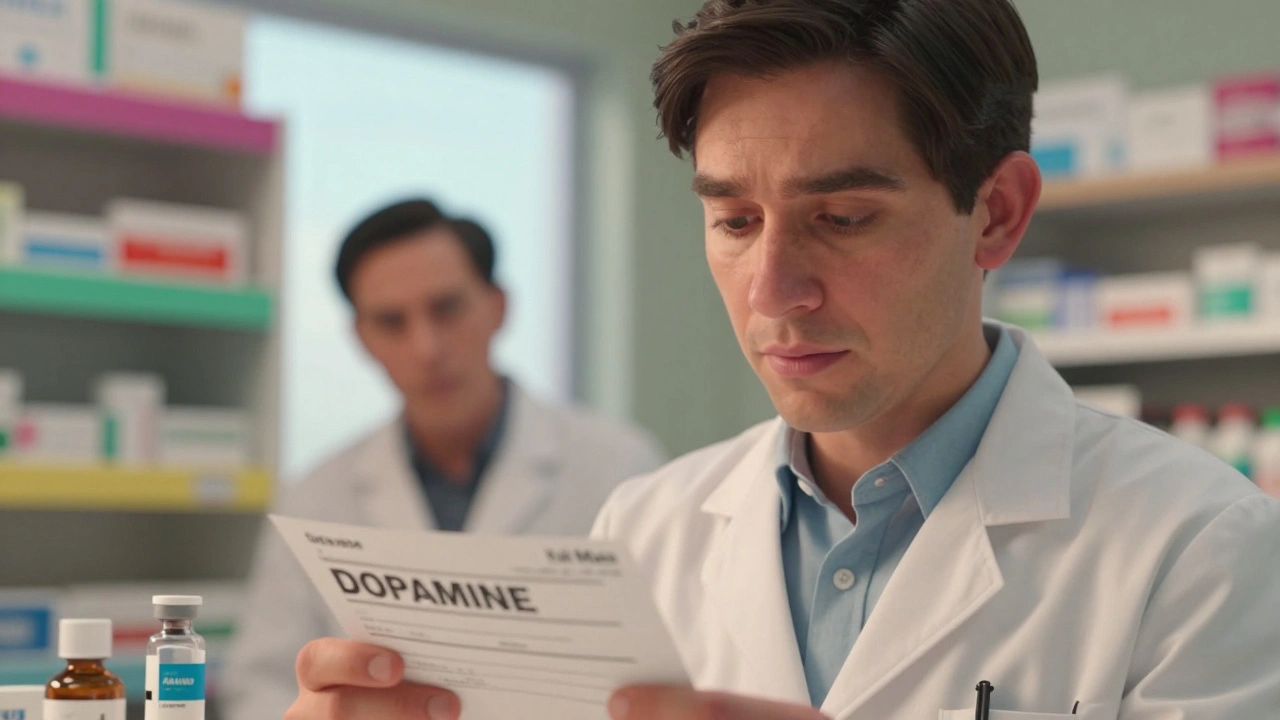
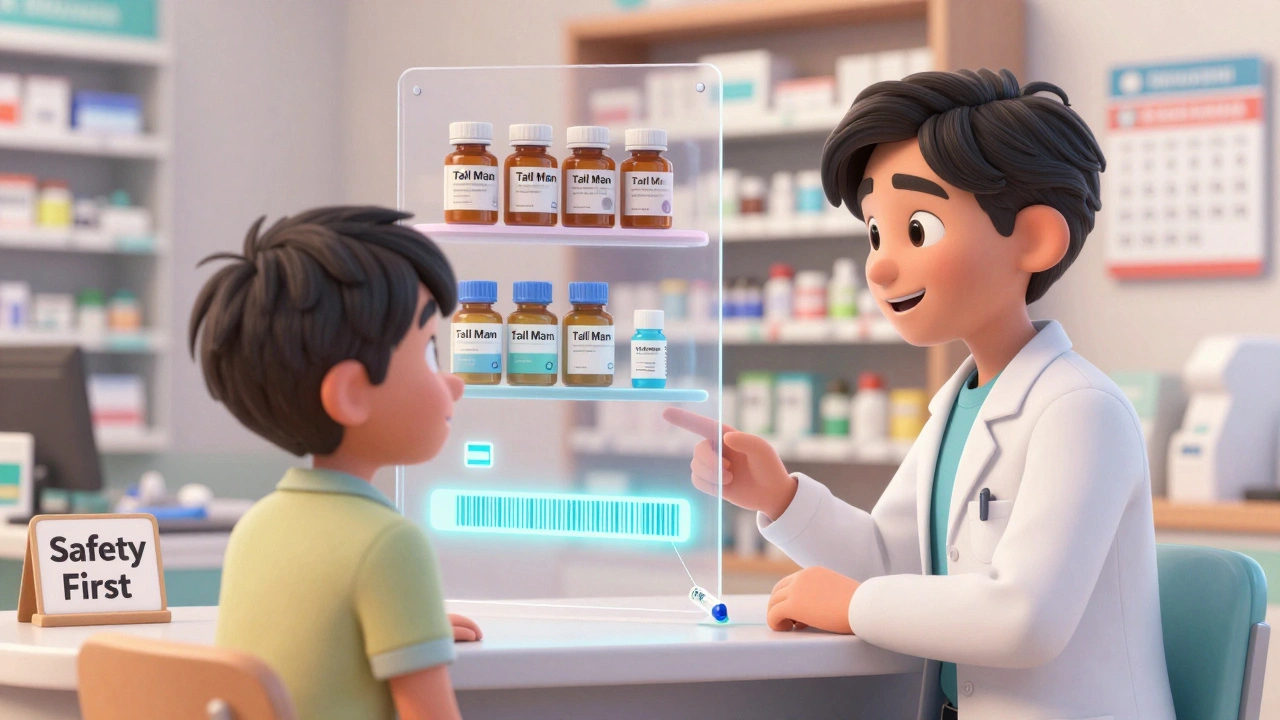
Names matter. And how they’re written matters even more. Tall Man Lettering (TML) is a simple technique: capitalise the parts of drug names that differ. For example:
- DOPamine instead of dopamine
- DOBUtamine instead of dobutamine
- HYDROmorphone instead of hydromorphone
- PARoxetine instead of paroxetine
When you see DOPamine and DOBUtamine side-by-side, your brain doesn’t confuse them. It sees the difference immediately. ISMP found that TML reduces selection errors by 47% when used consistently.
But here’s the problem: not all systems use it the same way. Some EHRs capitalise the first letter. Others use italics. Some don’t use it at all. In a 2022 survey, only 68% of hospitals used standardised TML. That’s dangerous. If a pharmacist moves from one hospital to another and the labels change, they’re flying blind.
Start with ISMP’s 2024 List of Confused Drug Names. It’s free. It’s updated quarterly. Use it to identify your top 10 risky pairs. Then demand your pharmacy software vendor enable consistent TML. If they won’t, print custom labels. Do it yourself. It’s not ideal-but it’s better than a patient getting the wrong drug.
Barcode Scanning: The Last Line of Defense
Barcode scanning isn’t optional anymore. It’s the safety net. When a pharmacist scans a medication and the system says, “This doesn’t match the prescription,” it stops the error before it leaves the counter.
A 2021 AHRQ report showed barcode scanning reduces medication administration errors by 86%. In a hospital in Manchester, they implemented barcode scanning alongside physical separation and TML. Over 12 months, they eliminated 100% of look-alike packaging errors. Zero incidents. Zero near-misses.
But it’s not magic. If staff bypass the scan because they’re rushed, it fails. A 2021 study at UCSF found that 5-12% of scans were skipped during peak hours. That’s why culture matters. Make scanning non-negotiable. Tie it to quality checks. Reward compliance. Punish shortcuts.
Costs? A full system runs $15,000-$50,000. But consider this: one preventable error can cost a hospital over $20,000 in legal fees, extended care, and lost trust. The return on investment is clear.
Combining Strategies: The Only Way to Get to 94% Safety
No single fix works alone. Physical separation? Great-but doesn’t help if the label is wrong. TML? Useful-but doesn’t stop someone grabbing the wrong bottle from the wrong shelf. Barcode scanning? Powerful-but useless if the barcode is misprinted or skipped.
The real answer? Layer them.
A 2023 study in the American Journal of Health-System Pharmacy found that pharmacies using all three strategies-physical separation, TML, and barcode scanning-achieved 94% error reduction. That’s not a coincidence. It’s science.
Start small. Pick your top three risky pairs. Separate them. Apply TML labels. Enable barcode scanning. Track your progress. Then move to the next three. Within a year, you’ll have cut your error rate in half.
What’s Holding Pharmacies Back?
Space. Budget. Resistance.
Community pharmacies are squeezed. Shelves are full. Budgets are tight. Staff are overstretched. It’s easy to say, “We don’t have room for more dividers.” But you don’t need a new room. You need to rearrange. Move rarely used drugs to the back. Clear out expired stock. Use vertical storage. Even a few inches of space can make a difference.
Cost is another excuse. But you don’t need a $50,000 system to start. Print custom TML labels for your top 5 risky pairs. Buy $200 in shelf dividers. Train staff for 30 minutes. That’s it. The rest can come later.
And resistance? It’s real. Pharmacists hate change. But when you show them the data-when you tell them, “This saved a patient in Aberdeen last month”-they listen. Share stories. Not statistics. Stories.
What’s Changing in 2025?
The FDA just issued new draft guidance in February 2025, requiring standardised Tall Man Lettering for 25 high-risk drug pairs by the end of the year. ISMP added 17 new LASA pairs to its list in January, including buprenorphine and butorphanol, which are already causing confusion in Scottish pharmacies.
Meanwhile, the National Council for Prescription Drug Programs (NCPDP) is rolling out a new standardised LASA data format in Q4 2025. This means EHRs and pharmacy systems will finally talk to each other using the same rules. No more mismatched labels when a patient moves from hospital to community pharmacy.
And AI is coming. Johns Hopkins is testing a prototype system that scans drug packaging and flags visual similarities before dispensing. It’s not perfect yet-but it’s getting close.
What You Can Do Today
You don’t need a big budget. You don’t need a tech upgrade. You need action.
- Get ISMP’s 2024 List of Confused Drug Names. Print it.
- Walk your shelves. Find the top 5 look-alike pairs. Mark them.
- Separate them with plastic dividers or coloured tape.
- Print custom labels with Tall Man Lettering for those drugs.
- Enable barcode scanning if you have it. If you don’t, push for it.
- Make a quick checklist: “Did I check for look-alikes before dispensing?” Add it to your daily routine.
It’s not about perfection. It’s about progress. One shelf. One label. One scan. At a time.
Final Thought: It’s Not About Technology. It’s About Care.
Technology helps. But the real safety net is the person behind the counter. The pharmacist who pauses. Who looks. Who asks, “Does this feel right?”
That pause? That’s what saves lives.
What are the most common look-alike drug pairs in UK pharmacies?
The most frequent look-alike pairs in UK pharmacies include hydralazine/hydroxyzine, insulin glargine/insulin lispro, paroxetine/fluoxetine, spironolactone/spiramycin, and buprenorphine/butorphanol. These pairs are listed in ISMP’s 2024 updated list of confused drug names, which is updated quarterly based on real-world error reports. Many of these drugs are commonly prescribed for chronic conditions, making errors especially dangerous.
Does Tall Man Lettering really work in practice?
Yes, but only if it’s applied consistently. ISMP’s analysis of 15 hospital systems showed a 47% reduction in selection errors when Tall Man Lettering was used correctly. However, inconsistent formatting across EHR systems reduces its effectiveness. In one case, a pharmacist in Leeds received a prescription for DOPamine but saw DOBUTamine displayed in the hospital’s EHR-because the system didn’t use standard capitalisation. That’s why pharmacies must enforce a single, clear standard for TML across all labels and screens.
Can small community pharmacies afford barcode scanning?
Yes, but not necessarily with a full system. Entry-level barcode scanners cost under £300. Many pharmacy management systems like Medi-Quick and Pharmasoft offer basic barcode integration at no extra cost. The bigger barrier isn’t price-it’s workflow. Staff must be trained to scan every time, without exception. Start with high-risk drugs only. Scan insulin, heparin, and anticoagulants first. Expand later. Even partial use cuts errors significantly.
How often should pharmacies review their packaging risks?
At least quarterly, and immediately when new drugs arrive. New medications are the biggest source of unanticipated look-alike risks. For example, when a new generic version of a drug hits the market, its packaging may look identical to another existing drug. ISMP recommends a formal review process: whenever a new drug is added to the formulary, compare its packaging to all existing drugs using a visual checklist. Don’t wait for an error to happen.
What’s the biggest mistake pharmacies make when trying to prevent these errors?
Relying on just one solution. Many pharmacies think, “We use Tall Man Lettering, so we’re safe.” But packaging similarity accounts for 35% of LASA errors, according to AHRQ. Names are only part of the problem. You need physical separation, clear labels, scanning, and staff awareness-all working together. The most dangerous pharmacies are the ones that feel they’ve “solved” the problem because they did one thing right.
Ignacio Pacheco
December 3, 2025 AT 02:33So let me get this straight-we’re spending millions on EHR upgrades while pharmacists are still grabbing insulin like it’s a Snickers bar? The real tragedy isn’t the packaging-it’s that we’ve known how to fix this since the 90s and still treat it like a suggestion, not a life-or-death protocol.
Myson Jones
December 5, 2025 AT 00:28Thank you for this thoughtful and necessary breakdown. As someone who has worked in community pharmacy for over two decades, I can tell you that even the smallest interventions-like a simple divider or a bolded letter-can prevent devastating outcomes. It’s not about technology. It’s about intentionality. And yes, it’s possible to do this without breaking the bank.
parth pandya
December 5, 2025 AT 21:31good point on tall man lettering! i was workin in delhi hospital last year and we had a mixup between paroxetin and fluoxetin-both looked the same on screen. we started printin labels with PAROXETIN and FLUOXETIN and error dropped by like 70%. no fancy system, just capital letters. small things matter.
sagar bhute
December 6, 2025 AT 12:03Let’s be real: this isn’t about ‘safety’-it’s about negligence masked as efficiency. Pharmacies cut corners because they’re profit-driven, not patient-driven. You think a $300 divider is expensive? Try billing a family for the funeral of their 72-year-old grandmother who got insulin instead of saline. That’s the real cost.
Cindy Lopez
December 6, 2025 AT 18:58Interesting. But you didn’t mention that most of these errors occur during shift changes, when the new pharmacist hasn’t memorized the shelf layout yet. Training is the real issue, not dividers or labels.
James Kerr
December 7, 2025 AT 19:06Love this. Seriously. I work in a small clinic and we just started separating insulin and heparin with red tape. No scanner yet, but we’ve had zero mix-ups in 4 months. Small wins, y’all. Keep doing the little things. 🙌
shalini vaishnav
December 8, 2025 AT 00:03Of course you Americans are still struggling with this. In India, we’ve had standardized packaging regulations since 2010. Every drug must have a distinct color code, font size, and mandatory bilingual labeling. Your system is archaic. You’re not behind-you’re embarrassingly behind.
Gene Linetsky
December 9, 2025 AT 02:08Who’s really behind this? The pharmaceutical companies. They design these packages to be confusing so you can’t easily switch generics. They know if you can’t tell the difference, you’ll just keep buying the expensive brand. This isn’t an accident-it’s a business model. The FDA’s new rules? A distraction. They’re still letting the same companies control the labels.
Francine Phillips
December 10, 2025 AT 23:48Barcodes help but only if people use them. I’ve seen techs swipe five times because the scanner’s ‘glitching’
Katherine Gianelli
December 12, 2025 AT 22:19God this hits hard. I lost my uncle to a mix-up like this-hydroxyzine instead of hydralazine. He was just trying to manage his blood pressure. The pharmacy said ‘it looked the same’ and handed it over. No one got fired. No one apologized. Just another statistic. Please don’t wait for a tragedy to act. Start today. One shelf. One label. One life.
Joykrishna Banerjee
December 14, 2025 AT 00:33While your proposed solutions are technically sound, they lack the necessary epistemological rigor. The real issue lies in the ontological dissonance between pharmaceutical semiotics and clinical cognition. Without a standardized taxonomy of visual pharmacological affordances, even TML and dividers are merely symptomatic palliatives. You need a semiotic audit, not a shelf rearrangement.
Rashmin Patel
December 14, 2025 AT 18:35I’ve been a pharmacist in Mumbai for 18 years and I can tell you-this isn’t just about labels or scanners. It’s about trust. When a pharmacist pauses, takes a breath, and looks at the bottle like it’s a person-not a product-that’s when the magic happens. I once stopped a mix-up between buprenorphine and butorphanol just because I noticed the cap was a slightly different shade of blue. Took me 3 seconds. Saved a life. No tech needed. Just presence.
Jim Schultz
December 15, 2025 AT 19:53Let’s be honest-this whole article is a distraction. The real problem? The FDA’s outdated approval process. They approve new drugs without requiring standardized packaging. Then they blame pharmacists for the fallout. It’s a corporate shell game. The same companies that profit from confusion are the ones lobbying against regulation. You’re fixing the symptom. The disease is corporate greed.
Kidar Saleh
December 16, 2025 AT 15:40As a pharmacist in Edinburgh, I’ve seen this firsthand. We installed dividers after the Glasgow insulin incident. No fanfare. No press release. Just a quiet change. And you know what? We haven’t had a single error since. It’s not about being heroic. It’s about being human. Pausing. Looking. Caring. That’s what saves lives-not software, not budgets, not regulations. Just someone who refuses to look away.