How to Coordinate Multiple Prescriptions for Fewer Copays
 Nov, 29 2025
Managing multiple prescriptions can feel like juggling too many balls at once-especially when each one has a different refill date, copay amount, and insurance rule. If you’re on three, five, or even eight medications for chronic conditions like diabetes, high blood pressure, or arthritis, you’re not just dealing with pills-you’re managing a whole system. And that system often costs more than it should, not because the drugs are expensive, but because of how often you’re paying copays.
Here’s the truth: medication synchronization isn’t just a pharmacy perk. It’s a proven way to cut your out-of-pocket costs, reduce missed doses, and simplify your life. And it’s free.
What Medication Synchronization Actually Does
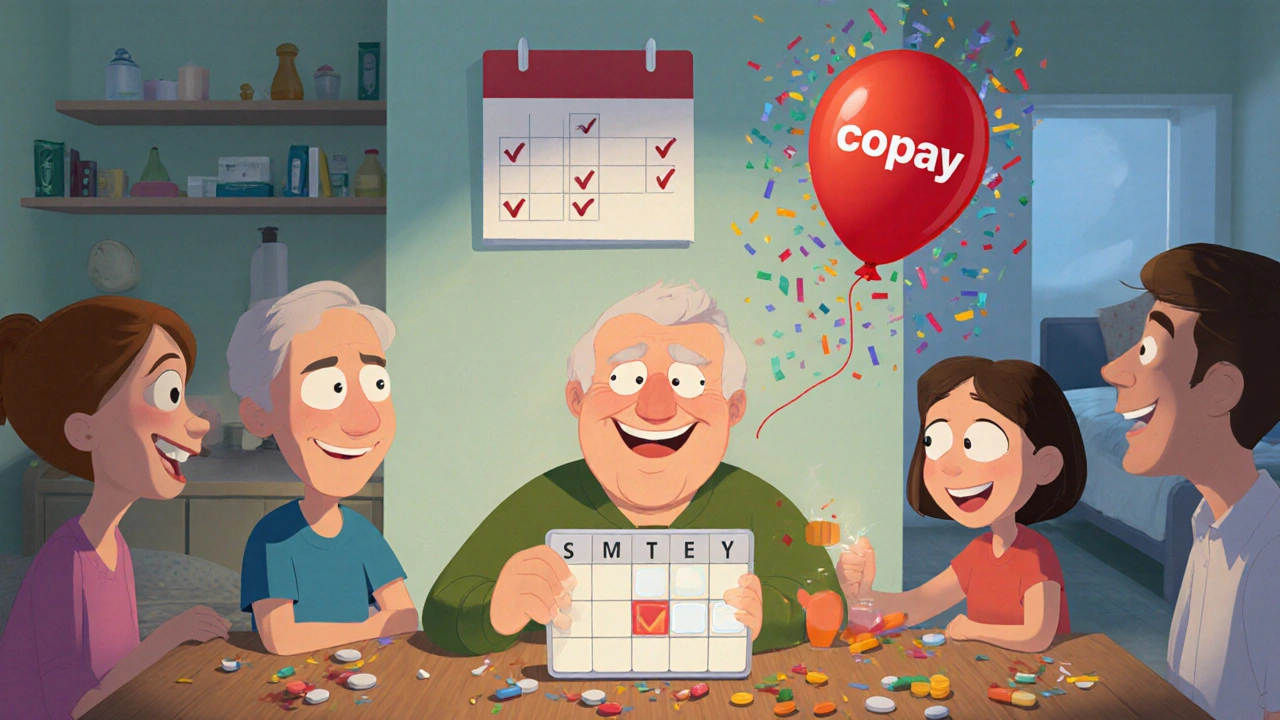
Medication synchronization, or "med sync," means getting all your regular prescriptions filled on the same day each month. Instead of running to the pharmacy every few weeks for one pill, you walk in once a month and pick up everything you need. That’s it. No more confusing calendars, no more surprise copays, no more forgetting which pill you’re supposed to take when.
This isn’t magic. It’s a structured process that pharmacies have been using since the early 2010s. The American Pharmacists Association laid out clear guidelines for it in 2014, and since then, studies have shown it cuts hospital visits by nearly 19% for Medicare patients. Why? Because when you’re not missing doses, your condition stays stable. And when you’re not making five trips a month to the pharmacy, you’re not paying five copays.
Take a real example: A 72-year-old woman on eight chronic medications was going to the pharmacy 12 times a year. Each trip cost her $10-$25 in copays. That’s $120-$300 a year just in fees-not even counting gas or bus fare. After enrolling in med sync, she went four times a year. Same meds. Same dosages. But now she paid only $40-$100 in copays annually. She saved money. She remembered to take her pills. And her doctor noticed her blood pressure improved.
How It Works: The Four-Step Process
Getting started is simple. You don’t need a doctor’s note. You don’t need to fill out forms online. Just walk into your pharmacy and ask.
- Enroll-Tell your pharmacist you want to sync your prescriptions. They’ll ask for a list of all your meds, including over-the-counter ones and supplements. Don’t skip anything. Even that daily aspirin matters.
- Medication review-The pharmacist checks everything: interactions, dosages, refill dates, insurance coverage. They’ll spot if you’re getting duplicate drugs or if one medication could be replaced with a combination pill.
- Short fills-This is the tricky part. To align all your refills, the pharmacy might give you a smaller supply of one or two meds for a few weeks. For example, if your blood pressure pill usually runs out in 30 days but your cholesterol pill runs out in 90, they might give you a 15-day supply of the cholesterol pill so both can sync up next month. It’s temporary. It’s safe. And it’s the only way to make the system work.
- Monthly pickup-Once everything’s aligned, you get a call or text every month: "Your meds are ready. Come in on the 15th." You walk in, pick up everything, and leave. No more guessing. No more stress.
The whole process takes 1 to 3 months, depending on how your refills are spaced. Don’t get discouraged if it doesn’t happen overnight. Patience pays off.
Why Copays Add Up Faster Than You Think
Here’s where most people get stuck: they think a $10 copay is cheap. But if you’re paying that for five different meds, every 30 days, that’s $50 a month. $600 a year. And that’s before you factor in insurance deductibles, tiered formularies, or copay accumulators.
Medicare beneficiaries in three-tiered plans-where drugs are grouped by cost-pay 57.6% more per prescription than those in simpler plans, even if their total drug spending is lower. That’s because insurers push higher-cost drugs into higher tiers, forcing patients to pay more out of pocket each time they refill.
And then there are copay accumulator programs. These are insurance tricks that started popping up around 2017. If you use a manufacturer’s coupon to lower your copay for a specialty drug, the insurer might not count that toward your deductible. So you’re paying less now-but your out-of-pocket costs stay high all year. One patient reported their $5,000 manufacturer coupon was voided by their insurer, turning a $50 monthly cost into $650. That’s not a savings. That’s a trap.
Med sync doesn’t fix copay amounts. But it cuts the number of times you pay them. And that’s huge.

Combination Pills: The Ultimate Shortcut
Some medications now come in single pills that combine two or more drugs. For example, instead of taking a blood pressure pill and a water pill separately, you might take one combo pill that does both. This eliminates coordination problems entirely.
Between 2018 and 2023, the FDA approved 127 new combination medications. These are especially common for diabetes, heart disease, and HIV. Ask your pharmacist: "Is there a combo pill for my meds?" If you’re on two drugs that work together, there’s a good chance one exists.
Studies show that patients who switch to combination pills are 27% less likely to miss doses. That’s not just about convenience. It’s about survival. Missing doses of heart or diabetes meds increases your risk of stroke, kidney failure, and hospitalization.
When Med Sync Doesn’t Work-and What to Do
Med sync isn’t perfect. Some meds can’t be synced because of insurance rules. For example:
- 90-day supplies (often cheaper) can’t always be synced with 30-day ones.
- Some acute meds, like antibiotics or painkillers, aren’t eligible.
- Medicare Part D limits early refills to just two days before you’ve used 70% of your supply.
If your pharmacy says they can’t sync a certain drug, ask them to request an "early refill exception." Most insurers approve these if your pharmacist explains it’s for adherence. In 63% of cases where refill schedules clash, pharmacists can get around the issue with a simple call to your insurance.
Another problem: specialty drugs. These are expensive, often used for conditions like rheumatoid arthritis or multiple sclerosis. They make up less than 20% of prescriptions but over half of all drug spending. Their copays can be $500 or more. Med sync helps you pick them up once a month instead of every few weeks-but it doesn’t lower the cost.
Here’s what to do: Ask your pharmacist about "copay maximizer" programs. These are alternative funding options from drugmakers that work around insurer restrictions. Some manufacturers now offer direct financial aid or mail-order discounts that bypass traditional copay cards. Don’t assume your coupon is useless. Ask.
Real Talk: What Patients Are Saying
On Reddit, users in the r/medicare community shared their experiences. One wrote: "I synced my mom’s 8 meds. We went from 12 pharmacy trips a year to 4. She hasn’t missed a dose since." Another said: "My copay accumulator wiped out my $5,000 coupon. I thought I was getting help-turns out, I was just being nickel-and-dimed."
Trustpilot reviews of Walgreens’ ScriptSync program show 4.2 out of 5 stars. Most praise the simplicity. But 32% of negative reviews mention the "short fill" period causing temporary shortages. That’s normal. Talk to your pharmacist. They can give you a few extra pills to cover the gap.
And here’s the kicker: Medicare beneficiaries who use med sync have 23.6% fewer hospital admissions for medication-related problems. That’s not just省钱. That’s staying out of the ER.
What You Need to Do Right Now
You don’t need to wait for your next doctor’s visit. You don’t need to call your insurer. You don’t need to fill out paperwork.
Go to your pharmacy. Ask the pharmacist: "Can you sync all my chronic medications to one day each month?"
Bring a list. Even if you think you know your meds, write them down. Include supplements. Include over-the-counter pills. Include the ones you only take when you feel bad.
Ask: "Is there a combo pill for any of these?"
Ask: "Do you know if my insurance has a copay accumulator program?"
Ask: "Can you help me find a manufacturer program that works with my plan?"
That’s it. That’s the whole strategy.
By the end of the next month, you could be paying fewer copays, taking your meds on time, and spending less time at the pharmacy. That’s not just smart. It’s life-changing.
Why This Matters More Than Ever
Drug prices keep rising. Specialty meds now cost more than $1,000 a month. Insurers are using complex rules to shift costs to patients. But medication synchronization is one of the few tools that puts control back in your hands.
By 2030, experts predict 95% of chronic medication management will use some form of synchronization. It’s becoming standard. Why? Because it works. It saves money. It saves lives.
You don’t need to wait for policy changes. You don’t need to wait for your doctor to bring it up. You can start today.
Can I sync my prescriptions if I’m on Medicare?
Yes. Medicare Part D patients can enroll in medication synchronization through any major pharmacy chain like CVS, Walgreens, or Rite Aid. The program is free, and pharmacies are required to offer it under CMS guidelines. Some Medicare plans may have restrictions on early refills, but pharmacists can often request exceptions.
Will med sync lower my copay amount per prescription?
No. Med sync doesn’t change how much you pay per pill. But it reduces how often you pay. If you used to pay five copays a month, you’ll now pay one. That can cut your annual out-of-pocket spending by 60-80%-even if each copay stays the same.
What if my insurance won’t let me refill early for sync?
Medicare Part D limits early refills to two days before you’ve used 70% of your current supply. But pharmacists can call your insurer for an "early refill exception" if it’s for adherence. In 63% of cases where refill dates clash, these exceptions are approved-especially when the pharmacist explains the clinical benefit.
Are combination pills always better than syncing?
Combination pills eliminate coordination issues entirely and can reduce missed doses by up to 27%. But they’re only available for specific drug pairs-like metformin and sitagliptin for diabetes, or amlodipine and lisinopril for high blood pressure. If a combo exists for your meds, it’s ideal. If not, med sync is the next best option.
Do I need to tell my doctor about med sync?
You don’t need permission, but it’s smart to tell your doctor. They can help identify if any of your meds could be switched to combination pills. Some doctors also use med sync data to spot adherence patterns and adjust treatments. Your pharmacist will update your record, but your doctor should know too.
What if I travel or live far from the pharmacy?
Many pharmacies offer mail-order for synchronized prescriptions, especially for 90-day supplies. Ask if your sync program includes home delivery. Some also let you pick up at any location within their chain. CVS, for example, allows ScriptSync pickups at any CVS Pharmacy nationwide.
How long does it take to get synced?
It usually takes 1 to 3 months, depending on how your refill dates are spaced. The pharmacy may need to give you short fills to align everything. Be patient. Once synced, you’ll get a monthly reminder and pick up everything at once-forever, unless your meds change.
Can I sync over-the-counter meds or supplements?
Yes. Pharmacists include all medications you take regularly-even aspirin, calcium, or vitamin D-when creating your sync plan. This helps them spot interactions and ensures you never run out of something important.
Peter Lubem Ause
November 29, 2025 AT 20:22Man, I wish I knew about this five years ago. I was paying $80 a month just in copays for my diabetes, BP, and cholesterol meds-five separate trips, every time I forgot one, I’d panic. Syncing turned it into one stop, one payment. No more scrambling. No more ‘did I take my pill?’ anxiety. I even started taking my fish oil and vitamin D with everything now, and my pharmacist caught that I was double-dosing on magnesium. Saved me from a nasty side effect. This isn’t just省钱-it’s sanity.
linda wood
November 30, 2025 AT 16:02So let me get this straight-you’re telling me the pharmacy can just… magically fix my insurance’s dumb copay accumulator trap by rearranging my refill dates? And I didn’t need to fight a robot for 47 minutes on the phone? 🤯
LINDA PUSPITASARI
December 2, 2025 AT 00:20OMG YES YES YES 😭 I synced my mom’s 9 meds last month and she cried because she finally slept through the night without worrying about pills. The short fill thing freaked her out at first but the pharmacist gave her 3 extra days of her BP med and she was fine. Also-combo pills? I didn’t know amlodipine and lisinopril were in one now! Going to ask my doc tomorrow. Thank you for this 🙏
gerardo beaudoin
December 2, 2025 AT 21:08Just walked into CVS today and asked. Pharmacist said ‘oh yeah, we do that’ and did it in 10 minutes. No forms, no drama. My meds are all synced to the 12th now. I’m already saving $120 a month. Why isn’t everyone doing this?
Joy Aniekwe
December 3, 2025 AT 15:57Wow. So the whole system is designed to make you pay more by scattering your refills? That’s not a bug, that’s a feature. And the copay accumulator thing? That’s pure predatory nonsense. My insurance did that to me last year. I thought I was getting help with my $300/month drug. Turns out they just made me pay the full deductible faster. This post is a public service.
tushar makwana
December 4, 2025 AT 20:16in india we dont have this kind of system but i heard from my cousin in texas he said his pharmacy do this and he save lot of money. maybe one day india will also have this. for now i just take all pills at morning and hope for best
Richard Thomas
December 5, 2025 AT 08:20While the operational efficiency of medication synchronization is undeniably laudable, one must critically examine the structural inequities that necessitate such workarounds in the first place. The fact that patients must navigate labyrinthine insurance protocols and pharmacist-mediated exceptions to avoid financial ruin speaks less to innovation and more to systemic failure in pharmaceutical reimbursement policy. One cannot help but wonder whether this is a Band-Aid on a hemorrhaging wound.
Monica Lindsey
December 6, 2025 AT 06:26You’re telling people to ask their pharmacist to fix insurance fraud? That’s like asking the cashier to fix the ATM that stole your money. Pathetic.
Bernie Terrien
December 7, 2025 AT 23:45This is the most beautiful thing I’ve read all year. The copay accumulator is a goddamn scam. I got burned by it. I’m going to sync my meds tomorrow and then I’m calling my insurer with a recorded line: ‘You’re not a health plan. You’re a toll booth.’
Jennifer Wang
December 8, 2025 AT 23:57Per CMS guidelines under 42 CFR § 423.120, pharmacies are indeed obligated to offer medication synchronization services to Medicare Part D beneficiaries. However, the implementation is contingent upon the plan’s formulary design and the pharmacy’s operational capacity. Patients should verify eligibility through their plan’s online portal or by contacting Member Services prior to initiating the process. Documentation of all communications is advised for dispute resolution.
stephen idiado
December 10, 2025 AT 03:40Med sync? That’s just a redistribution of administrative burden. You’re still paying the same copays-you’re just doing it less often. Meanwhile, the real issue is drug pricing, not refill scheduling. This is a distraction tactic by Big Pharma to make you think you’re in control while they jack up the base cost.