Future Legal Developments: Proposed Laws and Regulatory Changes in 2025-2026
 Jan, 23 2026
By early 2026, the legal landscape in the U.S. has shifted more in the last two years than in the previous decade. What used to be slow-moving policy debates have turned into fast-moving regulatory storms-especially in employment, housing, taxes, and criminal justice. If you're running a business, managing payroll, or even just filing your taxes, you can't afford to ignore what’s coming. This isn’t about distant future predictions. These are laws that took effect in 2025 or will kick in before the end of 2026. And they’re already changing how organizations operate.
California’s Labor Laws Are Rewriting the Rules
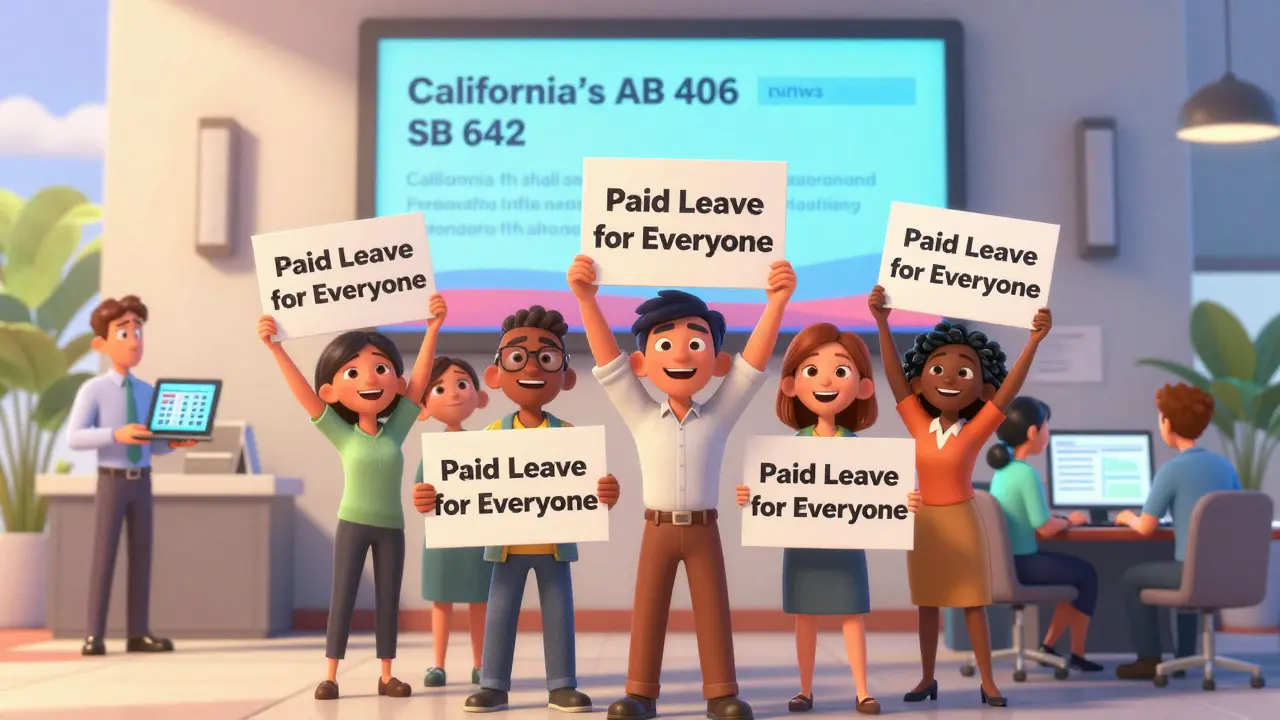
California didn’t just tweak its labor laws in 2025-it rebuilt them. Assembly Bill 406, which took effect October 1, 2025, merged three separate leave provisions into one: victims’ leave, family leave, and paid sick leave. Now, employees can take time off for domestic violence, sexual assault, or stalking, and employers must update their policies to reflect this. The Civil Rights Department released a new model notice, and failure to display it can cost businesses up to $5,000 per violation.
On top of that, Senate Bill 642 changed pay transparency rules. Employers with 15 or more workers must now list salary ranges in every job posting-even for remote roles if the employee could work in California. And if you’re hiring in California, you can no longer ask about salary history. The goal? Close the gender pay gap. But the cost? Companies report spending $1,200 to $1,800 per employee just to train managers and update HR systems.
Senate Bill 590, though not active until July 2028, is already forcing employers to rethink family definitions. Paid Family Leave will now cover anyone considered a “designated person”-a friend, partner, or caregiver who isn’t related by blood but has a close emotional bond. This isn’t just about compassion. It’s about legal liability. If you don’t update your leave policies to include these relationships, you risk lawsuits.
The Federal Tax Shift: What Changed in the ‘One, Big, Beautiful Bill’
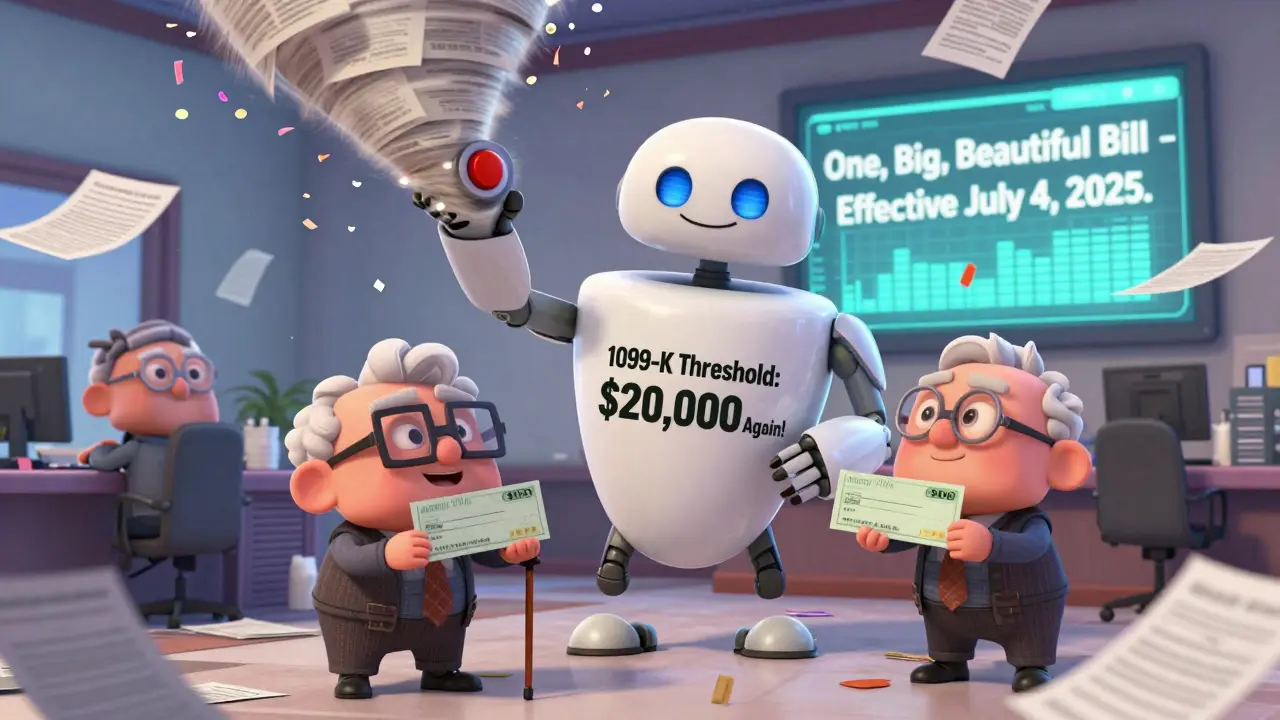
On July 4, 2025, Congress passed Public Law 119-21-dubbed the ‘One, Big, Beautiful Bill’-and it didn’t just tweak the tax code. It flipped it upside down. The most visible change? A $6,000 deduction for taxpayers aged 65 and older, effective through 2028. That’s not a credit. That’s a direct reduction in taxable income. For a retiree making $40,000 a year, this could mean paying $900 less in federal taxes annually.
But the real shock came with Form 1099-K. For years, the IRS required reporting for any third-party payment app transaction over $20,000 and 200 transactions. In 2023, that dropped to $600. In October 2025, the IRS reversed course. Back to $20,000. Why? Pressure from gig workers, small sellers, and freelancers who were drowning in paperwork. The change was retroactive to January 1, 2025, meaning tax professionals had to refile hundreds of thousands of returns.
The IRS also issued FS-2025-07 to clarify Employee Retention Credit rules under the new law. Many businesses that claimed credits in 2021 and 2022 now need to reevaluate eligibility. The agency warned of audits targeting those who claimed credits improperly. If your business used payroll services like Gusto or ADP, you likely got an automated alert. If you didn’t, you’re at risk.
Housing Reform: California Breaks the Development Logjam
California’s housing crisis has been called a national emergency. In June 2025, Governor Gavin Newsom signed AB 130 and SB 131-two bills that gutted the California Environmental Quality Act (CEQA) for housing projects. For decades, CEQA allowed neighbors to delay or block construction with lawsuits over minor environmental concerns. Now, if a project meets state affordability and density targets, it’s exempt from most CEQA reviews.
The result? Project approval times dropped from 3-5 years to 1-2 years. The California Building Industry Association estimates 25,000 additional housing units will be built annually. That’s a 15-20% increase. But it’s not all win-win. Developers now face stricter affordability mandates. In high-cost areas like San Francisco and Los Angeles, 35% of units in new projects must be reserved for low-income tenants. And local governments can’t impose parking minimums anymore.
Legal teams are scrambling. Law firms that once specialized in CEQA litigation are pivoting to advising developers on how to qualify for exemptions. Environmental groups are filing constitutional challenges. The courts will decide whether these changes violate state environmental protections. For now, the law stands-and construction cranes are rising faster than ever.
Firearms and Law Enforcement: LEOSA Reform Act Expands Carry Rights
On May 15, 2025, the House passed H.R.2243, the LEOSA Reform Act of 2025. It’s one of the most significant changes to concealed carry rights in decades. Qualified active and retired law enforcement officers can now carry firearms in places previously off-limits: school zones, national parks, state parks, and even some federal buildings. States can no longer require retired officers to requalify annually. The minimum requirement is now every three years.
But here’s the catch: this law doesn’t override local ordinances. In New York City, for example, retired officers still need a permit to carry. In Texas, they don’t. The law creates a patchwork of rules that even police departments are struggling to navigate. Many departments have issued new internal memos to officers, and legal advisors are being consulted before any officer travels out of state.
Private businesses can still ban firearms on their property. But now, if an off-duty officer walks into a coffee shop in California with a concealed weapon, the shop owner can’t legally ask them to leave unless they’re acting suspiciously. This has sparked lawsuits in states like New Jersey and Illinois, where local laws conflict with the federal statute.
The Supreme Court Is Rewriting Constitutional Boundaries
It’s the 20th anniversary of the Roberts Court. And it’s not just a milestone-it’s a turning point. In 2025, the Court took up five cases that could redefine presidential power, voting rights, and agency authority. One case, United States v. Federal Energy Regulatory Commission, challenges whether federal agencies can create rules without explicit congressional approval. If the Court rules against agencies, hundreds of regulations-from environmental standards to workplace safety rules-could vanish overnight.
Another case, State v. Davis, questions whether states can ban firearms in public spaces if they’re not licensed by the federal government. The outcome could invalidate gun control laws in 15 states. Legal departments at Fortune 500 companies have increased constitutional law expertise by 25% since early 2025. Why? Because every major decision from the Court now carries financial risk. A ruling that limits agency power could wipe out compliance costs overnight-or create new ones.
By late 2025, Bloomberg Law reported that 70% of corporate legal teams now track Supreme Court docket activity weekly. That’s up from 12% in 2020. The Court isn’t just interpreting law anymore. It’s shaping corporate strategy.

Compliance Is No Longer a Department-It’s a Company-Wide System
Here’s the hard truth: you can’t outsource compliance anymore. You can’t wait for a newsletter or a webinar. The changes are too fast, too complex, and too interconnected.
Companies are hiring compliance officers at a record pace. RegEd’s 2025 survey found that 63% of mid-sized firms increased compliance staff by 15-20%. Larger firms are turning to AI-powered RegTech tools. Deloitte found that 78% of Fortune 500 companies plan to use AI to monitor regulatory changes by 2026. These tools scan federal and state databases daily, flagging updates in real time. One company in Atlanta reduced compliance errors by 89% in six months after switching to a RegTech platform.
But technology alone isn’t enough. HR, legal, finance, and operations teams now meet weekly. Why? Because a change in paid leave rules affects payroll, benefits, and training. A tax deduction change impacts accounting, payroll, and employee communications. You need everyone in the room.
Organizations that treat compliance as a checklist are failing. Those treating it as a living system-constantly adapting, training, and auditing-are surviving. And thriving.
What’s Coming in 2026?
Don’t think 2025 was the peak. It was just the beginning. Over 1,200 new state-level regulations are expected in the second half of 2025, many taking effect in early 2026. The IRS will release tax inflation adjustments for 2026, including updates from the ‘One, Big, Beautiful Bill.’ Congress is still debating bills to restore free phone calls for detainees-a change that could impact prison contracting and legal access.
Healthcare is next. Medicare Advantage rules are being rolled back at the federal level, but states like New York and Massachusetts are tightening oversight. Expect a clash. Employers offering health plans will need to track both federal and state rules simultaneously.
And if you’re in finance, get ready. State insurance compliance requirements jumped 22% in the first half of 2025. That trend isn’t slowing. Gartner predicts RegTech spending will grow 35% in 2025 alone. If you’re not investing in compliance infrastructure, you’re betting your business on luck.
Final Reality Check
There’s no going back. The era of slow, predictable legal change is over. The U.S. is now a patchwork of 51 different legal systems-federal plus 50 states. What’s legal in one state is illegal in another. What’s required today might be gone tomorrow. And what’s banned now could be mandated next year.
Businesses that survive aren’t the ones with the biggest legal teams. They’re the ones with the most agile systems. They’re the ones who train staff monthly, update policies quarterly, and monitor changes daily. They don’t wait for lawyers to tell them what’s changed. They find out before it hits the news.
If you’re reading this and thinking, ‘I’ll handle it next quarter,’ you’re already behind. The laws are here. The clock is ticking. And the next change is already in motion.
Husain Atther
January 25, 2026 AT 10:19Interesting breakdown. I’ve been watching these changes from India, and it’s wild how one country’s legal shifts can ripple across global HR and compliance systems. The California leave policy update alone could influence multinational policies in Bangalore and Hyderabad. It’s not just US law anymore-it’s global operational law.
Izzy Hadala
January 25, 2026 AT 12:17The retroactive application of the Form 1099-K threshold change to January 1, 2025, constitutes a significant administrative and constitutional overreach. The IRS has no statutory authority to impose retroactive reporting obligations absent explicit congressional delegation. This sets a dangerous precedent for regulatory ex post facto enforcement, particularly concerning independent contractors who operated under prior thresholds.
Marlon Mentolaroc
January 26, 2026 AT 17:07Bro, the ‘One, Big, Beautiful Bill’ was a dumpster fire wrapped in a tax cut. $6k deduction for retirees? Cute. But the fact that they flipped the 1099-K back to $20k just because gig workers complained? That’s not policy-that’s panic. And now we’re stuck with a mess of refiles, audits, and confused small biz owners who thought they were ‘in the clear.’ Classic government whiplash.
Gina Beard
January 28, 2026 AT 02:56Compliance isn’t a department. It’s a mindset. And most people still think it’s someone else’s job.
Don Foster
January 30, 2026 AT 01:20CEQA reform? Please. You think eliminating environmental reviews for housing is progress? That’s not reform that’s surrender. You want affordable housing? Build it on federal land. Don’t gut 50 years of environmental law because cities are too lazy to zone properly. And don’t get me started on the LEOSA Act-now off-duty cops can carry in Starbucks and no one can ask them to leave? What’s next? Armed librarians?
siva lingam
January 31, 2026 AT 12:14So 1200 new regs in 2026... and you’re surprised? Welcome to America where bureaucracy is the national sport
Shelby Marcel
January 31, 2026 AT 22:06wait so the 1099-k thing went back to 20k?? but i swear i got an email last month saying it was still 600?? did i miss something or is the irs just messing with us??
blackbelt security
February 2, 2026 AT 08:29Agile systems win. Not big teams. Not fancy lawyers. Systems that adapt daily. If you’re still waiting for quarterly compliance updates, you’re already out of the game. Start small. Track one regulation. Automate it. Then add another. That’s how you survive.
Josh McEvoy
February 3, 2026 AT 00:25THE SUPREME COURT IS ABOUT TO ERASE HUNDREDS OF REGULATIONS 😱🤯 and no one’s talking about how this will tank small businesses who relied on those rules?? like… what if the EPA rules vanish overnight?? do we just stop testing water?? this is chaos 😭
Heather McCubbin
February 4, 2026 AT 10:58People still think compliance is paperwork. It’s not. It’s moral responsibility wrapped in legal jargon. If you’re not training your team monthly you’re not running a business you’re running a lawsuit waiting to happen
Tiffany Wagner
February 5, 2026 AT 08:58i just started a small biz last year and this post scared me but also helped. i signed up for a regtech tool and now i get daily alerts. it’s not perfect but i sleep better. thanks for the reality check