Evergreening: How Pharmaceutical Brands Delay Generic Drugs to Protect Profits
 Dec, 8 2025
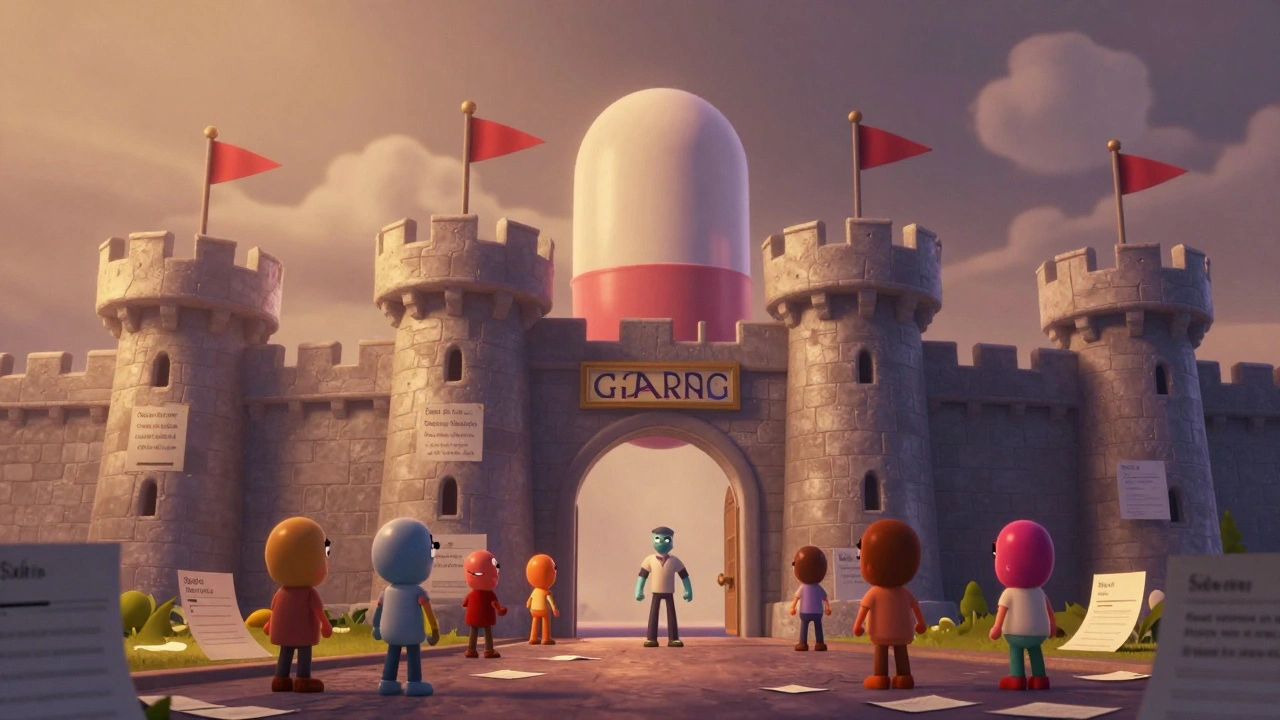
When a blockbuster drug’s patent is about to expire, you might expect prices to drop. After all, generics are cheaper, safer, and just as effective. But in many cases, they never show up - not because they can’t be made, but because the original brand has already locked the door. This is evergreening: a legal, calculated strategy used by pharmaceutical companies to stretch patent life by making tiny changes to old drugs. It’s not innovation. It’s a financial maneuver that keeps prices high and patients paying more.
How Evergreening Works - Step by Step
Every new drug starts with a 20-year patent clock. But that clock doesn’t tick down in a straight line. Companies file additional patents - dozens, sometimes hundreds - on minor tweaks: a new capsule shape, a delayed-release formula, a slightly different salt form, or a combo with another drug. Each new patent adds more time. The original patent might expire in 2027, but if a company files five more patents over the next decade, the drug stays protected until 2037 - or even 2040. Take Humira, the autoimmune drug made by AbbVie. Between 2002 and 2023, AbbVie filed 247 patents on Humira. Over 100 were granted. That’s not innovation. That’s a patent thicket. Each patent covers something so small - like a new injection device or a different dosing schedule - that it wouldn’t qualify as a new drug under normal standards. But under U.S. patent law, it’s enough to block generics. AstraZeneca did the same with Prilosec and Nexium. Prilosec, a heartburn drug, was a bestseller. When its patent neared expiration, AstraZeneca introduced Nexium - essentially the same active ingredient, just a slightly modified version. They marketed it as "the purple pill," claiming it worked better. In reality, clinical studies showed little to no difference. But Nexium came with a new patent, pushing back generic competition by years. The result? Billions in extra revenue.The Tools of the Trade
Pharmaceutical companies don’t rely on one trick. They use a playbook:- Product hopping: Replace the old drug with a new version - often with no real clinical benefit - and stop making the original. Patients are forced to switch, and generics can’t enter until the new patent expires.
- Orphan drug designation: Apply for special status for rare diseases, even if the drug treats common conditions. This gives seven years of exclusivity.
- Pediatric exclusivity: Run small studies on children, even if the drug isn’t meant for them. This adds six months to the patent.
- Authorized generics: Launch a generic version yourself, under your own brand. This keeps control of the market while pretending to allow competition.
- Patent clustering: File dozens of overlapping patents so any generic maker faces a legal minefield. Challenging one patent means risking lawsuits on the other 50.
Why It Costs Patients
Generic drugs cut prices by 80-85% within the first year. That’s not theory - it’s data. When a drug goes generic, pharmacies and insurers can offer it for pennies on the dollar. But when evergreening blocks generics, those savings vanish. Humira costs around $7,000 per month in the U.S. without insurance. In Canada, where generics entered earlier, the same drug costs under $100. That’s not because Canada is cheaper - it’s because AbbVie’s patent strategy delayed generic entry for over a decade. Millions of patients with rheumatoid arthritis, Crohn’s disease, and psoriasis paid thousands every month because of it. AstraZeneca’s strategy on its top six drugs extended patent life by more than 90 years combined. That’s not a typo. It’s 90 years of monopoly pricing on drugs for diabetes, acid reflux, and high blood pressure - conditions that affect tens of millions. The human cost is real. People skip doses. They ration pills. Some stop treatment entirely. A 2023 study found that 1 in 4 Americans with chronic conditions said they couldn’t afford their meds. Evergreening isn’t the only reason - but it’s a major one.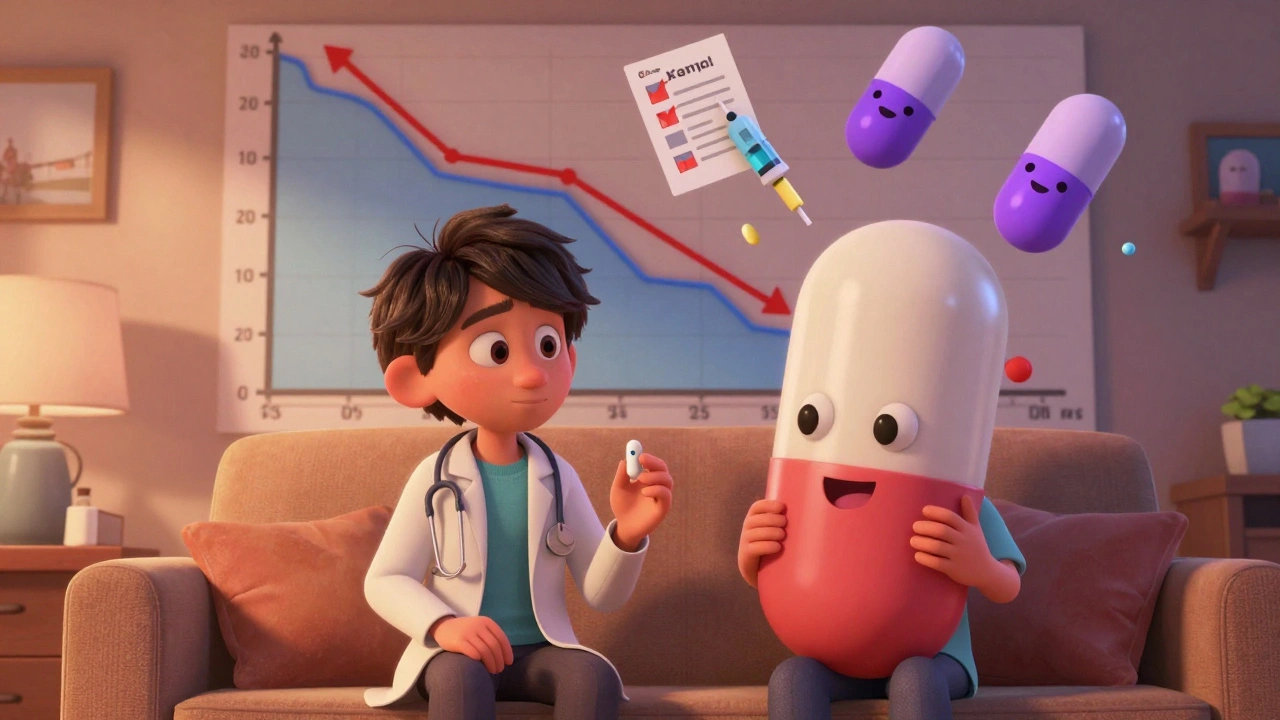
Is This Legal? Yes. Is It Right?
Legally, most of these tactics are allowed. The U.S. Patent and Trademark Office (USPTO) approves them. Courts often side with the brand. The FDA approves the new formulations. Everything follows the rules. But the rules were written for real innovation - not for companies that spend $10 million to tweak a pill and then charge $1 billion in extra revenue. Harvard researchers found that 78% of new patents on prescription drugs were for existing drugs, not new ones. That means most patent activity isn’t about creating new treatments - it’s about extending profits on old ones. Critics call it a scam. Supporters say it funds future research. But the numbers don’t add up. Developing a new drug costs $2.6 billion and takes 10-15 years. Evergreening costs a fraction of that - often under $100 million - and delivers the same profit. Why invest billions in risky new science when you can tweak a pill and lock in revenue for another decade?What’s Changing?
Pressure is building. In 2022, the U.S. Federal Trade Commission sued AbbVie over Humira’s patent strategy, calling it an illegal monopoly. The Inflation Reduction Act of 2022 gave Medicare the power to negotiate prices for the most expensive drugs - a direct hit to evergreening’s profit model. The European Medicines Agency now requires proof of "significant clinical benefit" before granting extra exclusivity. Canada and Australia have stricter rules on product hopping. The World Health Organization has publicly condemned evergreening for blocking access in low-income countries. Even within the industry, some executives admit the practice is unsustainable. "We’re running out of easy tweaks," one senior patent lawyer told a pharmaceutical conference in 2024. "The next wave will be biologics and nanotech - harder to copy, harder to challenge. But the backlash is coming. We can’t keep doing this forever."
What Can You Do?
As a patient, you have power - even if it feels small.- Ask your doctor if a generic version is available - even if your prescription says the brand name.
- Check if your drug is on the list of top evergreened drugs. Humira, Nexium, Lipitor, and Singulair are all on it.
- Use mail-order pharmacies or international sources (where legal) to find lower prices.
- Support policy changes. Call your representative. Ask why your tax dollars fund drug patents that block generics.
What’s Next?
The next frontier of evergreening isn’t pills anymore. It’s biologics - complex drugs made from living cells. These are harder to copy, and companies are already filing patents on minor variations: new delivery systems, storage methods, or even genetic tests to predict who responds to the drug. One company is patenting a test that says "only patients with Gene X should use this drug." That test becomes a barrier: if you don’t have Gene X, you’re told the drug won’t work - even though it might. The patent on the test blocks competitors from offering the same test with a cheaper version of the drug. This isn’t science fiction. It’s happening now. And without tighter rules, it will become the norm.Final Thought
Evergreening isn’t about saving lives. It’s about saving profits. The drugs themselves aren’t bad - many have saved millions. But the system that lets companies hold them hostage for decades is broken. Patients shouldn’t pay extra because a company spent a million dollars on a new pill shape instead of a billion on a new cure. The question isn’t whether evergreening works. It does. The question is: who’s paying the price?Is evergreening illegal?
No, evergreening is not illegal in most countries - including the U.S. It operates within the boundaries of patent law, even if it stretches them. Companies file new patents on minor modifications, and regulatory agencies approve them as long as they meet technical criteria. However, these tactics are increasingly challenged in court and by regulators who argue they abuse the system. The FTC’s 2022 lawsuit against AbbVie over Humira’s patent strategy is one example of growing legal pushback.
How do generics finally get approved if a drug is evergreened?
Generics can only enter after every patent protecting the drug has expired or been invalidated. Companies often file dozens of patents, so generics must challenge each one in court - a costly and time-consuming process. Sometimes, a court rules that a patent is invalid because the modification isn’t truly innovative. Other times, the brand company agrees to a settlement, allowing generics to enter early in exchange for payment (known as "pay-for-delay," which is now banned in the U.S.). Without a legal challenge, generics wait until the last patent expires - even if it’s 15 years after the original.
Do evergreened drugs actually work better than generics?
Almost never. Studies consistently show that modifications like new coatings, delayed-release forms, or combo pills offer little to no clinical benefit. For example, Nexium (AstraZeneca) was marketed as superior to Prilosec, but independent reviews found no meaningful difference in effectiveness. The same is true for many other evergreened drugs. The goal isn’t better outcomes - it’s keeping patients on the brand version so generics can’t enter.
What’s the difference between evergreening and real innovation?
Real innovation creates a new drug with a new active ingredient that treats a disease in a new way. Evergreening changes the delivery, dosage, or packaging of an existing drug - without improving how well it works. Developing a new drug costs $2.6 billion and takes over a decade. Evergreening costs a fraction of that - often under $100 million - and delivers the same profit. One expands medical science. The other extends a monopoly.
Are there any countries that stop evergreening?
Yes. The European Medicines Agency requires proof of "significant clinical benefit" before granting extra exclusivity for modified drugs. India and Brazil have rejected patent applications for minor changes, calling them "non-inventive." Canada and Australia have also tightened rules on product hopping and patent stacking. These countries prioritize patient access over corporate profits, and as a result, generics enter the market much sooner.
How can I find out if my drug is being evergreened?
Check the drug’s patent status on the U.S. FDA’s Orange Book database. Look for multiple patents listed under the same drug name - especially ones filed years after the original. Search news reports: drugs like Humira, Nexium, Lipitor, and Singulair are well-documented cases. If your drug has a "new" version that’s much more expensive and your doctor says the old one is no longer available, it’s likely being evergreened.
Will the Inflation Reduction Act stop evergreening?
It won’t stop it directly, but it weakens the financial incentive. By allowing Medicare to negotiate prices for the most expensive drugs, the law reduces the profit potential of evergreened drugs. If a drug can’t charge $7,000 a month, the business case for filing 200 patents becomes less attractive. It’s not a cure, but it’s a major deterrent.
Chris Marel
December 10, 2025 AT 00:09I’ve been on Humira for years. Saw the price jump from $1,200 to $7,000 in five years. My insurance barely covers it. I don’t care about patents-I just want to not choose between rent and my meds.
Someone told me about a Canadian pharmacy. I started ordering through them. Saved me $6,000 a year. Legal gray area? Maybe. But I’m alive because of it.
precious amzy
December 11, 2025 AT 05:26One must interrogate the epistemological foundations of pharmaceutical patent law. The very notion of ‘innovation’ has been co-opted by neoliberal capital, reducing the therapeutic act to a commodified spectacle of intellectual property. The Hatch-Waxman Act was never intended to function as a corporate shell game. It is, in essence, a failure of the social contract-a metaphysical betrayal of the Hippocratic Oath by the temple of venture capitalism.
William Umstattd
December 12, 2025 AT 03:27Let me be perfectly clear: this isn’t just unethical-it’s criminal. Companies aren’t just exploiting loopholes; they’re weaponizing the legal system to extort sick people. They file patents on colors, capsule shapes, and dosing schedules. That’s not innovation. That’s fraud. And the FDA and USPTO are complicit. No more excuses. This needs to be prosecuted as racketeering.
I’ve written to my reps. I’ve filed complaints. I’ve shared this article with everyone I know. If you’re not outraged, you’re part of the problem.
Tejas Bubane
December 12, 2025 AT 06:51Humira’s patent thicket is the most blatant case, but the real joke is how everyone acts surprised. Every big pharma company does this. Lipitor, Singulair, Nexium-same playbook. You think they’re spending billions on R&D? Nah. They’re spending millions on lawyers and marketing. The science is done. Now it’s just profit extraction.
And don’t even get me started on authorized generics. That’s like a thief letting you borrow your own TV while charging you rent for it.
Lisa Whitesel
December 13, 2025 AT 19:16Larry Lieberman
December 14, 2025 AT 14:53So I just found out my dad’s blood pressure med is being evergreened 😳
He’s 72 and pays $400/month for it. I just checked the Orange Book-there are 14 patents on it. 14. For a pill that’s been around since the 90s.
Just ordered the generic from India. Cost $12 for 90 pills. He’s gonna be so relieved. 🙏
Courtney Black
December 14, 2025 AT 19:42There’s a deeper layer here, beyond the financial exploitation. The psychological manipulation. The way companies rebrand the same molecule as a miracle cure with a new color and a catchy slogan. We’re conditioned to believe that if it’s newer, it’s better. If it’s branded, it’s superior. If it’s expensive, it’s valuable.
This isn’t just about patents. It’s about how we’ve been trained to trust the label over the science. We’ve surrendered our critical thinking to marketing departments in suits who speak in clinical jargon but think in quarterly earnings. And the worst part? We keep buying it.
iswarya bala
December 16, 2025 AT 16:23im from india and we have so many cheap generics here 😭
my cousin takes humira equivalent for like 300 rupees a month. its the same thing. same results. just no fancy marketing.
why cant america do this? its so sad. people are suffering for money. not for science.
om guru
December 17, 2025 AT 22:32It is imperative that we recognize the systemic failure in the current pharmaceutical regulatory architecture. The confluence of patent law, regulatory capture, and market monopolization has created a structure wherein patient welfare is subordinated to shareholder value.
One must advocate for structural reform: mandatory disclosure of all patent filings, independent clinical efficacy review prior to patent extension, and the establishment of a public patent review tribunal. Only then can we restore integrity to medical innovation.
Jennifer Blandford
December 19, 2025 AT 15:39I live in the US but I travel to Mexico for my meds. It’s wild. Same pill. Same dosage. Same manufacturer. Just different packaging. Costs $25 instead of $700.
People act like this is some shady black market thing. It’s not. It’s just the US being broken. I feel guilty buying it, but I also feel guilty not buying it. What kind of country makes you choose between your health and your savings?
Also-why is my doctor always pushing the brand? Is he getting kickbacks? Or just too lazy to look up the generic? 🤔
Raja Herbal
December 20, 2025 AT 18:33So let me get this straight. A company spends $100 million to change the color of a pill and then charges $1 billion more because of it.
Meanwhile, real scientists trying to cure cancer get funding cuts.
Yeah. That’s not capitalism. That’s a cult. And we’re all worshiping at the altar of profit.
Iris Carmen
December 21, 2025 AT 13:14my dr just switched me to the 'new' version of my med last year. said it was 'better.'
turns out it was just the same pill with a new patent.
cost me $200 more a month. i called the pharmacy. they said 'yeah we know.'
so why did they even let me switch? 😑
Delaine Kiara
December 22, 2025 AT 08:55Okay but let’s be real-this isn’t even the worst part. The worst part is how the media treats this. It’s like, ‘Oh, big pharma is just trying to protect their IP!’ No. You don’t protect IP by filing 247 patents on the same drug. You protect IP by inventing something new.
And don’t even get me started on the ‘but they need to fund research!’ argument. Where’s the proof? Where’s the data? 78% of patents are on existing drugs. That’s not funding the future. That’s just milking the past.
And the FDA approves this? The same agency that’s supposed to protect us? I’m not even mad anymore. I’m just numb.
Also, the fact that people still think generics are ‘inferior’? That’s the real tragedy. We’ve been brainwashed. Like, you’d never say a store-brand toilet paper is worse than Charmin, but you’ll pay 10x for a brand-name pill because your doctor said so. What is wrong with us?
Lauren Dare
December 23, 2025 AT 02:33The term 'evergreening' is itself a euphemism. It implies sustainability. Growth. Renewal. In reality, it’s patent trolling dressed in lab coats. The industry uses regulatory language to sanitize predatory behavior. 'Product hopping' sounds like a marketing strategy. 'Authorized generics' sounds like competition. But they’re all mechanisms of monopolistic control.
The real innovation here isn’t medical-it’s legal engineering. And the victims aren’t shareholders. They’re the 1 in 4 Americans skipping doses because they can’t afford their meds. This isn’t capitalism. It’s institutionalized exploitation.
Gilbert Lacasandile
December 23, 2025 AT 21:23I’ve been reading all these comments and I just want to say-thank you. This is such an important issue and it’s hard to talk about because it feels too big. But seeing people share their stories, their savings, their struggles… it gives me hope.
I’m not a doctor or a lawyer. But I’m going to start asking my pharmacy every time I fill a script: 'Is there a generic?' And I’m going to tell my friends. And I’m going to write to my rep.
We don’t need to fix everything at once. But we can start by asking the right questions.