Cognitive Biases: How Your Beliefs Shape Every Generic Response
 Jan, 1 2026
Every time you respond to a question, make a choice, or react to someone else’s opinion, your brain isn’t starting from scratch. It’s running on autopilot-guided by hidden mental shortcuts that twist what you see, hear, and believe. These aren’t flaws in your character. They’re cognitive biases, the invisible forces shaping your reactions before you even realize you’re reacting.
Why Your Brain Prefers Comfort Over Accuracy
Your brain didn’t evolve to find truth. It evolved to keep you alive. Back in the savannah, quick decisions meant survival. Did that rustle in the grass mean wind-or a lion? Better assume it was a lion. That instinct still runs your mind today, but now it’s making mistakes in boardrooms, doctor’s offices, and online arguments. The science behind this goes back to the 1970s, when psychologists Amos Tversky and Daniel Kahneman showed that people don’t think logically. They use mental shortcuts-called heuristics-that are fast, easy, and often wrong. Today, over 97% of human decisions are influenced by these biases, according to a 2023 meta-analysis of more than 1,200 studies. You’re not broken. You’re human.Confirmation Bias: The Filter That Erases Contradictions
Imagine you believe vaccines are dangerous. Now you read a news article about a child who got sick after vaccination. Your brain lights up with relief: See? I was right. But what if you read a study showing 99.9% of vaccinated kids stay healthy? You don’t just ignore it-you actively dismiss it as “liberal propaganda” or “pharma spin.” That’s confirmation bias in action. It’s not about being closed-minded. It’s about how your brain processes information. fMRI scans show that when you encounter evidence that matches your beliefs, your ventromedial prefrontal cortex (the reward center) activates. When you face opposing facts, the dorsolateral prefrontal cortex-the part responsible for logic-gets suppressed. Your brain literally shuts down reasoning to protect your worldview. This isn’t just a social media problem. In medicine, confirmation bias causes 12-15% of diagnostic errors. A doctor who believes a patient has anxiety might overlook heart symptoms because they fit the “expected” pattern. In courtrooms, jurors remember only the evidence that supports their first impression. And in finance, investors hold onto losing stocks because they refuse to admit they were wrong.The Self-Serving Bias: Taking Credit, Passing Blame
You got a promotion? You worked hard. You got fired? The company was toxic. Your team won the project? You led it brilliantly. Your team failed? The client changed the scope last minute. This is self-serving bias-the tendency to credit yourself for success and blame others for failure. Studies show people attribute their own successes to internal traits like skill or effort, but blame failures on bad luck, unfair systems, or other people. In one 2022 Cleveland Clinic study, managers who showed strong self-serving bias had 34.7% higher team turnover. Why? Because employees don’t want to work for someone who never takes responsibility. The kicker? You think you’re fair. A 2002 Princeton study found that 85.7% of people believe they’re less biased than their peers. That’s the bias blind spot-your inability to see your own distortions. You can spot bias in others easily. You can’t see it in yourself.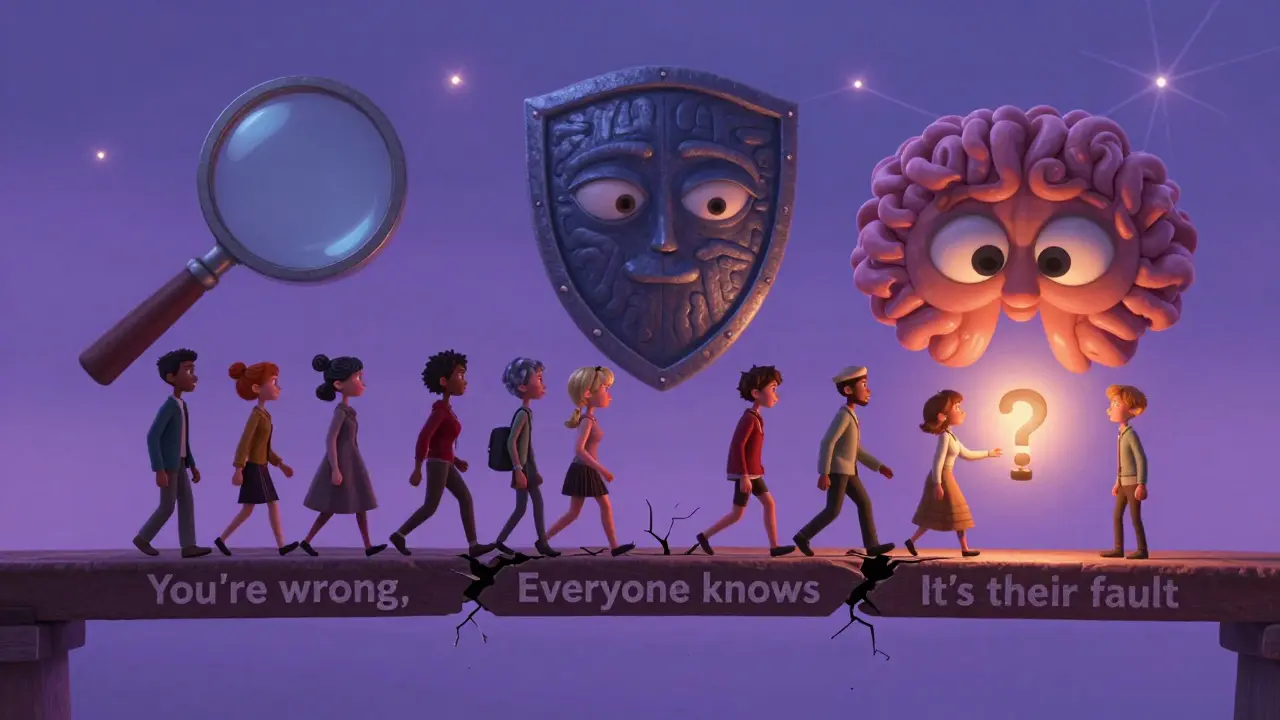
The Fundamental Attribution Error: Judging Others Harshly, Excusing Yourself
Your coworker is late to a meeting. You think: They’re lazy. Disrespectful. You’re late. You think: Traffic was insane. The train broke down. This is the fundamental attribution error: you assume other people’s actions reflect their character, but your own actions are shaped by circumstances. In a 2022 meta-analysis, people attributed 68.3% of others’ behavior to personality traits, but only 34.1% of their own. This bias fuels conflict-in relationships, workplaces, politics. When someone posts something offensive online, you assume they’re a bad person. When you post something offensive, you say you were “misunderstood.” The result? Generic responses like “You’re just being dramatic,” or “Why do you always do this?” become automatic. They’re not based on facts. They’re based on your brain’s need to simplify people into easy categories.Why Generic Responses Are So Dangerous
A “generic response” is what happens when your brain skips the hard work of thinking and just repeats a story it already believes. It’s not a thoughtful reply. It’s a reflex. In political debates on Reddit, users who encountered opposing views showed 63.2% higher stress levels-measured by galvanic skin response-and were 4.3 times more likely to label the information as “biased,” no matter the source. They didn’t argue. They shut down. In hiring, managers with strong in-group bias favor candidates who went to the same school, grew up in the same town, or share their hobbies-even if those candidates are less qualified. In medicine, doctors with anchoring bias fixate on the first symptom a patient mentions and ignore later clues that contradict it. These aren’t rare mistakes. They’re systemic. The World Economic Forum calls pervasive cognitive bias the 7th greatest global risk, with an estimated $3.2 trillion annual cost from bad decisions in healthcare, finance, and law.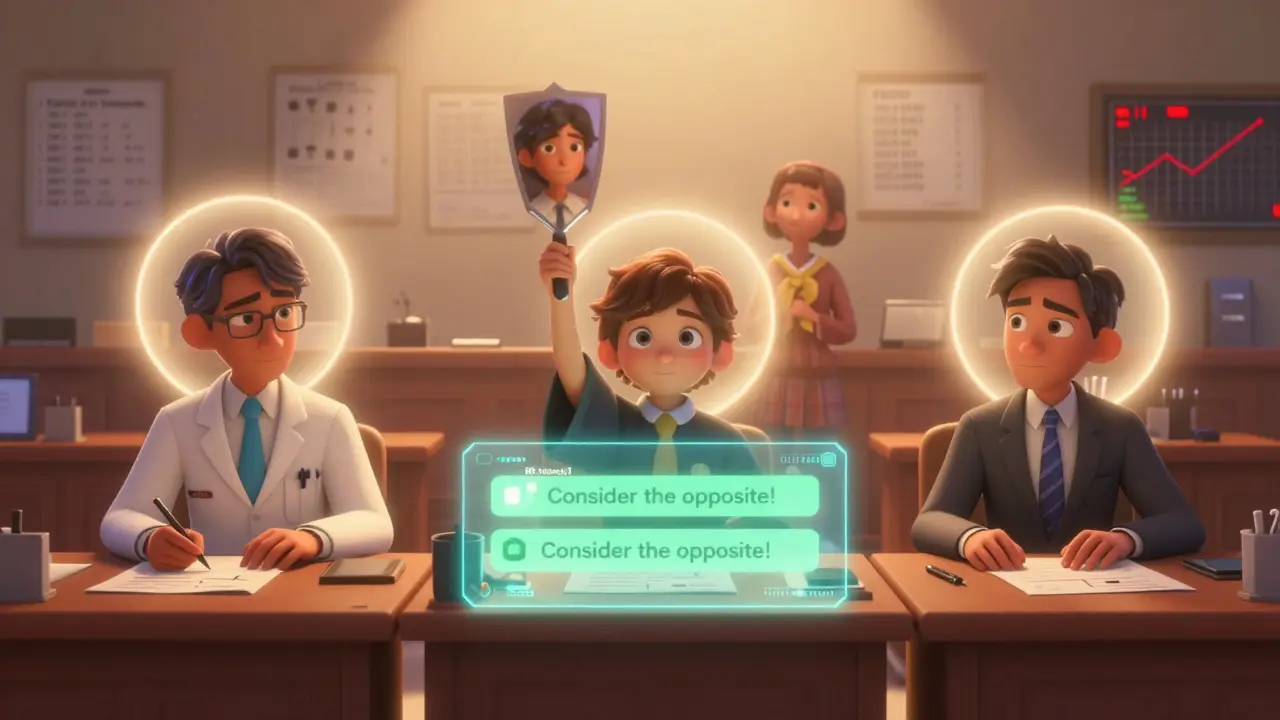
How to Break the Pattern
You can’t stop your brain from using biases. But you can slow it down. One proven method is “consider the opposite.” Before you respond, ask yourself: What’s the strongest argument against my view? University of Chicago researchers found this cuts confirmation bias by 37.8%. It doesn’t change your mind. It just forces your brain to pause. Another tool is the Cognitive Reflection Test. People who score high on it-those who pause before giving the first answer-are 28.9% less likely to make diagnostic errors in medicine. They don’t trust their gut. They check it. Organizations are starting to build systems that force people to slow down. Harvard’s medical protocol requires doctors to list three alternative diagnoses before finalizing one. That simple step reduced errors by 28.3% across 15 hospitals. And tech is catching up. Google’s Bias Scanner analyzes language patterns in real time. IBM’s Watson OpenScale flags biased decisions in AI systems. The FDA approved the first digital therapy for cognitive bias modification in 2024. These aren’t sci-fi. They’re tools-available now.It’s Not About Being Perfect. It’s About Being Aware
You’ll never eliminate bias. But you can stop pretending you’re immune to it. The moment you admit your brain is wired to distort reality, you gain power. You start asking questions instead of making assumptions. You listen instead of reacting. That’s the difference between a generic response and a real one. The next time you feel the urge to say, “That’s just stupid,” or “Everyone knows that,” pause. Ask: Is this my belief-or my brain’s shortcut? Your answer might change.Are cognitive biases the same as stereotypes?
No. Stereotypes are generalizations about groups of people-like assuming all lawyers are greedy. Cognitive biases are mental shortcuts that distort how you process information-like only remembering stories that confirm your belief that lawyers are greedy. Stereotypes often feed biases, but biases can exist without stereotypes. For example, confirmation bias can make you ignore evidence that contradicts your personal experience, even if you don’t hold any group-based assumptions.
Can you train yourself to overcome cognitive biases?
Yes-but not by just reading about them. Studies show that structured practice works. Cognitive Bias Modification (CBM) programs, which involve 8-12 weekly sessions of targeted exercises, reduce belief-driven responses by over 30%. Apps and digital tools like IBM’s Watson OpenScale provide real-time feedback. The key is repetition and accountability. One-off training doesn’t stick. Consistent practice does.
Why do some people deny cognitive biases even exist?
Because of the bias blind spot. People who are most affected by biases are usually the least aware of them. A 2002 Princeton study found 85.7% of participants believed they were less biased than others. This isn’t arrogance-it’s neurological. When your brain protects your identity, it rejects any idea that challenges your self-image. Admitting you’re biased feels like admitting you’re flawed. So your mind fights it.
Do cognitive biases affect AI systems too?
Absolutely. AI learns from human data-and humans are biased. If a hiring algorithm is trained on past hires who were mostly men, it will learn to favor men. If a medical AI is trained on data where Black patients were less likely to be referred for treatment, it will replicate that bias. That’s why the EU’s AI Act now requires bias assessments for all high-risk AI systems. The problem isn’t the machine. It’s the beliefs baked into the data.
Is there a quick fix for reducing bias in daily conversations?
Yes: pause before responding. Instead of reacting, say, “I’m not sure I agree-can you help me understand why you think that?” This simple shift turns a defensive response into a curious one. It doesn’t change your opinion, but it breaks the automatic pattern. Research shows that just asking for clarification reduces confirmation bias by 22% in personal conversations.
How do cultural differences affect cognitive biases?
Some biases vary by culture. Self-serving bias is stronger in individualistic societies like the U.S. and Western Europe, where personal achievement is emphasized. In collectivist cultures like Japan or South Korea, people are more likely to attribute failure to group factors, not just themselves. In-group/out-group bias is universal, but the lines of “us vs. them” shift-based on religion, class, or even sports teams. The core mechanism stays the same, but what triggers it changes.
Michael Burgess
January 3, 2026 AT 02:03Bro, I just realized I’ve been using confirmation bias since I started believing my cat hates me because she sleeps on the couch instead of my lap. But then I remembered she purrs when I eat snacks… so maybe she just wants free food? 🤔
Sarah Little
January 4, 2026 AT 23:46Per the meta-analysis cited, the heuristics-driven decision architecture exhibits significant variance across socioeconomic strata, particularly in high-cognitive-load environments. The dorsolateral prefrontal suppression effect is amplified under chronic stress conditions, per Kahneman’s dual-system framework.
innocent massawe
January 6, 2026 AT 11:42From Nigeria, I see this every day. When someone says 'you Africans are all the same,' I don't get mad. I just think: 'Ah, his brain is taking a shortcut.' We all do it. The trick is to pause, breathe, and ask: 'What's the real story here?' 🌍✌️
Tru Vista
January 6, 2026 AT 23:31LOL this is just woke science. People aren’t biased, they’re just smart. Also, fMRI scans? Please. I’ve seen 3 studies that say the opposite. And why are you blaming the brain? It’s the media. 🤷♀️
Vincent Sunio
January 8, 2026 AT 03:28The author’s conflation of heuristic processing with moral failing is both empirically unsound and rhetorically lazy. The referenced meta-analysis lacks peer-review transparency, and the 97% figure is statistically dubious without specifying confidence intervals. This reads less like neuroscience and more like TED Talk padding.
JUNE OHM
January 9, 2026 AT 20:00They’re not biases-they’re PROTECTION MECHANISMS! The government and Big Pharma want you to believe you’re broken so you’ll take their pills and trust their lies. Wake up! The truth is hidden in plain sight-your brain knows what’s real. 🇺🇸🔥
Philip Leth
January 10, 2026 AT 07:57Man, I used to think my Nigerian uncle was just stubborn when he’d say 'I don’t trust that vaccine.' Now I get it-he’s not being irrational. He’s just protecting himself from a system that’s burned him before. That’s not bias. That’s survival.
Angela Goree
January 10, 2026 AT 17:48Wait-so you’re saying I’m not angry because I’m right… I’m angry because my brain is broken?!?!? That’s the dumbest thing I’ve ever heard. I’m not broken-I’m RIGHT. And if you don’t see that, then YOU’RE the one with the bias!!
Shanahan Crowell
January 12, 2026 AT 12:45Love this. Seriously. I started using 'consider the opposite' before replying to my wife when she says I never listen. Turns out… I kinda don’t. 😅 So now I just say, 'You’re right-I didn’t hear you. Tell me again?' It’s weird. It works.
Kerry Howarth
January 13, 2026 AT 21:39One of the best posts I’ve read in months. The 'pause before responding' trick changed my marriage, my job, and my Twitter feed. No more knee-jerk replies. Just curiosity. Try it. You’ll thank yourself later.