Canagliflozin and Amputation Risk: What You Need to Know Now
 Jan, 17 2026
Canagliflozin Risk Assessment Tool
Understanding Your Risk
This tool helps you identify your personal risk factors for foot complications when taking canagliflozin (INVOKANA®). Based on your responses, you'll receive a risk assessment with specific recommendations.
Important note: This tool is for informational purposes only. Always consult your healthcare provider for medical advice.
Risk Factors Checklist
Your Risk Assessment
When you're managing type 2 diabetes, choosing the right medication isn't just about lowering blood sugar. It’s about balancing benefits with real, sometimes serious, risks. One drug that’s sparked intense debate is canagliflozin - sold as INVOKANA®. It helps control glucose, reduces heart failure risk, and protects the kidneys. But it’s also linked to a higher chance of foot and leg amputations. If you’re on this drug, or your doctor is considering it, you need to know the facts - not the hype, not the fear, but what the data actually says.
What the Studies Actually Found
The big red flag came from the CANVAS Program in 2017. This wasn’t a small study. It combined two major clinical trials with over 10,000 people with type 2 diabetes and high heart disease risk. The results showed something alarming: people taking canagliflozin had nearly twice the rate of lower-limb amputations compared to those on placebo. The numbers were clear: 5.5 amputations per 1,000 patient-years for the 300 mg dose. That’s compared to 2.8 per 1,000 with placebo. The risk wasn’t random. Most amputations were minor - toes or parts of the foot. But about 20% were major, above the ankle. That’s life-changing. The FDA reacted fast. In June 2017, they added a boxed warning - the strongest safety alert they have - for amputation risk. For years, doctors and patients were on edge. But then came more data. The CREDENCE trial, focused on people with diabetic kidney disease, showed that canagliflozin cut kidney failure and heart attacks. The benefits were too strong to ignore. In January 2020, the FDA removed the boxed warning. But they didn’t say the risk disappeared. They moved it to the Warnings and Precautions section, where it still sits today.Is This a Class-Wide Problem?
This is the million-dollar question. Are all SGLT2 inhibitors dangerous? Or is this just canagliflozin? The answer is: it’s not the whole class. Empagliflozin (Jardiance) and dapagliflozin (Farxiga) didn’t show the same signal in their own large trials. EMPA-REG OUTCOME found no increase in amputations with empagliflozin. DECLARE-TIMI 58 even showed a slight drop in amputation risk with dapagliflozin - not enough to be called protective, but certainly not harmful. A 2023 meta-analysis of 74,000 patients confirmed it: only canagliflozin had a statistically significant link to amputation. The odds ratio was 1.6 - meaning a 60% higher chance compared to other drugs or placebo. For other SGLT2 inhibitors, the risk was flat. Why? No one’s 100% sure. But experts suspect it’s tied to how strongly canagliflozin lowers blood pressure and body weight. It drops systolic pressure by about 3.7 mmHg more than other drugs in the class. That might reduce blood flow to already compromised feet. It also causes more fluid loss, which could worsen dehydration in people with poor circulation.Who’s at Real Risk?
Not everyone on canagliflozin will lose a toe. The risk is concentrated in a specific group. If you have any of these, your risk goes up:- History of foot ulcers or prior amputation
- Diabetic neuropathy (nerve damage causing numbness)
- Peripheral artery disease (PAD) - blocked arteries in the legs
- Current smoking
- Absent or weak foot pulses

Real People, Real Stories
Behind the statistics are real lives. On Reddit, one user wrote: “After 18 months on Invokana, my podiatrist found a non-healing ulcer. I lost my toe. My endocrinologist switched me to Jardiance right away.” Another said: “Three years on Invokana. No foot issues. My A1c dropped from 8.5% to 6.2%. I feel great.” These aren’t outliers. They’re the spectrum. The FDA’s adverse event database shows about 1,892 amputation reports among 4.2 million canagliflozin prescriptions - a rate of 0.045%. That sounds small. But when you’re the one losing a toe, it’s not small at all. The number needed to harm - how many people need to be treated before one extra amputation happens - is about 556 per year. That’s low compared to many side effects. But for someone with poor circulation, the risk isn’t theoretical. It’s immediate.How to Stay Safe If You’re on Canagliflozin
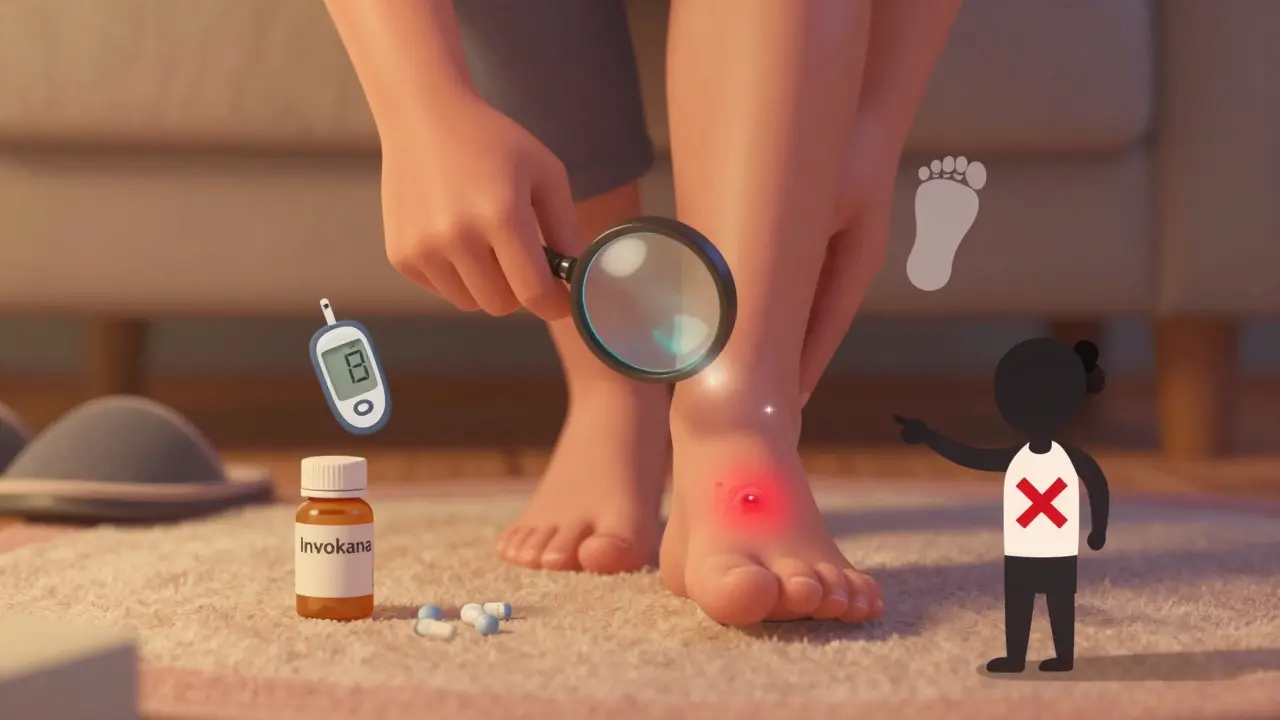
You don’t have to stop the drug. But you must be vigilant. Here’s what you should do:- Check your feet every day. Look for redness, swelling, cuts, blisters, or sores. Use a mirror if you can’t see the bottom of your feet.
- Never go barefoot. Even indoors. A small step on a sharp object can turn into an ulcer if you have neuropathy.
- Report any pain or sores immediately. Don’t wait. Don’t assume it’s just a callus. Early treatment stops amputations.
- Get foot exams at every doctor visit. Your provider should check pulses, sensation, and skin condition.
- Stop smoking. Smoking narrows arteries. It makes everything worse.
- Ask about your ABI. If you’ve never had it done, ask your doctor. It takes 5 minutes and can change your treatment plan.

Lydia H.
January 19, 2026 AT 12:07Man, I just read this whole thing and I’m sitting here thinking-meds are tools, not magic. Canagliflozin isn’t evil, it’s just loud. Like a chainsaw-you don’t use it in a library, but if you’re clearing a fallen tree? Perfect tool.
It’s not about avoiding risk. It’s about knowing where you stand. If your feet feel fine and your ABI’s solid? Go ahead. If you’ve got neuropathy and smoke? Maybe don’t. Simple as that.
I’m not scared of the drug. I’m scared of people who treat meds like lottery tickets.
Also-daily foot checks? That’s just good diabetes hygiene. Should be standard for everyone, not just those on this med.
Astha Jain
January 20, 2026 AT 08:43canagliflozin is so overrated frfr. like why are we even talking abt this? jardiance is way better and no one even mentions it. also my cousin lost 2 toes on it and now she’s on metformin and says she feels like a new person. also the fda is just scared of lawsuits so they downgraded the warning but the risk is still there lmao.
Lewis Yeaple
January 20, 2026 AT 15:18It is imperative to underscore that the CANVAS trial’s hazard ratio of 1.92 for lower-limb amputation (95% CI: 1.38–2.68) remains statistically significant even after adjustment for confounders such as age, sex, duration of diabetes, and baseline eGFR. The CREDENCE trial, while demonstrating renal benefit, did not alter the amputation risk profile in the intention-to-treat analysis.
Furthermore, the differential pharmacokinetics of canagliflozin-specifically its higher plasma concentration and prolonged half-life relative to other SGLT2 inhibitors-may contribute to its distinct adverse effect profile. This is not a class effect; it is a compound-specific phenomenon.
Physicians must perform a risk-benefit analysis prior to initiation, and patients must be counseled on the necessity of routine podiatric surveillance. Failure to do so constitutes a breach of the standard of care.
Malikah Rajap
January 21, 2026 AT 07:49Okay, I just had to say this-I’ve been on Jardiance for 2 years, and honestly? My feet have never felt better. No numbness, no weird tingles, no ulcers. I used to be terrified to walk barefoot, even in my own house. Now? I’m gardening in flip-flops. 🌿
But here’s the thing: I didn’t just switch because I was scared. I switched because my doctor listened. She asked me about my history, checked my pulses, and didn’t push me into anything. That’s the real win here-not the drug, but the care.
Also, if you’re not checking your feet daily, you’re not treating diabetes-you’re ignoring it. And that’s not bravery. That’s just... risky.
Also also-smoking? Please. Put the cigarette down. Your toes will thank you. And so will your heart.
sujit paul
January 22, 2026 AT 22:33Let me be blunt: this entire narrative is a corporate illusion. Canagliflozin was pushed aggressively because it was profitable. The amputation risk? A side effect buried under marketing. The FDA’s downgrade? A political move to appease investors. Janssen knew. They knew the vascular impact. They knew the dehydration risk in elderly diabetics. They just didn’t care.
And now? They’re testing a "new extended-release version"-like that’s going to fix the fundamental flaw. It’s not the delivery. It’s the molecule. It’s the SGLT2 inhibition itself-too aggressive, too systemic.
Meanwhile, metformin, insulin, GLP-1s-they’ve been here for decades. Safe. Proven. Affordable. Why are we gambling with toes for a 0.5% A1c drop? The system is broken. And you’re all just scrolling, nodding, and taking pills.
Wake up. This isn’t medicine. It’s monetized risk.
Aman Kumar
January 23, 2026 AT 10:06The data is unequivocal: canagliflozin induces a volume-depleted state via osmotic diuresis, which exacerbates pre-existing microvascular insufficiency in the distal extremities-particularly in those with concomitant neuropathy and PAD. This is not speculative; it’s pathophysiological.
Furthermore, the absence of a similar signal with empagliflozin or dapagliflozin is attributable to their lower renal tubular reabsorption inhibition potency, resulting in reduced interstitial fluid shifts. The pharmacodynamic profile is not interchangeable.
Patients with an ABI < 0.9 represent a high-risk phenotype; prescribing canagliflozin in this cohort constitutes iatrogenic harm. The AMA and ADA guidelines are not suggestions-they are clinical imperatives.
And yet, we still see primary care providers prescribing this without screening. That’s not negligence. That’s malpractice.
Foot checks? Of course. But prevention begins at the prescription pad-not the bathroom mirror.
Jake Rudin
January 23, 2026 AT 11:32I’ve been thinking about this a lot…
What if the real problem isn’t the drug… but how we treat people with diabetes? We hand them a pill and say, "Here, take this," and then expect them to check their feet every day, quit smoking, lose weight, monitor their A1c, and never miss a doctor’s appointment… while they’re working two jobs, without insurance, and eating food that’s literally the only thing they can afford.
Canagliflozin’s risk? Real.
But the risk of not having access to care, to podiatrists, to healthy food, to clean socks, to a doctor who actually listens? That’s the real epidemic.
And we’re blaming the drug… instead of the system.
…I don’t know. I just… feel like we’re missing the point.
Maybe the drug is fine. Maybe the people aren’t.
Phil Hillson
January 25, 2026 AT 09:07Y’all are overthinking this. I was on Invokana for a year. No foot issues. Lost 30 lbs. My A1c dropped to 5.9. My doctor said I’m basically cured. Now I’m on Jardiance because my cousin had a toe removed and she cried for a week. So I switched. Not because I needed to. Because I felt guilty.
Also my cat licked my foot once and I screamed. I think I have neuropathy now. I’m going to the ER. Send help. Or tacos. Tacos help.
Josh Kenna
January 26, 2026 AT 21:36Just wanted to say-thank you for writing this. I’m a nurse in a diabetes clinic and I see this every day. People scared to ask questions. Doctors rushing through appointments. One guy came in with a blackened toe and said, "I didn’t think it was that bad. I thought it was just a blister."
We switched him to Farxiga. He’s got a stump now. But he’s alive. And he checks his feet every night. He even bought a mirror. I cried when he showed me.
So yeah. This matters. Not because of stats. Because of people. Don’t let fear stop you from asking. Don’t let pride stop you from listening.
And if your doctor won’t do an ABI? Find a new one.
- Josh, who’s seen too many feet go too far