Antiseizure Medications and Generic Substitution: Risks and Best Practices
 Jan, 3 2026
When you’ve been seizure-free for years, the last thing you want is a change in your medication to throw everything off. But for many people taking antiseizure medications (ASMs), that’s exactly what happens when a pharmacy switches their brand-name drug for a generic version-often without telling them. It’s legal. It’s common. And in some cases, it’s dangerous.
Why Generic Substitution Matters for Antiseizure Medications
Generic drugs are cheaper. That’s the whole point. In the U.S., about 90% of all antiseizure prescriptions are filled with generics. Brands like Lamictal, Tegretol, and Depakote cost three to eight times more than their generic equivalents. For patients on fixed incomes, or without good insurance, switching to generics can mean the difference between staying on treatment and going without. But ASMs aren’t like antibiotics or blood pressure pills. Many of them have a narrow therapeutic index (NTI). That means the difference between a dose that works and one that causes harm is tiny. A 15% drop in blood levels might lead to a breakthrough seizure. A 15% increase could cause dizziness, confusion, or even liver damage. The FDA says generics are bioequivalent-meaning they deliver the same amount of active ingredient into the bloodstream within an acceptable range (80-125% of the brand). But that range is wide. For a drug like lamotrigine, where even a 10% fluctuation can trigger seizures, that 45% swing isn’t just statistical noise. It’s a real risk.What the Evidence Shows: Real-World Consequences
A 2008 study in Neurology followed patients who switched from brand-name lamotrigine to generic. Those patients had 23% more doctor visits and 18% more hospital stays. Not because they were noncompliant. Not because their epilepsy worsened naturally. Because the generic version, while technically "equivalent," didn’t behave the same in their bodies. A global survey of 1,247 healthcare providers in 68 countries found that 40% had seen patients experience more seizures after switching to generics. Seventeen percent reported more side effects-ranging from rashes to memory lapses. And it wasn’t just in developing countries. This happened in the U.S., the U.K., Canada, and Australia. Patient stories are even more telling. On the Epilepsy Foundation’s forum, one person wrote: "I was seizure-free for five years. After my pharmacy switched me to generic lamotrigine, I had three seizures in two weeks." Another on Reddit said: "The pills looked different. I started doubting if I’d taken them. My anxiety spiked-and so did my seizures." These aren’t isolated incidents. A 2021 survey by the International League Against Epilepsy found that 68% of patients were anxious about generic substitution. Over 40% said they’d pay more out of pocket to stick with the same brand.The Regulatory Divide: FDA vs. Clinicians
The FDA maintains that generics are safe and effective. They point out that many people have seizures even while staying on the same brand. That’s true. But it misses the point. The question isn’t whether seizures happen. It’s whether switching formulations increases the risk. Neurologists who treat complex epilepsy cases don’t agree. At Montefiore Medical Center, Dr. Philip Glass says his team never switches patients on difficult-to-control seizures. They keep the same formulation-brand or generic-because consistency matters. Johns Hopkins found that 27% of patients who switched to a generic ASM later switched back to the brand. That’s more than double the rate seen with other medications. The UK’s Medicines and Healthcare products Regulatory Agency (MHRA) says it clearly: "Consistency of supply is important where the consequence of therapeutic failure might have serious clinical consequences." That’s not a recommendation. It’s a warning.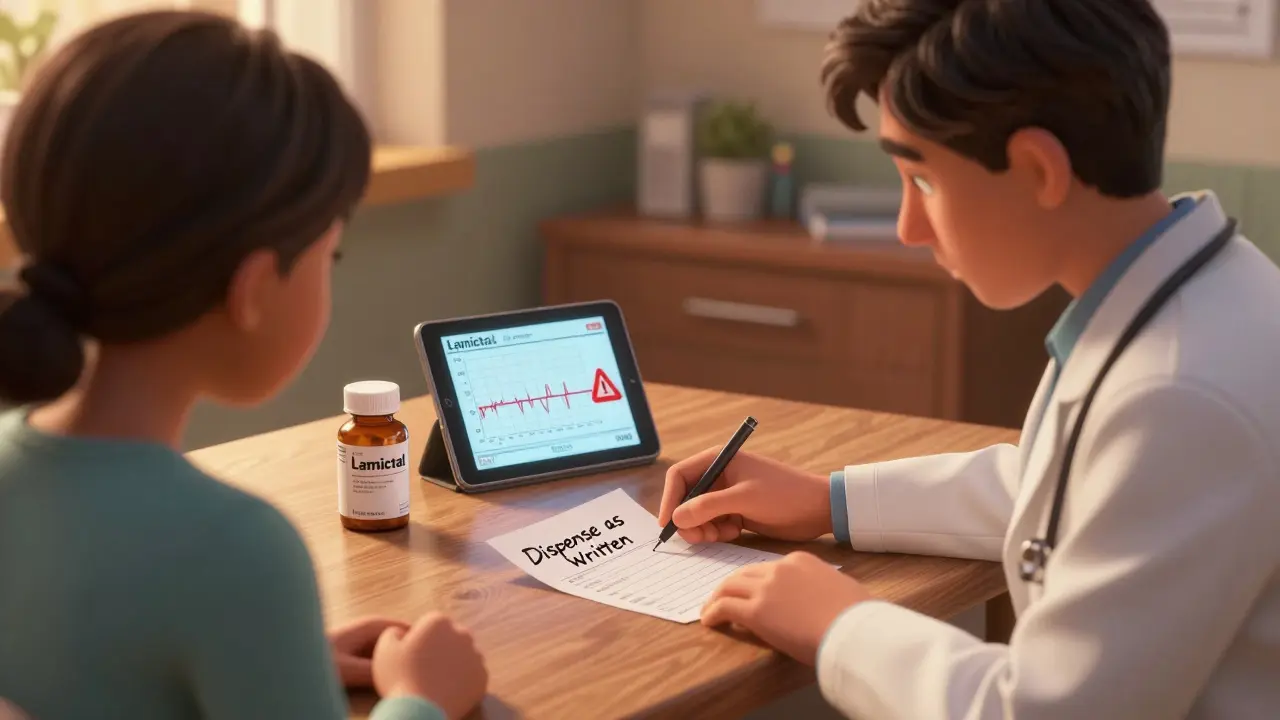
Which Drugs Are Most Risky?
Not all antiseizure medications carry the same risk. Three stand out:- Carbamazepine - Used for focal and generalized seizures. Small changes in blood levels can cause toxicity or loss of control.
- Lamotrigine - Especially risky because of its slow titration schedule. A sudden change in absorption can trigger a life-threatening rash or seizures.
- Valproic acid - Narrow window between therapeutic and toxic levels. Liver toxicity is a real concern.
Best Practices: What Doctors and Patients Should Do
There’s no one-size-fits-all answer. But here’s what works:- Don’t switch without talking to your neurologist. If you’re stable, staying on the same formulation is safer than switching for cost savings.
- Ask for a prescription that says "dispense as written" or "no substitution." This legally prevents the pharmacy from swapping your drug.
- Know your pills. If the shape, color, or marking changes, check with your pharmacist. Write down the details. Keep a photo on your phone.
- Track your symptoms. If you notice more seizures, mood changes, dizziness, or rashes after a switch, report it immediately. Don’t wait.
- Check for excipients. Some generics use fillers like lactose or carbohydrates. If you’re on a ketogenic diet, even small amounts can disrupt ketosis and trigger seizures.

What’s Changing? New Guidelines and Future Risks
The FDA is considering tighter bioequivalence standards for NTI drugs-narrowing the acceptable range from 80-125% to 90-111%. That’s a step forward. But it’s still not enough for drugs like lamotrigine, where even a 5% variation can matter. A major multi-center study (NCT04987654), launched in 2024, is tracking seizure outcomes in patients who switch versus those who stay on the same formulation. Results won’t be out until 2027. Until then, we’re flying blind. The 2024 International Epilepsy Guidelines now recommend an individualized approach: assess seizure type, frequency, comorbidities, and patient anxiety before allowing substitution. For someone with daily seizures and memory issues? Don’t switch. For someone on a stable, low dose of a simple ASM with no history of problems? Maybe it’s fine.What You Can Do Today
If you take antiseizure medication:- Call your neurologist. Ask if your current version is safe to switch.
- Ask your pharmacist to notify you before switching brands.
- Keep a log: date of switch, pill appearance, any new symptoms.
- Join a patient group. You’re not alone. Thousands have been through this.
- Use resources like the Epilepsy Foundation’s Medication Access Program. They help patients get brand-name drugs if generics aren’t safe for them.
Can I legally refuse a generic antiseizure medication?
Yes. In the U.S. and U.K., you can ask your doctor to write "dispense as written" or "no substitution" on your prescription. This legally prevents the pharmacy from switching your drug without your consent. Pharmacists must honor this request.
Why do generics look different even if they’re the same drug?
By law, generic drugs can’t look exactly like the brand-name version, so manufacturers change the color, shape, or markings. This is to avoid trademark infringement. But for people with epilepsy, especially those with memory or anxiety issues, these visual changes can cause confusion, missed doses, or even trigger seizures.
Are all generic antiseizure medications the same?
No. Different manufacturers use different fillers, binders, and release methods-even if the active ingredient is identical. Two generics of lamotrigine from different companies may have different absorption rates. That’s why sticking with one brand or generic version is safer than switching between generics.
Should I avoid generics if I have epilepsy?
Not necessarily. Many people take generics safely. But if you have frequent seizures, take multiple medications, have memory issues, or are on a special diet like keto, the risks are higher. Talk to your neurologist before switching. Stability matters more than cost in these cases.
What should I do if I have a seizure after switching to a generic?
Seek medical attention immediately. Report the switch to your neurologist and pharmacist. Document the date of the switch, the new pill’s appearance, and any other symptoms. You may need to switch back. Many insurance plans will cover the brand-name drug if you can prove a medical necessity.
Akshaya Gandra _ Student - EastCaryMS
January 4, 2026 AT 10:44i just read this and my brain is like… wait so my cousin who had seizures after switching generics wasn’t just being dramatic? i thought she was overreacting but now i’m scared for everyone i know on these meds. also why do pharmacies even do this without telling us???
Joseph Snow
January 5, 2026 AT 02:47Let’s be real: this is just Big Pharma’s way of keeping people hooked on expensive drugs under the guise of ‘safety.’ The FDA approves generics, and they’re tested-period. If your seizures worsen, maybe you’re not taking them right. Stop blaming the system and start taking responsibility.
Also, ‘dispense as written’? That’s just a loophole for the wealthy. Most people can’t afford brand-name drugs. This whole post is fearmongering dressed up as advocacy.
en Max
January 6, 2026 AT 01:49While the FDA’s bioequivalence thresholds (80–125%) are statistically defensible, they are clinically inadequate for narrow-therapeutic-index antiseizure medications (NTI-ASMs), particularly lamotrigine, carbamazepine, and valproic acid. The pharmacokinetic variability-particularly in Cmax, Tmax, and AUC-can produce subtherapeutic troughs or supratherapeutic peaks, which correlate directly with breakthrough seizure events and adverse dermatological reactions.
Moreover, excipient heterogeneity (e.g., lactose, cellulose derivatives, or pH-modifying agents) may alter gastric dissolution kinetics, especially in patients with comorbid GI motility disorders. The 2008 Neurology cohort study and the 2021 ILAE survey provide robust epidemiological support for formulation-specific risk stratification. Clinical practice guidelines must evolve beyond ‘generic = interchangeable’ assumptions.
Angie Rehe
January 7, 2026 AT 03:12So you’re telling me that a pharmacy worker who doesn’t even have a medical degree gets to decide whether my brain stays stable? That’s not healthcare-that’s Russian roulette with pills.
And don’t give me that ‘it’s legal’ nonsense. Just because something’s legal doesn’t make it ethical. I’ve seen people cry because they got a different-looking pill and panicked-and then had a seizure 48 hours later. This isn’t about cost. It’s about control. And someone’s making money off our fear.
Jacob Milano
January 8, 2026 AT 03:06I’ve been on lamotrigine for 12 years-brand name, then generic, then back to brand after a weird rash and two near-miss seizures. Honestly? The difference wasn’t just in the numbers. It was in my head. The anxiety of wondering if I took the right pill… the way my thoughts felt slower, heavier… it wasn’t in my head. It was in my body.
Don’t let anyone tell you it’s all in your head. Your brain knows when something’s off. Listen to it. Keep a photo of your pill. Talk to your doc. You’re not being paranoid-you’re being smart.
Enrique González
January 9, 2026 AT 11:09Hey-just wanted to say this post saved my life. I switched generics last month and started zoning out constantly. Thought I was losing it. Then I saw this and checked my pill. Different color. Same name. I called my neurologist. We switched back. I haven’t had a foggy day since.
You’re not alone. Speak up. You’ve got this.
Michael Rudge
January 11, 2026 AT 00:37Oh wow. A whole article about how generics might not be *exactly* identical to brand-name drugs. Shocking. Next you’ll tell me that tap water isn’t the same as bottled water. Or that not all aspirin is created equal.
Maybe if people stopped obsessing over pill colors and learned to trust science, they wouldn’t be so fragile. Also, why do you think the FDA approves these? Because they’re idiots? No-they’re the ones who know what they’re doing. You’re just scared of saving money.
Doreen Pachificus
January 12, 2026 AT 21:57Interesting. I’ve been on carbamazepine for 8 years and switched generics twice. Never had an issue. But then again, I don’t have seizures anymore. Maybe it’s about the individual? I wonder if the studies controlled for adherence or lifestyle factors like sleep or alcohol.
Also, what about the people who can’t afford brand? Are we just saying they should suffer more?
Cassie Tynan
January 13, 2026 AT 13:28So we’re telling people their brain is too delicate to handle a 15% fluctuation in drug levels… but we’re fine with letting them live in a world where their rent goes up 20% every year, their job is unstable, and their therapist is $200/hour?
It’s not the generic. It’s the system. We treat epilepsy like it’s a luxury condition, not a medical necessity. Fix that, and no one will care if the pill is blue or white.
Catherine HARDY
January 15, 2026 AT 07:46Have you ever wondered why the same generic lamotrigine from one pharmacy gives you a rash, but the exact same one from another doesn’t? Because they’re not the same. Different manufacturers. Different fillers. Different labs. And guess who’s not telling you which one you’re getting?
I think the FDA is in on it. They don’t want you to know that your life depends on which warehouse your pills came from. This isn’t medicine-it’s a lottery.
bob bob
January 15, 2026 AT 18:15My mom’s on valproic acid. Switched to generic last year. No issues. But she’s also super consistent-takes it at the same time every day, never skips, tracks everything. Maybe it’s not the drug. Maybe it’s how you use it.
Still, I get why people freak out. I’d be scared too. Just… maybe talk to your doc before assuming the worst?
Vicki Yuan
January 17, 2026 AT 11:26Thank you for this comprehensive, evidence-based overview. The distinction between pharmacokinetic bioequivalence and clinical interchangeability is critical-and routinely misunderstood. The 2024 ILAE guidelines’ emphasis on individualized risk assessment is a significant advancement. I urge all clinicians to implement pre-substitution counseling, document formulation history, and advocate for ‘dispense as written’ where indicated. Patient autonomy and neurological stability are not negotiable.