Allergic Asthma: Triggers, Allergen Avoidance, and Immunotherapy
 Mar, 4 2026
When your breathing gets tight every spring, or you wake up wheezing after vacuuming, you might be dealing with allergic asthma. It’s not just a bad cold or seasonal sniffles - it’s your immune system overreacting to things most people ignore. About 60% of adults and over 80% of children with asthma in the U.S. have this form, according to the American College of Allergy, Asthma, and Immunology. That means if you or someone you know struggles with asthma, there’s a very good chance allergies are at the root of it.
What Exactly Happens in Allergic Asthma?
Allergic asthma isn’t caused by stress or exercise alone. It starts when your body mistakes harmless substances - like pollen, dust mites, or cat dander - for invaders. Your immune system responds by producing IgE antibodies. These stick to mast cells in your airways. When you breathe in the allergen again, those mast cells burst open, releasing histamine and other chemicals. That’s when your airways swell, tighten, and produce extra mucus. The result? Coughing, wheezing, chest tightness, and shortness of breath.
Doctors can spot this pattern with a few simple tests. A skin prick test that shows a wheal larger than 3mm means you’re sensitized. Blood tests often reveal IgE levels above 100 kU/L - and in severe cases, over 400 kU/L. Sputum tests might show more than 3% eosinophils, a type of white blood cell that fuels inflammation. These aren’t just lab numbers. They’re clues that tell your doctor: this asthma is allergic, and it can be managed differently.
The Top Triggers You Can’t Ignore
Not all triggers are created equal. Some are seasonal, others are hiding in your home. Knowing which ones affect you is the first step to control.
Outdoor triggers change with the seasons. Tree pollen hits hardest between February and April, peaking in March. Grass pollen spikes in June, and ragweed takes over from August to October. In temperate regions, pollen counts can jump from 10 to over 100 grains per cubic meter during peak season. That’s enough to trigger symptoms even in people on daily medication.
Indoor triggers are more constant. Dust mites live in bedding, carpets, and upholstered furniture. They thrive when humidity is above 50%. In fact, 84% of U.S. homes have enough dust mite allergen to cause reactions - more than 2 micrograms per gram of dust. Cat allergen (Fel d 1) is even more widespread: 79% of homes have levels above the 8 µg/g threshold that triggers sensitization. Dog allergen (Can f 1) is in two-thirds of homes. Mold spores like Alternaria spike during late summer thunderstorms, with emergency room visits jumping 3.5 times when counts hit 500 spores per cubic meter.
And it’s not just what’s in the air. Pollutants like PM2.5 - tiny particles from traffic and smoke - make things worse. Studies show they can damage the lining of your airways within 24 hours, letting allergens slip deeper into your lungs. This is why asthma flares often get worse in cities or after wildfires.
How to Avoid Allergens - Real Strategies That Work
Avoiding allergens sounds simple. But most people try half-measures and wonder why they’re still struggling. Here’s what actually works, based on real-world data and clinical guidelines.
- Bedding: Use allergen-proof covers on mattresses, pillows, and box springs. A 2021 study found this reduces dust mite allergen exposure by 90%. Look for tightly woven fabrics with pores smaller than 10 micrometers.
- Laundry: Wash sheets and pillowcases weekly in hot water - at least 130°F. Cold water does almost nothing. Heat kills dust mites and washes away their waste.
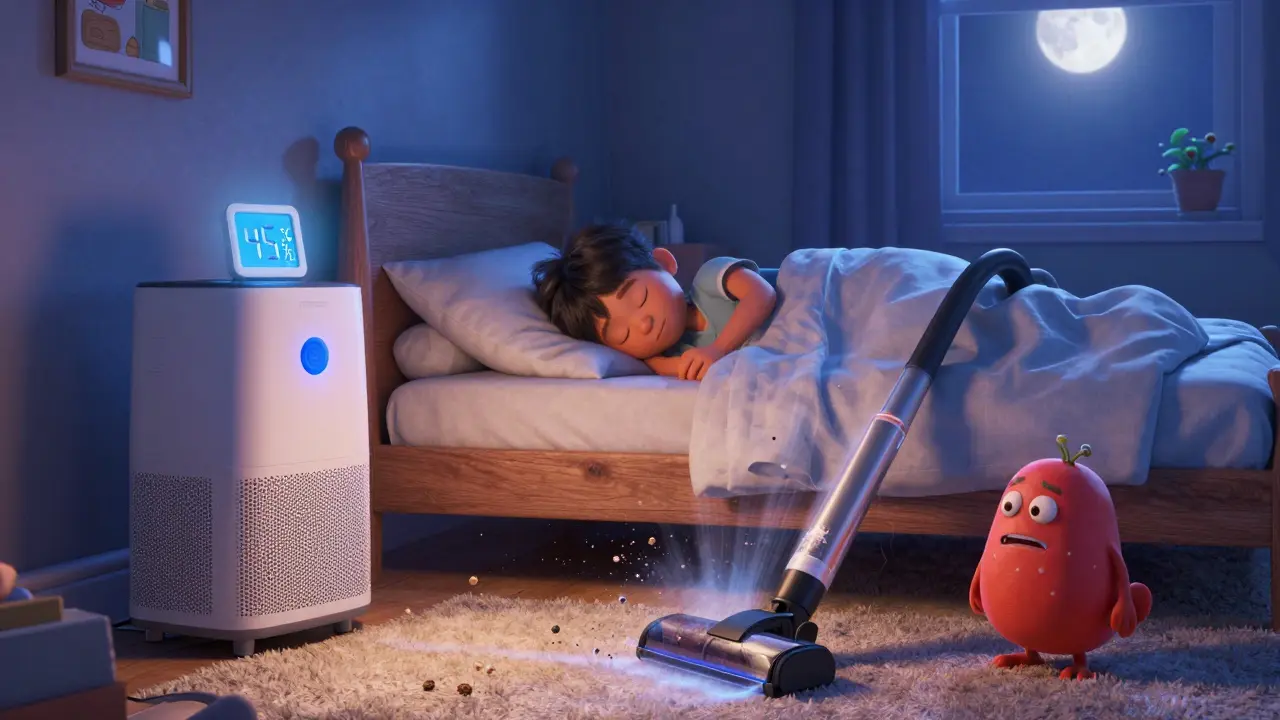
- Vacuuming: Use a vacuum with a HEPA filter. Vacuum at least twice a week. A 2021 study showed this cuts cat allergen levels by 42%. Avoid feather dusters - they just stir up dust.
- Humidity: Keep indoor humidity between 30% and 50%. Use a hygrometer to measure it. If you’re above 50%, use a dehumidifier. At 45% RH, dust mite populations drop from 20 µg/g to under 0.5 µg/g.
- Pollen: Keep windows closed when pollen counts exceed 9.7 grains per cubic meter. Check local pollen forecasts daily. Wear an N95 mask when gardening or raking leaves - it blocks 85% of pollen. Shower and change clothes after being outside. This reduces allergen transfer to your bedding by 70%.
- Cats and dogs: If you’re allergic, keep pets out of the bedroom. Wash them weekly with pet-safe shampoo. Use an air purifier with a HEPA filter in the main living areas. It won’t eliminate allergens, but it helps reduce airborne levels.
One user on Reddit shared their success: after replacing bedding with allergen-proof covers, using a Dyson V15 vacuum, and running a dehumidifier to keep humidity at 45%, their peak flow increased from 380 to 470 L/min over six months. That’s not luck - it’s targeted action.
Immunotherapy: The Only Treatment That Changes the Disease
Medications like inhalers and antihistamines help manage symptoms. But they don’t fix the root problem. Immunotherapy does. It’s the only treatment that can actually retrain your immune system.
There are two main types: subcutaneous (SCIT) and sublingual (SLIT). SCIT involves regular injections under the skin. It starts with weekly shots of tiny allergen doses, gradually increasing over 4-6 months until you reach a maintenance dose. Then you switch to monthly shots for 3-5 years. SLIT uses daily drops or tablets placed under the tongue. It’s less invasive, but takes longer to show results.
A 2021 Cochrane review of 88 trials found immunotherapy reduces asthma symptoms by 30-50% more than medication alone. For house dust mite allergies, SLIT cut symptom scores by 35% - while inhaled steroids alone only did 15%. In one case, a 12-year-old with severe cat allergy saw IgE levels drop from 120 kU/L to 15 kU/L after three years of immunotherapy. Their symptoms vanished. No more rescue inhalers.
But it’s not for everyone. You need to be consistent. Most people don’t notice improvement until after 12-18 months. And about 28% of SCIT users report injection site reactions. SLIT users often feel oral itching in the first month - but it usually fades. Still, 65% of SLIT users say it’s worth it because they can take it at home.
The good news? Insurance in the U.S. covers 80% of immunotherapy costs under Medicare Part B. In Europe, where healthcare is universal, 28% of allergic asthma patients get immunotherapy - compared to just 15% in the U.S. That gap is narrowing as new options emerge.
New Frontiers: Precision Medicine and Smart Tech
The future of allergic asthma isn’t just about avoiding triggers or getting shots. It’s getting smarter.
The NIH is testing genetic markers like rs230548 on chromosome 17q21. This single gene variant predicts immunotherapy response with 85% accuracy. That means in a few years, doctors might test your DNA before starting treatment - avoiding costly, ineffective therapies.
New devices are also helping. The Allergen Insight nasal sensor, cleared by the FDA in 2023, detects airborne allergens as low as 0.1 µg/m³. It syncs to your phone and warns you when levels spike. Meanwhile, the AsthmaIQ platform, launched in April 2024, combines pollen forecasts, your inhaler use, and air quality data to predict your next flare-up with 92% sensitivity.
Even biologics - expensive monthly injections like omalizumab - are becoming more targeted. They work best in allergic asthma, cutting exacerbations by 49% in those with high IgE. But here’s the catch: over 30% of people diagnosed with allergic asthma don’t actually have type 2 inflammation. Giving them biologics is like using a sledgehammer for a thumbtack. That’s why doctors now check blood eosinophils and FeNO levels before prescribing. If your eosinophils are below 300 cells/µL or your FeNO is under 25 ppb, biologics likely won’t help.

What Doesn’t Work - And Why
Many people try air purifiers, salt lamps, or essential oils. These don’t reduce allergen levels enough to matter. A HEPA filter helps. A scented candle? Not even close.
Removing pets from the home sounds logical. But studies show many people still react to cat allergen months after the pet is gone. The allergen clings to carpets, curtains, and even walls. It takes months to fully clear.
And don’t assume that moving to a dry climate will help. Ragweed, mold, and dust mites are everywhere. The real solution isn’t location - it’s consistent, evidence-based avoidance and, for many, immunotherapy.
When to See a Specialist
If you’re using your rescue inhaler more than twice a week, or waking up at night with wheezing, it’s time to see an allergist. They can confirm if you have allergic asthma, test for specific triggers, and help you decide if immunotherapy is right for you.
Don’t wait until you’re in the ER. The goal isn’t just to survive the season - it’s to stop needing rescue meds altogether. With the right plan, many people with allergic asthma can live without daily symptoms. Not just manage - thrive.
Can allergic asthma be cured?
Allergic asthma can’t be completely cured, but immunotherapy can lead to long-term remission. Studies show that after 3-5 years of consistent treatment, many patients stop needing daily medications. Some, especially children, may never have symptoms again. It doesn’t erase the allergy, but it trains your immune system to ignore it.
Is immunotherapy safe for children?
Yes. Sublingual immunotherapy (SLIT) is approved for children as young as 5 for grass and ragweed allergies. Subcutaneous immunotherapy (SCIT) is safe for kids over 7. Both are effective and reduce the risk of developing new allergies or asthma progression. The American Academy of Allergy, Asthma & Immunology recommends it for children with moderate-to-severe allergic asthma who don’t respond well to medications.
How long does it take for immunotherapy to work?
Most people start noticing improvement after 6-12 months. Significant symptom reduction typically occurs after 12-18 months. Full benefit often takes 3-5 years. Patience is key - this isn’t a quick fix. But the effects last long after treatment ends. Many patients stay symptom-free for years.
Do I still need my inhaler if I do immunotherapy?
Yes - at least at first. Immunotherapy doesn’t replace rescue or controller medications immediately. You’ll likely keep using your inhaler during the first year. As your immune system adjusts, your doctor will gradually reduce your medications. Many people eventually stop daily inhalers entirely. But never stop meds without your doctor’s guidance.
Can I do immunotherapy if I have other allergies?
Absolutely. In fact, most people with allergic asthma have multiple triggers. Immunotherapy can target up to 5 allergens at once - like dust mites, cat dander, and ragweed. It’s often more effective when you treat all major triggers together. Your allergist will test you and build a custom mix based on your sensitivity levels.
Ian Kiplagat
March 5, 2026 AT 00:48Amina Aminkhuslen
March 5, 2026 AT 19:07amber carrillo
March 5, 2026 AT 21:40Tim Hnatko
March 6, 2026 AT 02:30Aaron Pace
March 6, 2026 AT 10:24Joey Pearson
March 8, 2026 AT 03:03Roland Silber
March 9, 2026 AT 14:06Patrick Jackson
March 10, 2026 AT 06:32Adebayo Muhammad
March 10, 2026 AT 15:48Pranay Roy
March 12, 2026 AT 08:33Joe Prism
March 12, 2026 AT 13:25Bridget Verwey
March 14, 2026 AT 02:12Andrew Poulin
March 15, 2026 AT 23:09Weston Potgieter
March 16, 2026 AT 08:07